Khinalig village: visiting Europe's highest continuously inhabited settlement
Quba · about 4 to 4.5 hours via Quba from Baku
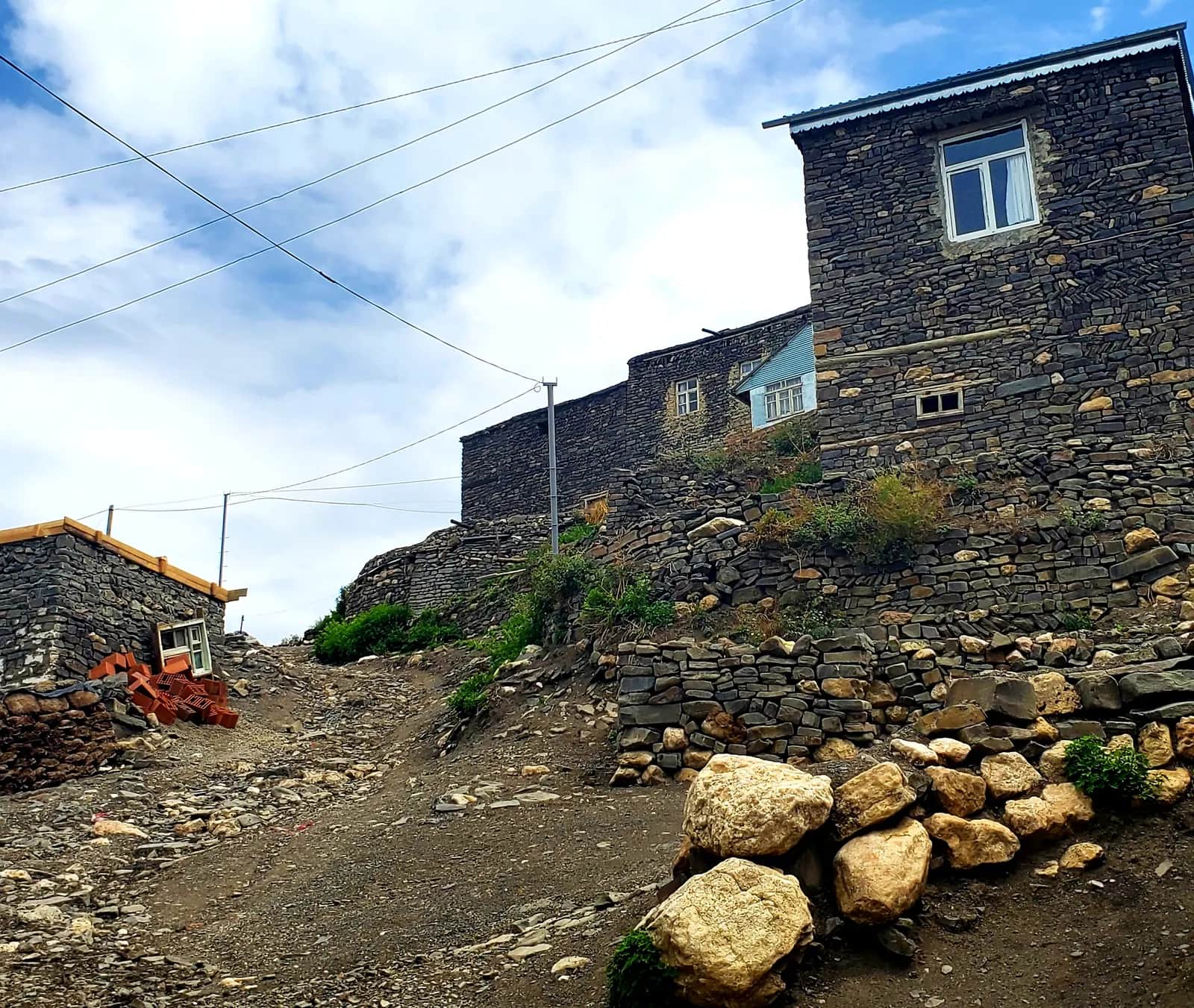
Khinalig (also written Khinaliq or Khinalug) is a stone village at about 2,350 m in the Greater Caucasus of northern Azerbaijan, reached by a paved 60 km mountain road from Quba. Continuously inhabited for roughly 5,000 years, it has its own language unrelated to Azerbaijani and, together with the Köç Yolu transhumance route, was inscribed as a UNESCO World Heritage cultural landscape in 2023 under criteria (iii) and (v). There is no gate fee and no permit for the village itself.
.jpg)
- Region
- Quba
- From Baku
- 225 km · about 4 to 4.5 hours via Quba
- Status
- UNESCO World Heritage (2023)
- Best season
- Late May to early October; winter access depends on snow
- Time to spend
- Half a day at the village; better with a Quba or village overnight
- Entry
- Free. Checked on 11 August 2026: no Khinalig admission is sold on the State Tourism Agency's Reserves Management Center ticket list or on iTicket.az, even though the village is managed as the Khinalig and Köç Yolu reserve. Budget for transport, a guesthouse bed, meals and whatever the village museum asks at the door. Cash only.
- Hours
- No gate and no opening hours. The village is lived in and open at any hour; the road decides access, and heavy snow closes it in practice for days at a time between November and April.
- A terraced stone village at about 2,350 m, lived in continuously for some 5,000 years
- The Khinalug language, an isolate spoken nowhere else in the world
- UNESCO World Heritage cultural landscape (2023), inscribed together with the Köç Yolu transhumance route
- No gate, no ticket and no permit for the village; the road and the weather are the only gatekeepers
- The Atachay canyon drive from Quba, one of Azerbaijan's great mountain roads
- Guesthouse overnights with shepherd-family hosts above the cloud line
Khinalig is a stone village at about 2,350 m in the Quba district of northern Azerbaijan, lived in for something like 5,000 years, speaking a language that exists nowhere else. Since 2023 it anchors a UNESCO World Heritage cultural landscape together with the Köç Yolu, the shepherds' migration route that still moves thousands of animals between lowland winter pastures and these mountains twice a year. Two facts decide whether a trip here happens at all, and both now point the same way: the village needs no permit, and the road up from Quba is asphalt. Birtour, a Baku-based DMC, runs it as day 5 of our 4x4 expeditions and as a private-tour destination from Baku. The notes below are what we brief travellers with, re-checked on 11 August 2026.
Where is Khinalig and how do you get there?
About 225 km from Baku: roughly 170 km of highway to Quba, then a mountain road climbing the Atachay canyon to the village. Plan 4 to 4.5 hours each way in good conditions. There is no bus. Without your own car the options are a shared taxi from Quba or a driver-guide day out of Baku.
The canyon road is the event as much as the village. Route aggregators put the Quba climb at 50 to 57 km; our odometers read closer to 60 from the middle of Quba town, and either figure comes out at about an hour and a half. Surface, seasons and the vehicle question have their own page in the Quba to Khinalig road guide.
The approach from Baku improved in June 2026, which is worth knowing if your last visit was earlier. A 66 km stretch of the M-1 between km 53 and km 119 had its failed concrete pavement stripped and relaid in asphalt-concrete, and reopened to traffic. A separate 129 km section running north from the H.Z. Tağıyev settlement has been designated a toll road by Cabinet decision, so a corridor that used to be free now needs a line in the transport budget.
Without a car, shared Niva and UAZ taxis run from the centre of Quba at traveller-reported rates of 15 to 20 AZN a seat, or 50 to 60 AZN for the whole vehicle. Those are mid-2026 secondary figures, worth re-confirming at the stand rather than treating as a tariff.
How much does it cost to visit Khinalig?
Nothing at the village itself. Khinalig is administered as the Khinalig and Köç Yolu State Historical-Cultural and Ethnographic Reserve, but on 11 August 2026 it carried no admission on the Reserves Management Center's own ticket list and no session on iTicket.az. You pay for transport, a guesthouse bed, meals, and whatever the museum asks at the door.
That is worth stating plainly because the same Reserves Management Center raised foreign-adult entry from 9 to 15 AZN on 1 January 2026 at Ateshgah, Yanar Dag, Kish, Sheki Khan's Palace and Diri Baba. A rise cannot reach a site that sells no ticket, and Khinalig does not. Bring cash anyway: card acceptance up the canyon is nonexistent, and a guesthouse dinner, a bed and a driver are all settled in manat notes.
Do you need a permit for Khinalig?
No, and as of August 2026 there is finally a published source saying so rather than an absence to reason from. Azerbaijan's state tourism board states that the Khinalig to Galakhudat trail does not pass through a special protected nature area or a border protection zone. The village and the road in need no paperwork at all.
What that statement does not remove is the frontier itself. The Russian border is close, border guards patrol the high ground, and walkers get stopped and asked for documents as a matter of routine. Carry passports rather than photocopies, and a few words of Russian go further than English at a checkpoint. This is a document check, not a permit problem, and the difference matters: there is nothing to obtain and nothing to pay for.
Which leads to the one consumer warning on this page. Nobody sells a Khinalig village permit, because no such thing is issued. If someone offers to arrange one, they are selling you the absence of a requirement.
The high routes beyond the settled valley are a genuinely different product. Operators running the Gizilgaya circuit, Mt Shahdag and the Khinalig to Laza crossing obtain three separate permissions, from the State Border Service, Shahdag National Park and the Ministry of Emergency Situations, and one Baku operator publishes a hard rule of registration and full payment 30 days before departure. The border-zone permits guide sets out the tiers and says where the public record still runs out. On our 8-day 4x4 expedition the paperwork for the routes that need it is filed before anyone lands in Baku.
Do you need a 4x4 to reach Khinalig?
Not for the main road in dry summer. The Quba climb is asphalt as of August 2026 and travellers have driven it in a two-wheel-drive minivan. A 4x4 stops being optional on the Griz and Sucay side valleys in any month, in shoulder-season mud, on early snow, and on any winter attempt.
The "4x4 or nothing" line that dominates older writing about this road is out of date for the main approach, and repeating it is the most common error on the subject. The road's real hazard is not its surface. In its own published words the state roads agency says the Quba to Khinalig road suffers frequent long-duration closures from avalanches, landslides and large rockfall onto the carriageway, which is the stated reason an alternative route through Alpan, Kürkün and Susay was commissioned at all. The first leg of that scheme was reported complete; the 30 km continuation to Khinalig has no opening announcement we can find, so plan around the canyon road and nothing else.
What is actually in the village?
Terraced stone houses stacked so one family's roof is the next family's yard, a small history museum, a working mosque, and a way of life still organised around sheep. Guesthouses have become the second income after herding. Meals are what the mountains produce: bread, cheese, honey, lamb.
The Khinalug language is the quiet headline. It is an isolate, related to nothing around it, spoken by this one community, and it has survived at altitude for millennia. You will hear it in the lanes; Azerbaijani and some Russian cover visitors. Staying overnight with a family is the single best way to experience the place, and it keeps the money in the village rather than in a Baku coach operator's account.
Why did UNESCO list Khinalig?
The 2023 inscription, reference 1696, covers the Cultural Landscape of Khinalig People and the Köç Yolu Transhumance Route under criteria (iii) and (v). The property is not only the village. It takes in the summer pastures above it, the winter pastures down in the lowlands, and the roughly 200 km route between the two.
Twice a year, in spring and autumn windows, herds move the full distance and briefly own every road they cross. We keep a separate guide to seeing the Köç Yolu migration, because almost nothing practical about it exists in English. One caveat on sourcing: the UNESCO site itself was unreachable when we re-checked on 11 August 2026, returning a 403, so the wording above comes from the Azerbaijani National Commission for UNESCO and the state tourism board rather than from whc.unesco.org directly.
Is Khinalig really Europe's highest village?
Only under the most generous of the three Europe and Asia boundary conventions. The Kuma-Manych line places the whole Caucasus in Asia. The Greater Caucasus watershed line puts the northern slope in Europe and the southern slope, where Khinalig sits, in Asia. Only the third convention, drawing the boundary at Azerbaijan's southern border, makes the label work.
We still use the phrase, including in the title of this page, because it is what people type into a search box. It is worth knowing what it rests on before you repeat it to a group at 2,350 m. The parts that hold under any convention are the altitude, the continuous habitation and the language.
While we are trimming: the 5,000-year figure comes from the reserve and from every guide who works the road, and we repeat it for the same reason. We have never seen the excavation report behind it, and neither has anyone we have asked. Treat it as the village's own account of itself, which is a different kind of claim from a dated stratigraphy.
When should you go, and at what time of day?
Late May to early October is the reliable window: the road is at its best, the pastures are working, and the village sits above the heat of the lowlands. September and early October add settled weather and long light, which is why our expeditions favour that window. Aim to leave Quba by nine in the morning.
The time-of-day point is not about photographs. The canyon is single-carriageway with blind hairpins and unbarriered drops in places, and our standing rule on Greater Caucasus legs is that mountain driving ends before dusk, because livestock on unlit roads is the incident pattern we schedule around. A nine o'clock start out of Quba leaves the descent in daylight with room to spare.
Winter is for specialists. The village stays inhabited, the road closes in practice after heavy snow, sometimes for days, and we do not put self-drive convoys on it between November and April.
What we would not recommend
Four things. Do not run Khinalig as a return day trip from Baku: the arithmetic is 170 km of highway, 60 km of mountain road and the same again back, which puts eight hours of driving inside one set of daylight hours and leaves the village with the scraps. Sleep in Quba or in a village guesthouse instead.
Do not self-drive it between December and April. The roads agency's own closure language is about this road specifically, and a hire car on a closed canyon road is not a story with a good ending.
Do not pay anyone for a village permit, for the reason set out above.
And do not pair Khinalig with Laza in the same day expecting a short hop between them. They look adjacent on a map and there is no road link at all; the connection is a high mountain trek across permit territory. Laza is a separate approach up from Qusar, and the practical way to have both is consecutive days with a night in Quba between, which is exactly how our expedition sequences them.
For self-drivers renting a vehicle, use the driving in Azerbaijan checklist to confirm whether the exact route and side-valley surfaces are permitted, together with the excess, tyres, underbody, assistance and recovery terms. For operators pricing a Khinalig leg into an existing Azerbaijan programme, net rates by group size are published.
- Where is Khinalig and how high is it?
- Khinalig sits at about 2,350 m in the Greater Caucasus of northern Azerbaijan, roughly 60 km up a mountain road from Quba and about 225 km from Baku. It is widely described as the highest continuously inhabited village in Europe, terraced into a ridge above the Atachay canyon.
- Do you need a permit to visit Khinalig?
- No. Azerbaijan's state tourism board states directly that the Khinalig to Galakhudat trail does not pass through a special protected nature area or a border protection zone, which is the clearest published statement on this we have found, re-read on 11 August 2026. The village and the road to it need no paperwork. The high routes beyond, inside Shahdag National Park and toward the frontier, are a different product with three separate permissions and a runway measured in weeks.
- How much does it cost to enter Khinalig?
- Nothing. Khinalig is administered as the Khinalig and Köç Yolu State Historical-Cultural and Ethnographic Reserve, but on 11 August 2026 it carried no admission on the Reserves Management Center's own ticket list and no session on iTicket.az. The 1 January 2026 rise that took foreign-adult entry to 15 AZN at Ateshgah, Yanar Dag, Kish, Sheki Khan's Palace and Diri Baba does not reach a site that sells no ticket.
- Do you need a 4x4 to reach Khinalig?
- In dry summer conditions, no: the main road from Quba is asphalt as of August 2026 and a normal car reaches the village with care. Travellers have driven it in a two-wheel-drive minivan. A 4x4 becomes necessary for the Griz and Sucay side valleys in any month, for shoulder-season mud and early snow, and for winter attempts. The full month-by-month picture is in our Quba to Khinalig road guide.
- How do you get to Khinalig without a car?
- There is no bus. Shared Niva and UAZ taxis run from the centre of Quba, at traveller-reported rates of 15 to 20 AZN a seat or 50 to 60 AZN for the whole vehicle in mid-2026. Those are secondary figures worth re-confirming at the stand, and the ride up takes about an hour and a half.
- What is special about the Khinalug language?
- The village speaks Khinalug, a language isolate unrelated to Azerbaijani or any neighbouring tongue, used by this one community. It is one of the reasons UNESCO inscribed the village and its transhumance route as a cultural landscape in 2023, and one of the reasons the village feels like nowhere else in the Caucasus.
- Is Khinalig really the highest village in Europe?
- Only under the most generous of the three Europe and Asia boundary conventions. The Kuma-Manych line puts the whole Caucasus in Asia. The Greater Caucasus watershed line puts the northern slope in Europe and the southern slope, where Khinalig sits, in Asia. What holds regardless of the label is the altitude of about 2,350 m, continuous habitation, and a language spoken nowhere else.
- Is Khinalig worth the drive from Baku?
- Yes, with one caveat: treat it as a full day or an overnight, not a photo stop. The drive is about 4 to 4.5 hours each way from Baku, and the village rewards slow time: stone lanes, the small museum, shepherd hospitality, and the Atachay canyon views on the road itself. Day-trippers who allow 2 hours up top regret it.
- Can you visit Khinalig in winter?
- The village stays inhabited year-round, but heavy snowfall closes the road in practice for days at a time between November and April. The state roads agency names avalanches, landslides and large rockfall as causes of frequent long-duration closure on this specific road. Winter visits are possible in good weather windows with local knowledge and the right vehicle; we do not run self-drive convoys up in those months.
Guide
The Quba to Khinalig road: conditions, seasons, and when you need a 4x4
Guide
Do you need a permit for Khinalig? Border-zone rules explained
Guide
Köç Yolu: how to see Azerbaijan's UNESCO transhumance migration
Destination
Laza village: cliffs, waterfalls and the rough track under Shahdag
Itinerary
Azerbaijan 4x4 self-drive expedition: 8 days, Talysh to Greater Caucasus