Baku for corporate events: a 2027 planner’s guide
listicle · 15 min read
Assess Baku for a corporate event against delegate flights and entry, venue layout, comparable costs and programme constraints before requesting a dated proposal.

BIRTOUR is a Baku-based DMC and event management company delivering event planning, production, venues, hotels, transfers, guides and activities. This guide helps you assess Baku for a conference, incentive or gala against the delegate routes, venue layout and technical specification. For a complete programme proposal, use our Baku event management and MICE page or send your event brief.
If the event is specifically a corporate dinner rather than a full conference, use the Baku gala dinner brief to compare venue format, guest movement, catering and production before requesting a quote.
Why a destination wins a MICE shortlist
A destination does not win an RFP because it is beautiful. It wins because it clears four practical tests, in roughly this order: can we get the group there without an entry or routing problem, is there a published venue that fits the headcount and the format, can we compare the budget against alternatives on the same scope, and will delegates remember the trip.
Baku is worth testing against each of those criteria for the specific corporate programme. The rest of this guide takes those tests one at a time. Where Baku is strong we say why with a number, and where the number comes from an operator's own page we say which one. Where it is not the right call we say that too, because the fastest way to lose a procurement reader is to pretend a destination has no limits.
How easy is Baku to reach from the GCC, EU, and CIS?
Begin with the actual delegate origin list, not a generic flight-time average. The airport's live flight information and each carrier's dated schedule are the sources to check for nonstops, connections and arrival waves. A route advertised in one season may not operate on the event date.
For GCC, EU and CIS groups, price the complete travel day: departure airport, connection buffer if needed, arrival time, baggage and equipment, then hotel or venue transfer. If a large delegation comes from one city, confirm a workable flight and room block together before treating Baku as a short-haul choice. A connecting route may still suit the brief, but it needs the same door-to-door comparison as a competing destination.
The second thing to know about access is structural rather than seasonal. For a cross-border extension, confirm the passport, purpose and direction before pricing vehicles and guides. Road entry is restricted, and official advice differs on road-exit permission. The visa-free rail exception is separate. Confirm the actual crossing before booking; see the entry and rail rules.
One scheduling note belongs with access. The official 2027 Formula 1 schedule lists the Azerbaijan Grand Prix for 24–26 September, with the race on Sunday 26 September and session times still to be confirmed. The city-centre circuit can change movement plans and the event may affect room availability. Request dated hotel and venue offers and check the 2027 access notices when published; do not apply a past-year closure plan or price premium. For a group attending the race, our F1 corporate hospitality guide separates confirmed access from planning assumptions.
When is the best time of year for a Baku corporate event?
April to June and September to October can suit outdoor receptions in Baku, subject to the event format and weather forecast. Compare dated hotel and venue offers rather than assuming a seasonal saving. July and August run to a mean daily maximum near 32°C in Baku; for the 2027 Grand Prix week in late September, check the actual room block and city-centre access plan before fixing an event.
Seasonality decides more than the weather. It drives hotel rates, outdoor-program viability, and availability, so it is worth getting right early. An outdoor evening program in midsummer needs shade, water, timing discipline, and an indoor backup that you actually hold rather than hope to skip. Winter usually calls for an indoor plan; confirm the specific venue and dates before inferring a price advantage.
Two things we would put in a brief rather than leave to discovery. Caspian-side outdoor service is a wind question, not a temperature one: moderate and strong winds are most frequent in autumn and winter, and the northerly Khazri can gust hard enough to end terrace service. And if your program touches the water, the practical charter window is June to September, when the sea runs warm and rainfall is close to zero. The national bathing season opens 15 June and swimming is prohibited above 10 metres per second of wind, which is a usable planning trigger even for a chartered boat.
If your program has a fixed date, that is fine, the city runs year-round. If the date is flexible, compare several weather-suitable windows and ask for the same supplier scope on each date. Our seasonal guide for groups goes month by month.
Does Baku have the venue capacity for a mid-size program?
Published venue options exist for a 100 to 200-person brief. On the operators' own August 2026 meetings pages, the JW Marriott Absheron publishes a largest event space rated to 1,000, Hilton Baku's Sevda Ballroom runs 675 m² at 650 theatre or 320 banquet, and the Four Seasons Segah Grand Ballroom runs 640 m² at 300 banquet or 500 reception.
For a venue shortlist, distinguish the property summary from the capacity of a named room in the required seating layout.
- Fairmont Baku has a large ballroom as well as smaller meeting rooms. Its current meetings page summarises Nizami Ganjavi at 1,014 m² and up to 1,000 guests, but its room chart gives 840 theatre and 720 banquet. Uzeyir Hajibeyov is separate: the summary says 150, while its chart gives 180 theatre and 144 banquet. Ask for the named room, seated layout and production footprint before putting a 250-person plenary there.
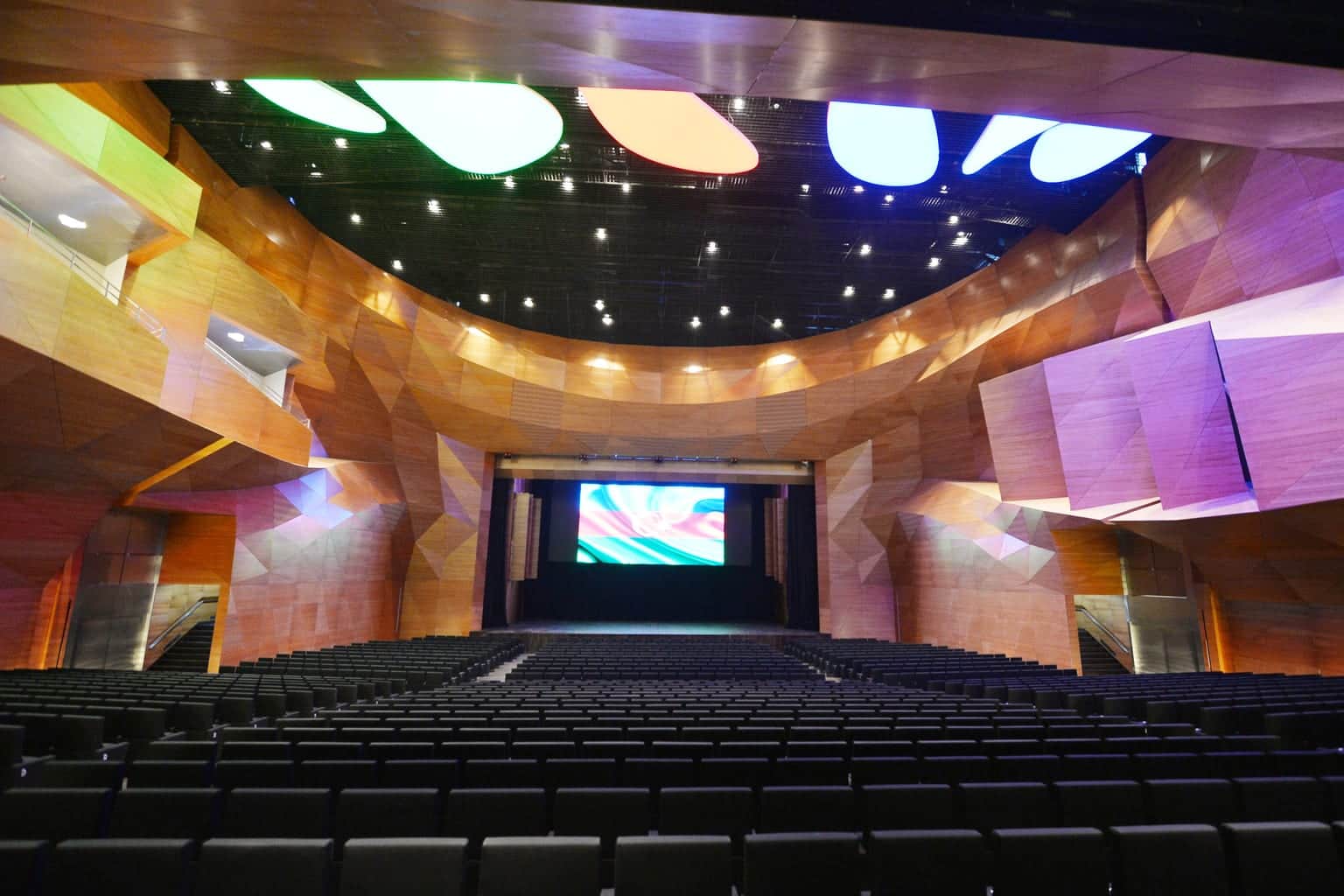
- The Baku Convention Center publishes a large auditorium. Its auditorium seats 3,428 with a moving floor that reconfigures the room in 18 minutes, six simultaneous-translation rooms and a 112 m² LED wall, inside a 46,000 m² building the operator describes as the largest congress centre in the Caucasus. Note that the operator's own about page quotes different totals from its hall pages, so confirm the current room count in writing before you print it in a delegate pack.
Practical checks for the selected rooms:
- For 100 to 200 guests, shortlist named rooms by seating layout, stage, breaks and technical footprint. Published maximum capacity alone does not prove availability, an appropriate room setup or a competitive price.
- For a large or technically complex event, check the exact room layout, rigging and AV specification against dated supplier offers. Identify any outside crew, equipment or longer lead times in the proposal rather than assuming a fixed headcount threshold.
- Off-site venues add the differentiation. A gala in a restored Old City courtyard or a reception on the Caspian waterfront reads very differently from a hotel ballroom, and the city has both.
- Use the selected venue’s published room information and request a current floor plan, layout and technical specification. A general directory or historical capacity figure does not confirm suitability or availability for the event.
One thing that works in Baku's favour on a procurement sheet. The 5★ label here is a mandatory state classification under Article 9.1 of the Law on Tourism, awarded within six months of opening, with new criteria approved on 25 May 2026 that add environmental and energy requirements as mandatory items and assess same-brand properties per building. It is an audited category rather than a property's own marketing. For the full room-by-room view with the numbers each operator publishes, our venues catalogue is the working list we quote from.
Which events should inform the date choice for 2027?
The following organiser announcements were checked on 25 August 2026. Use them to identify dates that may overlap with your programme, then check the organisers’ current information. The 13th World Urban Forum ran 17 to 22 May 2026 and its host site reported over 57,000 participants from 176 countries. In 2027, SportAccord brings 1,700-plus leaders from 120-plus federations to the Baku Convention Center on 9 to 13 May, Baku Energy Week returns to the Expo Center on 2 to 4 June, and the 43rd Rhythmic Gymnastics World Championships run 15 to 19 September. A calendar entry does not confirm a particular hotel rate, sold-out period or supplier capacity. Check rooms, venues and production availability together for the proposed dates.
The ICCA public abstract referenced in this guide reports Azerbaijan at 89th worldwide and Baku at 248th, with eight qualifying association meetings each, using 2023 data. This is a historical association-meeting measure, not a current ranking or a measure of BIRTOUR’s delivery capacity. Consult the current ICCA publication for a newer comparison.
For the bureau, PCO and bid mechanics behind a congress rather than a corporate program, our congress and conference organiser support guide covers who does what now that business events sit inside the tourism board. The full dated list, with the 2026 exhibitions and the 2027 dates as they publish, is the Baku exhibition and congress calendar.
Is Baku cheaper than Dubai for a corporate event?
That depends on the dates, headcount and production specification. A lower headline hotel rate can be offset by a larger room block, venue hire, imported technical equipment or extra transport. We do not have a like-for-like, current supplier sample that supports a fixed percentage saving over Dubai.
Ask both destinations to price the same brief and compare the total contracted cost, not a room rate or an advertised package. The quote should separate accommodation and room taxes, meeting space, AV and staging, catering, airport and intercity transfers, guides, staffing, contingency and currency assumptions. It should mark what is included, optional, subject to availability or supplied by a third party.
The 2026 Baku MICE cost benchmarks show planning ranges by component, and our corporate offsite pricing page shows a worked Baku example. Neither is a live Dubai comparison. Send the event format, dates, delegate and room counts, technical rider and decision deadline to receive a comparable Baku proposal.
Do corporate groups need visas for Azerbaijan in 2027?
The four-country pilot for Saudi, Omani, Kuwaiti and Bahraini ordinary passports is for tourism, up to three entries of 30 days between 15 February 2026 and 15 February 2027. The State Migration Service says non-tourism visitors need the appropriate visa. Confirm a corporate event's purpose with the embassy; do not classify it as tourism from the programme title alone. UAE and Qatar have separate arrangements. Official Migration Service notice, checked 19 September 2026.
Build the arrival list by passport and purpose, with time to resolve exceptions. The standard ASAN product is single-entry, with up to 30 days in a 90-day validity window. Its information page lists USD 29 including the service fee; the three-working-day processing period does not remove the need for a document buffer.
The group entry guide separates citizen and resident routes. Confirm travel dates and flights with the carrier; rail has its own visa-free eligibility rule, which is not a general opening of the road border.
What can delegates actually do in and around Baku?
Inside the city, the UNESCO-listed Old City sits a short walk from the Flame Towers and the Heydar Aliyev Center. Outside it, Gobustan's rock art and mud volcanoes are an hour out, Gabala suits a mountain team-building day, Sheki brings a silk-road town with a UNESCO-inscribed khan's palace, and a Caspian sunset cruise gives the program its reward evening.
Access, venues, cost, and entry rules get a program approved. The experience is what makes delegates glad they came, and it is where Baku punches above its profile. A single day can move from medieval lanes to contemporary architecture without a long coach leg, a contrast that photographs well and gives an incentive program a narrative.
Two operational details that save an argument later. The Absheron sites now sell dated, timed sessions with QR entry through the state ticketing channel, and their hours do not match: Gobustan closes at 17:00 while Ateshgah runs to 20:00, which should drive the running order of any Absheron day. And the Yanardag and Ateshgah combination ticket is valid for 72 hours from first entry, so the two sites no longer have to sit inside the same half-day. Yanardag's reserve administration also requires written permission for professional photography and video, which matters the moment a branded film crew is attached. Source: Yanardag reserve visitor rules, checked 19 September 2026.
For a structured shortlist, the Baku team-building activity guide separates facilitated formats from cultural, outdoor and reward experiences and labels every headcount as a planning band that must be reconfirmed for the date.
Safety and duty of care, the question procurement asks quietly
Travel buyers carry duty-of-care obligations. Do not infer that a hotel star rating certifies medical or security provision, or that a city programme removes the need for a destination risk review. The US State Department's Azerbaijan advisory is Level 3, “Reconsider travel,” and the UK Foreign Office advice warns against travel to parts of the country. Both were checked on 24 September 2026. These advisories are nationality-specific inputs to a corporate decision, not a single verdict for every delegate.
Before approval, check each delegate's government's current advice, the exact itinerary and the employer's travel and insurance rules. The written duty-of-care annex should name programme locations, arrival routes, emergency contacts, verified medical access, transport contingencies and the person responsible on site. Confirm each hotel's actual security and medical arrangements with the property; a local DMC can coordinate the agreed response plan and escalation contacts on the day.
For a corporate travel manager, the useful output is a documented, itinerary-specific risk decision that procurement, the insurer and the group organiser can review before the contract is signed.
Planning your event in Baku
Birtour manages and delivers the complete event and guest programme: event planning, production, venues, hotels, transfers, guides and activities. Send your dates, guest count, delegate origins and event brief so our team can prepare an itemised proposal.
For large productions, the proposal should include the venue-specific technical plan, equipment and crew requirements, schedule and contingency arrangements. Match each delegate's flight options and the destination experience to the brief before confirming the programme.
Fireworks, drone filming and other activities requiring authorisation are assessed for the specific venue and date. Our team checks the applicable permissions and venue conditions before confirming them in the scope. Entry eligibility is checked for each guest's nationality against the responsible official source; final immigration decisions remain with the authorities.
Request a complete event proposal.
How a Baku program comes together
The destination clears the tests. What decides whether a delegate has a smooth week or a bumpy one is on-ground execution, and that is a DMC question rather than a destination question. Baku sharpens that distinction, because what a planner abroad can research stops at the hotel contract and what decides the week starts after it.
A local DMC carries the parts that do not show up in a glossy proposal: identifying the authority and applicant for drone work or late amplified sound, confirming dietary controls with the selected property, testing the transfer loading plan against the actual fleet and access point, and writing the live support and escalation window into the operating plan. For an activity requiring approval, confirm the responsible authority or venue, applicant, documents, fees and lead time for the exact plan. The proposal should state what is confirmed, what remains subject to approval and who owns each next step. We wrote up how to evaluate any DMC, including the questions to ask before you sign, in our DMC selection guide. To see a full planning model rather than a checklist, the GCC incentive blueprint shows how a 120-person brief can be structured without treating unconfirmed suppliers as fixed.
For the planning sequence itself, from the 12-week brief to show day, our step-by-step corporate event guide provides a planning sequence to adapt to the brief and confirmed supplier deadlines.
The short version
Baku can be evaluated for a 2027 mid-size corporate-event shortlist against the same practical tests as competing destinations. The temporary visa-free pilot covers ordinary-passport tourists from four named Gulf countries only through 15 February 2027; business travel and later departures need purpose-specific checks. Standard ASAN e-visa processing is three working days for eligible passports. Road entry remains restricted. Several published rooms can be evaluated for a 100 to 200-person brief; date-specific capacity and price still need written confirmation. Published room maxima are not live inventory.
Older venue decks can mislead in either direction. JW Marriott and the Convention Center publish large spaces, while Fairmont's 1,000-guest summary is not the same as the 840-theatre / 720-banquet room chart. Re-read the named room and layout before sending a shortlist. The cost case needs a like-for-like supplier quote; neither a tourism downturn nor a headline hotel rate proves a saving. Large or technically complex events need a dated venue and supplier plan.
For planners pricing a 2027 programme, send the headcount, dates and format, and start from the worked example on our corporate offsite pricing page. Check the dated source and current supplier offer before relying on entry rules, venue capacity or price.
- Is Baku a good MICE destination for groups of 100 to 200?
- Yes. Baku has published venue options for a 100 to 200-person brief. The JW Marriott Absheron publishes a largest event space rated to 1,000, Hilton Baku's Sevda Ballroom takes 650 theatre or 320 banquet, and the Four Seasons Segah Grand Ballroom takes 300 banquet or 500 reception. For a larger or technically complex event, confirm the specific room layout, supplier capacity and any outside crew in the written proposal.
- How does Baku compare to Dubai on cost for a corporate event?
- There is no reliable fixed saving. Price the same dates, room block, venue layout, AV specification, catering, transfers and staffing in both destinations, then compare the total contracted scope and exclusions.
- Do corporate groups need a visa for Azerbaijan in 2027?
- The four-country pilot for Saudi, Omani, Kuwaiti and Bahraini ordinary passports is for tourism, up to three entries of 30 days between 15 February 2026 and 15 February 2027. The State Migration Service says non-tourism visitors need the appropriate visa. Confirm a corporate event's purpose with the embassy; do not classify it as tourism from the programme title alone. UAE and Qatar have separate arrangements.
- Can a corporate group enter Azerbaijan overland from Georgia or Türkiye?
- Road entry is restricted. For a cross-border extension, confirm each traveller’s passport, purpose, direction and the current crossing rules with the relevant authorities before offering an overland leg. Official advice differs on road-exit permission; the rail exception has separate eligibility rules.
- When should I avoid scheduling an event in Baku?
- The official 2027 Formula 1 schedule lists Baku for 24–26 September, with the race on Sunday 26 September. Remembrance Day follows on Monday 27 September. Check room and venue availability and the published access plan for the actual dates; do not assume a specific price uplift. July and August bring heat, so outdoor events need suitable timing and an indoor alternative.
- Do I need a local DMC or can I book a Baku event directly?
- You can book individual services directly or request a complete programme. BIRTOUR delivers event planning, production, venues, hotels, transfers, guides and activities in one agreed scope. Compare who handles the operating plan, guest movements, technical requirements, dietary arrangements and contingencies; the written proposal should identify inclusions and responsibilities.
Guide
How to plan a corporate event in Baku: a planner's guide
Guide
Baku MICE costs: how to compare conference and event quotes
Guide
Best time to visit Azerbaijan: month-by-month weather, routes and busy dates
Guide
Baku Conference Venues and Meeting Rooms: 14 Candidates to Compare
Guide
Azerbaijan entry rules for GCC groups (2026): the visa-free pilot, the fourth-entry catch, and registration
Guide
PCO in Azerbaijan: choosing a congress organiser and local partner in Baku
Guide
Baku exhibitions and congresses: 2026–2027 event calendar
Case study
Luxury Azerbaijan incentive blueprint for 120 GCC guests
Pricing
Corporate offsite in Baku: cost components for a 50-person programme