Ateshgah Fire Temple, Baku: history, the piped flame, and how to visit
Baku (Surakhani) · about 30 to 40 minutes from Baku
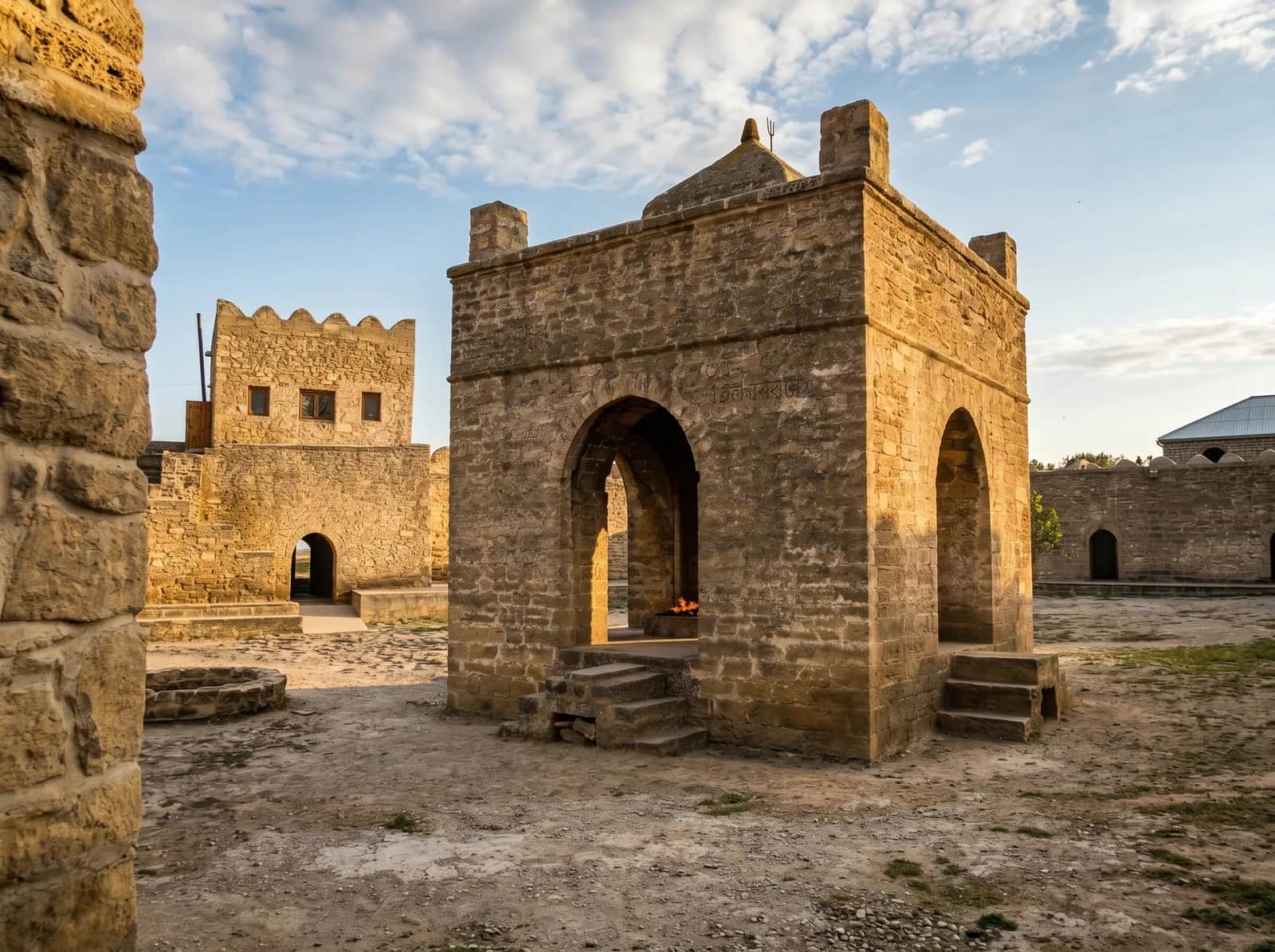
The Ateshgah Fire Temple is a castle-like pentagonal complex in Surakhani on the outskirts of Baku, built around a former natural gas vent and used through the 17th and 18th centuries by Hindu, Sikh and Zoroastrian worshippers, mostly Indian merchants. Carved doorway inscriptions in Sanskrit, Punjabi and Persian honour the fire goddess Jwala Ji. The original natural flame went out around 1969 and the fire burning today runs on piped gas. It has been a museum since 1975 and on Azerbaijan's UNESCO tentative list since 1998.
- Region
- Absheron
- From Baku
- 30 km · about 30 to 40 minutes
- Status
- UNESCO Tentative List (1998)
- Best season
- Year-round; late afternoon reads better than midday
- Time to spend
- About 1 hour
- Entry
- Published tariff, checked 11 August 2026: 15 AZN for foreign visitors, 2 AZN for Azerbaijani adults, 1 AZN for Azerbaijani students. Free for foreign children under 12 and for Azerbaijani under-18s. A guided tour adds 3 AZN in Azerbaijani or 10 AZN in other languages. Combined ticket with Yanar Dag 25 AZN, valid 72 hours; three-site combo adding the mud volcano complex 35 AZN. Sold as dated sessions on iTicket.az and at the gate
- Hours
- Daily 10:00 to 20:00 with no day off, per the iTicket.az session grid published through 30 September 2026. The reserve's own site states no hours, so treat 20:00 as the last session rather than a guaranteed last entry
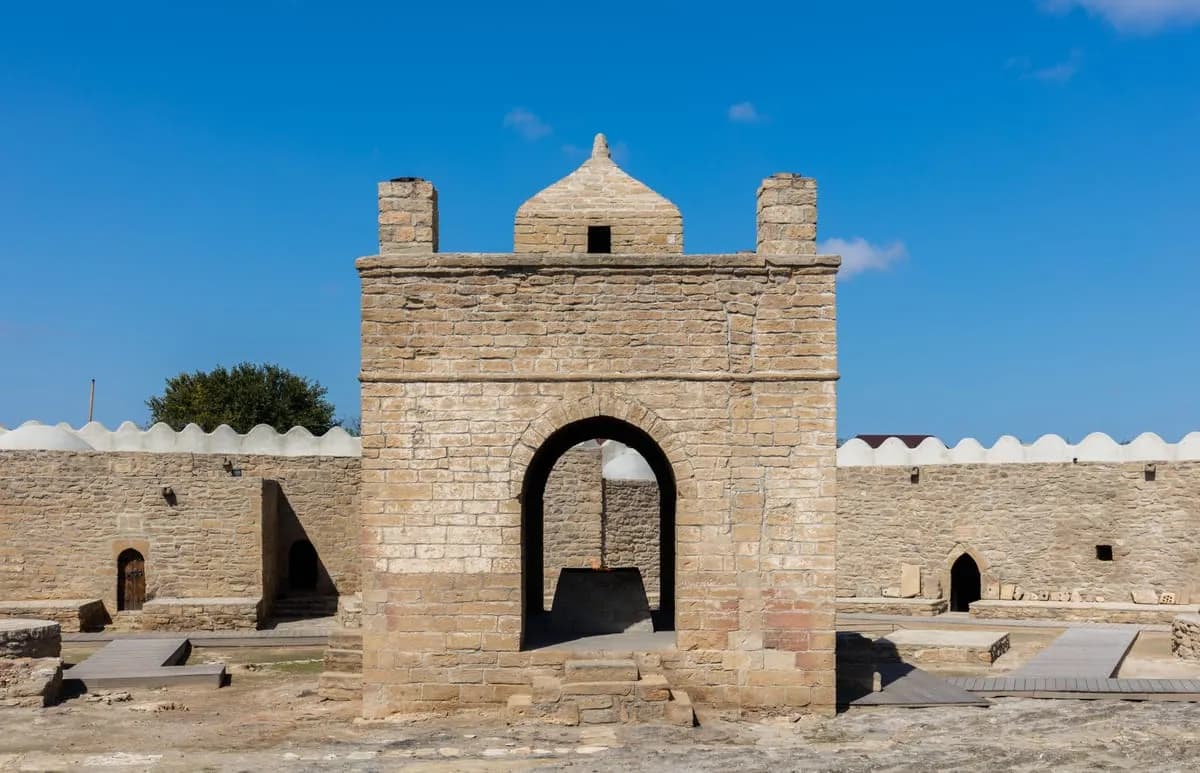
- The pentagonal walled complex with a single fortified gateway
- The central four-vent fire altar under an open stone pavilion
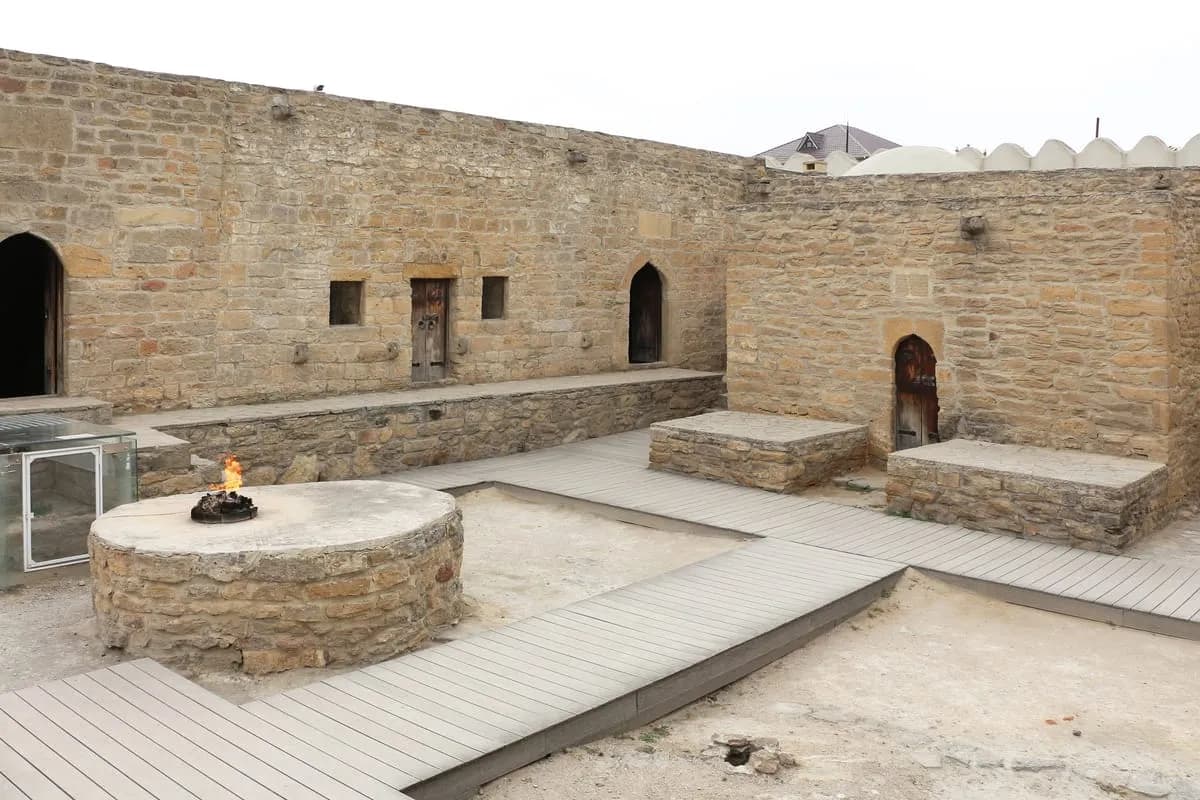
- Perimeter pilgrim cells, now holding museum dioramas of worship and merchant life
- Carved inscriptions in Sanskrit, Punjabi and Persian over the cell doorways
- A 20:00 close, the latest of any ticketed site on a Baku day out
- The 25 AZN combined ticket with Yanar Dag, valid 72 hours from the booked session
People come to Ateshgah expecting an ancient eternal fire and find something more interesting: a small fortified temple raised by Indian merchants far from home, around a flame that has since changed its source. Here is what the place actually is, who built it, what it costs at the gate in August 2026, when in the day to arrive, and how to fit it into a half-day on the Absheron peninsula.
What is the Ateshgah Fire Temple?
Ateshgah is a pentagonal, castle-like temple in Surakhani, a district on the eastern outskirts of Baku, built around a natural gas vent whose flame drew worshippers. A single fortified gateway opens into a walled courtyard ringed by small cells, with a four-vent stone altar under an open pavilion at the centre. It has run as a museum since 1975.
The complex became a state historical and architectural reserve in 2007 and now sits under the State Tourism Agency's Reserves Management Center, which is the practical reason its ticket sells through the same channel as Yanar Dag and the mud volcanoes. The cells around the courtyard hold museum dioramas of worship, pilgrimage and the merchant life that paid for the place.
How much is entry to Ateshgah in 2026?
Fifteen manat for foreign adults, 2 AZN for Azerbaijani adults and 1 AZN for Azerbaijani students. Foreign children under 12 and Azerbaijani under-18s enter free. We re-read the reserve's own tariff page on 11 August 2026, because the 9 AZN figure that still dominates search results expired on 1 January 2026.
| Ticket | Published price, August 2026 |
|---|---|
| Foreign adult | 15 AZN |
| Azerbaijani adult | 2 AZN |
| Azerbaijani student with ID | 1 AZN |
| Foreign child under 12, Azerbaijani under 18 | Free |
| Guided tour in Azerbaijani | 3 AZN |
| Guided tour in other languages | 10 AZN |
| Ateshgah plus Yanar Dag combo | 25 AZN, valid 72 hours |
| Ateshgah, Yanar Dag and the mud volcano complex | 35 AZN, valid 72 hours |
The rise was not Ateshgah's alone. The Reserves Management Center announced on 18 December 2025 that foreign-adult entry across its sites would move from 9 to 15 AZN on 1 January 2026, and the same decision covered Kish church, the Sheki Khan's Palace and Diri Baba. Local prices did not change at any of them. Free entry also runs to people with disabilities, members of low-income families, war veterans and first-degree relatives of martyrs.
Tickets are dated, timed sessions with QR entry sold through iTicket.az, with a gate window as well. One ticket covers one person, and the combined tickets are non-refundable and non-exchangeable once booked.
What time is Ateshgah open?
Daily 10:00 to 20:00, with no day off in the published calendar. That comes from the iTicket.az session grid running through 30 September 2026, not from the reserve, which states no hours on its own site. Treat 20:00 as the last session rather than a guaranteed last entry.
Those two hours after 18:00 are the most useful scheduling fact on the Absheron. The Gobustan rock-art reserve shuts at 17:00 and Yanar Dag's own site says 19:00, so Ateshgah is the one ticketed stop on a Baku day out that can absorb a late start, a long lunch or a delayed group. We sequence southern sites first and put Surakhani last for exactly that reason.
How old is Ateshgah, and who built it?
Most of the standing complex dates to the 17th and 18th centuries. Hindu and Sikh merchants from India, trading across the Caspian, built and paid for it on ground already sacred for its natural fire. Carved inscriptions over the cell doorways run in Sanskrit, Punjabi and Persian, most of them dedicated to the fire goddess Jwala Ji.
The scripts are worth looking up for: Devanagari for the Sanskrit, Gurmukhi for the Punjabi. That makes Ateshgah substantially a Hindu and Sikh temple raised on a spot sacred to fire long before, rather than simply a Zoroastrian one, and the guides who flatten it into "the Zoroastrian temple" are skipping the part that explains the building. The burning slope at Yanar Dag to the north shows the kind of natural flame that drew people here in the first place.
Is the Ateshgah flame natural?
Not any more, and this is the fact most visitors get wrong. The vent flame went out around 1969, after decades of oil and gas extraction nearby dropped the underground pressure. What burns in the central altar today is utility gas piped in from Baku and lit for visitors, not an unbroken ancient burn.
We say that at the gate rather than let a guest work it out from the plaques halfway round. The honest version is a better story anyway: a temple built around a fire that the world's oldest industrial oil field eventually starved. That says more about the Absheron than eternity does.
Is Ateshgah a UNESCO World Heritage site?
No. Azerbaijan added it to the UNESCO tentative list in 1998, under the name Surakhany, Atashgyakh, and it has stayed there since. Tentative means nominated by the state party, not inscribed by the committee, and a good deal of travel copy blurs the two.
Azerbaijan's inscribed properties are the Walled City of Baku with the Shirvanshah's Palace and Maiden Tower (2000), the Gobustan Rock Art Cultural Landscape (2007), the historic centre of Sheki with the Khan's Palace (2019), and the Khinalig cultural landscape with the Köç Yolu route (2023). Ateshgah is on the waiting list beside the Lok-Batan mud cone and the Binagadi fauna deposit.
How do you get to Ateshgah from Baku?
Ateshgah sits in Surakhani on Baku's eastern outskirts, about 30 km and 30 to 40 minutes by road on decent urban Absheron asphalt. There is no convenient direct public transport to the gate, so in practice you arrive by car, taxi or guided tour, usually with Yanar Dag half an hour north in the same run.
We use that routing on the Absheron leg of our 6-day Azerbaijan cultural tour, and we also run it as a 7-hour Gobustan and fire-sites day tour from Baku that covers the temple, Yanar Dag, the petroglyphs and the mud volcanoes in one day. If you are coming by taxi under your own steam, agree the return leg before you get out. Surakhani is residential and the street outside the gate is not a place cars circle looking for fares.
Some visitors now arrive with a Japanese TV drama in mind. VIVANT filmed its second season in Azerbaijan, and Baku Media Center, the production partner, named eight regions where the crew worked; that list names regions, not buildings, and nobody on the production has named Ateshgah. The temple's place on those trips is a matter of routing. It stands between the city and the airport, so day 4 of our ten-day VIVANT-regions tour pairs it with Yanar Dag in the morning before the flight to Nakhchivan. Our VIVANT in Azerbaijan page sets out who has named which places, and on whose authority.
Is Ateshgah worth visiting, and how long do you need?
About an hour, and yes if what you want is the merchant history rather than a spectacle. The altar flame is small and piped. The interest is in the cells, the carved dedications and the museum reconstruction of pilgrim life. Anyone who came for a wall of natural fire wants Yanar Dag as well.
Late afternoon is the better slot, and this is the part itineraries usually get wrong. The courtyard is open and unshaded, Baku runs 32 to 38 degrees through July and August, and the altar flame reads as pale glare against daylight. Once the light drops it separates from the stone. In high summer that means arriving around 18:30 and using the 20:00 close, which no other ticketed site on this circuit gives you. In late December the light goes by 17:15, so a 16:00 arrival does the same job.
Walk it in this order: the central pavilion first, then the ring of cells clockwise, looking up at the doorways for the dedications, and the museum rooms last.
Can you combine Ateshgah with Yanar Dag?
Yes, and on one ticket. The two reserves sell a combined 25 AZN ticket that stays valid for 72 hours from the booked session, so the pair no longer has to sit inside the same half-day. A 35 AZN version adds the mud volcano complex south of the city.
They are easy to confuse and are not the same thing. Yanar Dag is a natural gas fire breaking out of a hillside on its own, roughly one to three metres high along about ten metres of slope. Ateshgah is a built temple whose flame now arrives by pipe. Seen together the pair makes the point better than either does alone: the Absheron burns, and people built things around it. For groups being sequenced across a whole year rather than a single afternoon, our month-by-month planner's calendar covers how the same day shifts between January and July.
What we would not recommend
Three things. Do not buy the 25 AZN combo if you are already booked on a tour that includes both admissions. Do not assume snapshot rules cover a professional shoot here. And do not drive 30 km each way for the temple on its own.
On the combo, it exists for independent travellers and only earns its price when you actually split the two fire sites across different days inside the 72-hour window. If both admissions sit in a tour price already, buying it again is money spent twice.
On photography, Ateshgah publishes no policy at all, which is not the same as permission. Yanar Dag, run by the same agency, requires written permission from its administration for professional photo and video work, and we clear anything beyond a handheld camera with the Ateshgah administration in advance rather than argue it at the gate. A drone and a lighting crew are not a thing to improvise on arrival.
On the standalone trip, an hour at the temple does not carry a 60 km round trip by itself. Pair it with Yanar Dag, or fold it into a day that also takes in Gobustan, or leave it out. For operator partners building an Absheron half-day into a longer Caucasus programme, the ground handling sits on our Azerbaijan DMC page.
- What is the Ateshgah Fire Temple?
- Ateshgah is a pentagonal, fort-like temple in Surakhani on Baku's outskirts, built around a natural gas vent that once fed a flame. Hindu, Sikh and Zoroastrian worshippers, mostly Indian merchants, used it through the 17th and 18th centuries. It has run as a museum since 1975.
- How much is entry to Ateshgah in 2026?
- Fifteen manat for foreign adults, 2 AZN for Azerbaijani adults and 1 AZN for Azerbaijani students, re-read on 11 August 2026. Foreign children under 12 and Azerbaijani under-18s enter free. A guided tour adds 3 AZN in Azerbaijani or 10 AZN in other languages. The 9 AZN figure still circulating online expired on 1 January 2026.
- What time does Ateshgah open and close?
- Daily 10:00 to 20:00, with no day off in the published calendar. That comes from the iTicket.az session grid running to 30 September 2026, because the reserve's own site states no hours at all. Treat 20:00 as the last session rather than a guaranteed last entry, and confirm on arrival.
- How old is it and who built it?
- Most of the standing complex dates to the 17th and 18th centuries. It was built and funded largely by Hindu and Sikh merchants from India who traded along the Caspian, on a spot already sacred for its natural fire. Doorway inscriptions record their names and dedications to Jwala Ji.
- Is the flame natural?
- No. The original natural flame went out around 1969 after decades of nearby oil and gas extraction lowered the underground pressure. The fire you see today is fed by piped utility gas from Baku and lit for visitors, so treat any claim of an unbroken ancient natural flame as inaccurate.
- Is Ateshgah a UNESCO World Heritage site?
- No, and the distinction matters. Azerbaijan put it on the UNESCO tentative list in 1998 as Surakhany, Atashgyakh, and it has stayed there since. Tentative means nominated, not inscribed. Azerbaijan's inscribed properties are the Walled City of Baku, Gobustan rock art, the historic centre of Sheki, and the Khinalig cultural landscape.
- How do you get there from Baku?
- Ateshgah is in Surakhani on Baku's outskirts, about 30 km and 30 to 40 minutes by road through urban Absheron. Most visitors come by car, taxi or guided tour and pair it with Yanar Dag a little to the north. There is no convenient direct public transport to the gate.
- Is Ateshgah worth visiting?
- Yes if you want the merchant history rather than a spectacle. The flame itself is small and piped, and the interest sits in the cells, the carved dedications and the museum. Budget about an hour. Anyone who came for a wall of natural fire should add Yanar Dag half an hour north.
- Can you combine it with Yanar Dag?
- Yes, and on one ticket. The two reserves sell a combined 25 AZN ticket valid for 72 hours from the booked session, so they no longer have to fall in the same half-day. A 35 AZN version adds the mud volcano complex south of the city. Combos cover one person and are non-refundable.
- Can you take photographs at Ateshgah?
- Personal photography is normal practice and nobody stops a phone or a handheld camera. The reserve publishes no photography policy at all, though, so anything commercial should be cleared with the administration first. Yanar Dag, run by the same agency, requires written permission for professional photo and video work.
Tour package
6-Day Azerbaijan Cultural Tour from Baku
Destination
Yanar Dag (Burning Mountain): the ever-burning hillside near Baku
Destination
Old City of Baku (Icherisheher): walls, Maiden Tower, and how to visit
Experience
Gobustan, Mud Volcanoes & Absheron Fire Tour from Baku
Tour package
VIVANT Azerbaijan Grand Tour: 10 Days, All Eight Filming Regions
Guide
The eight VIVANT filming regions: distances, drive times and how they connect