Gobustan, Mud Volcanoes & Absheron Fire Tour from Baku
A full day from Baku to the UNESCO rock art of Gobustan, the cold mud volcanoes, and the eternal fire sites of the Absheron peninsula, with a licensed guide and door-to-door transport.
About 7 hours · English/Russian/Turkish · Baku · Gobustan · Absheron
Operated by Birtour DMC since 2014
- Duration
- About 7 hours
- Languages
- English · Russian · Turkish
- Max group
- 18 people
- Meeting point
- Central Baku hotel pickup
- Pickup
- Hotel pickup
- From
- On request
- UNESCO
- Geology
- History
- Fire
- Nature
Highlights
- Walk the UNESCO-listed Gobustan petroglyphs with a licensed guide
- Ride out to the cold mud volcanoes, usually in a Soviet-era 4x4
- See the eternal flames at Ateshgah and Yanar Dag in one afternoon
- Door-to-door transport from central Baku hotels
- Choose a shared small group or a private tour
What you'll see, in order
Stop
01
20 minBibi-Heybat Mosque
A short stop at the reconstructed seaside mosque on the road south out of Baku.
Stop
02
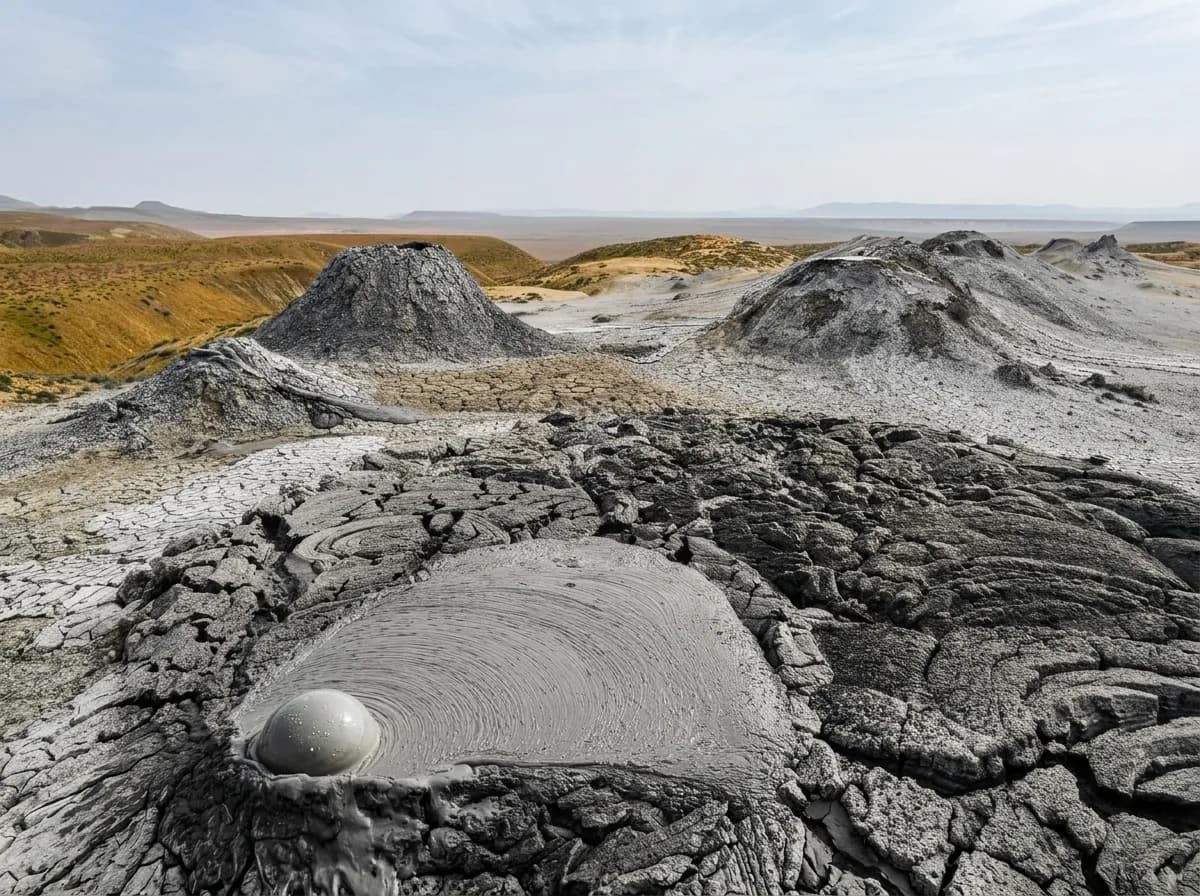
30 minAdmission includedGobustan mud volcanoes
A field of cold, bubbling mud cones reached over rough track, usually by Soviet-era 4x4.
Stop
03
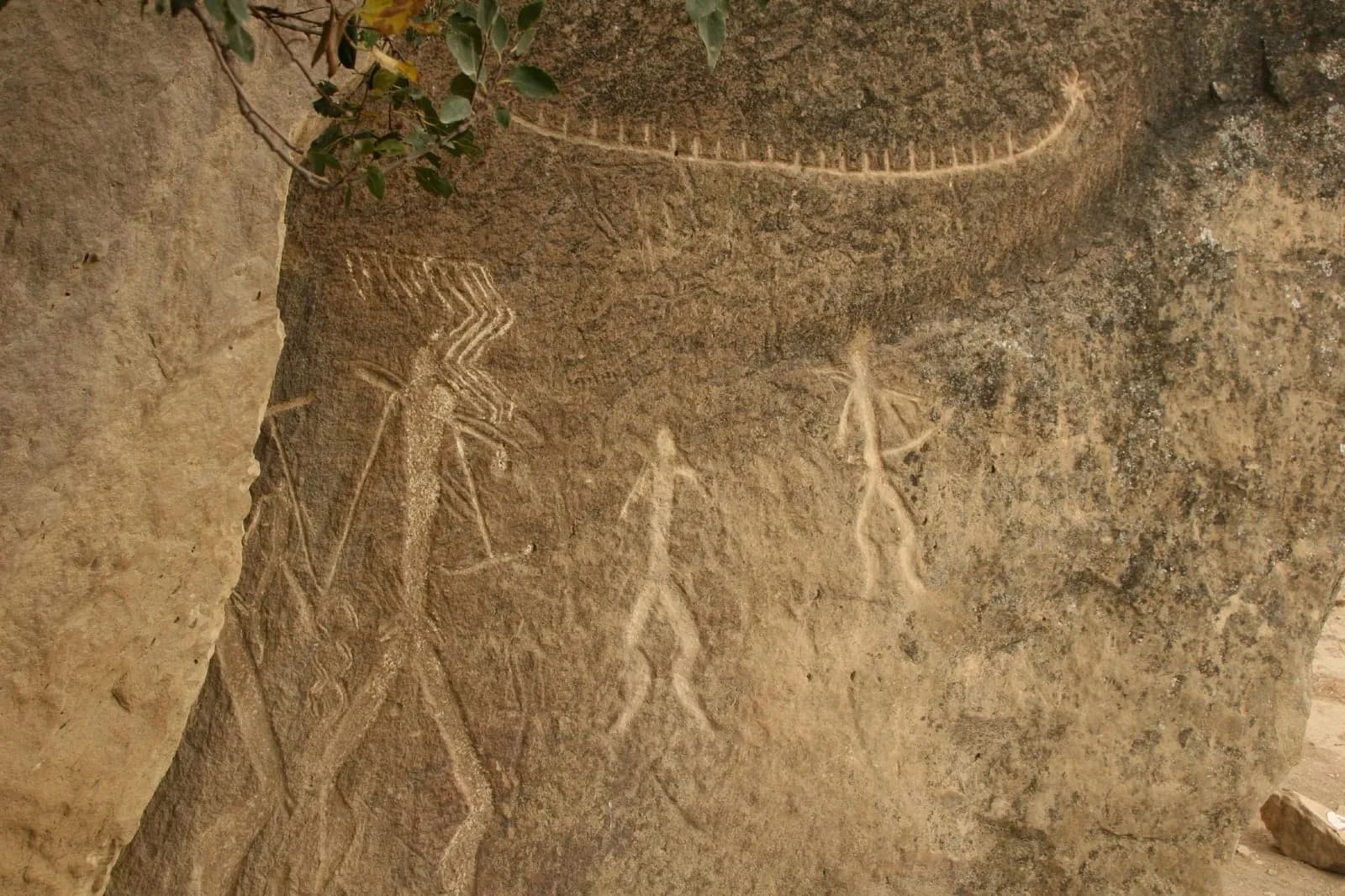
60 minAdmission includedGobustan rock art (Qobustan National Park)
Thousands of petroglyphs carved over millennia, inscribed by UNESCO in 2007, with the site museum.
Stop
04
30 minSurakhany
The Absheron village built over natural gas vents, home to the fire temple.
Stop
05
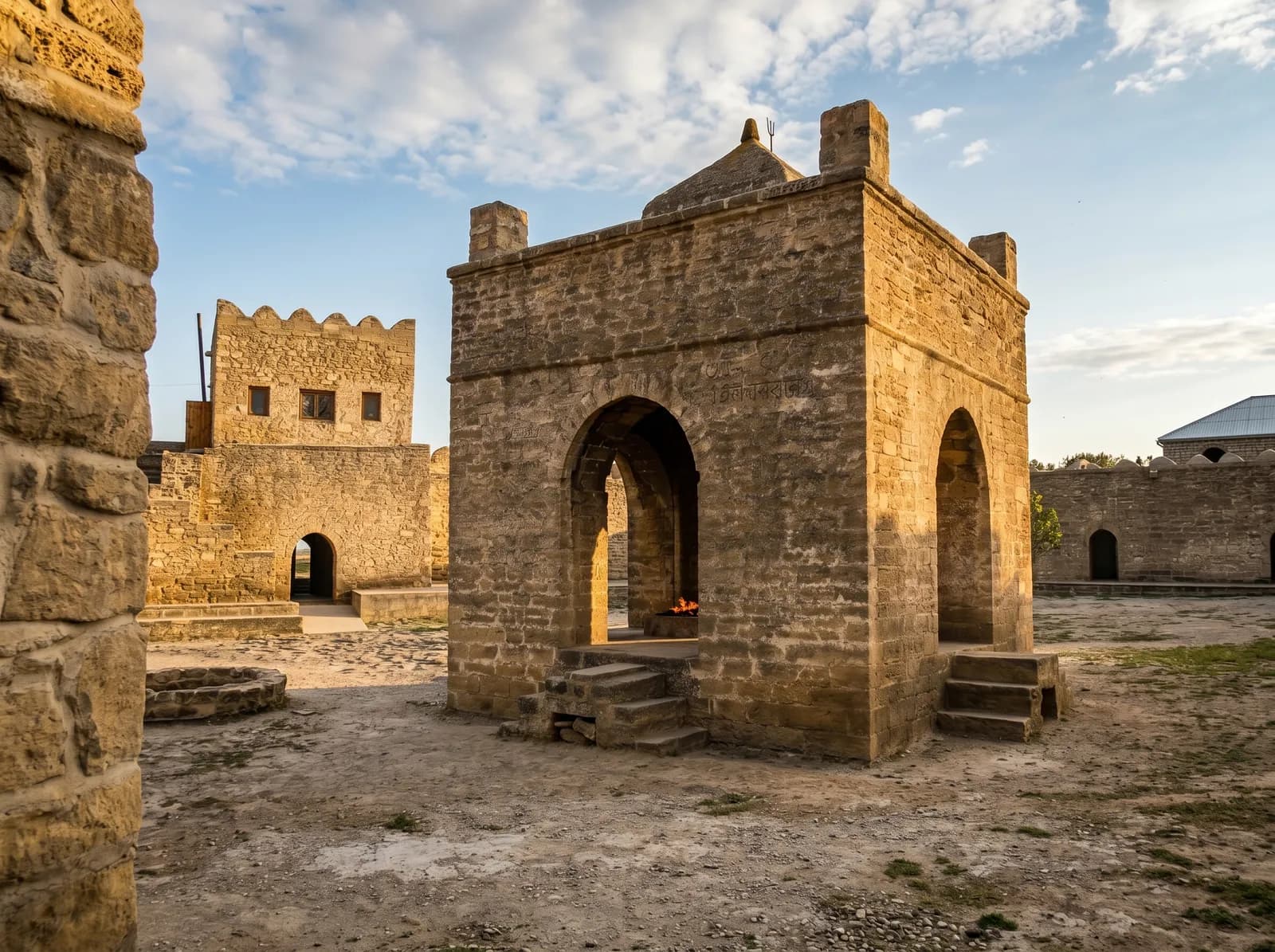
30 minAdmission includedAteshgah Fire Temple
The pentagonal fire temple where a natural flame once drew Zoroastrian and Hindu pilgrims.
Stop
06
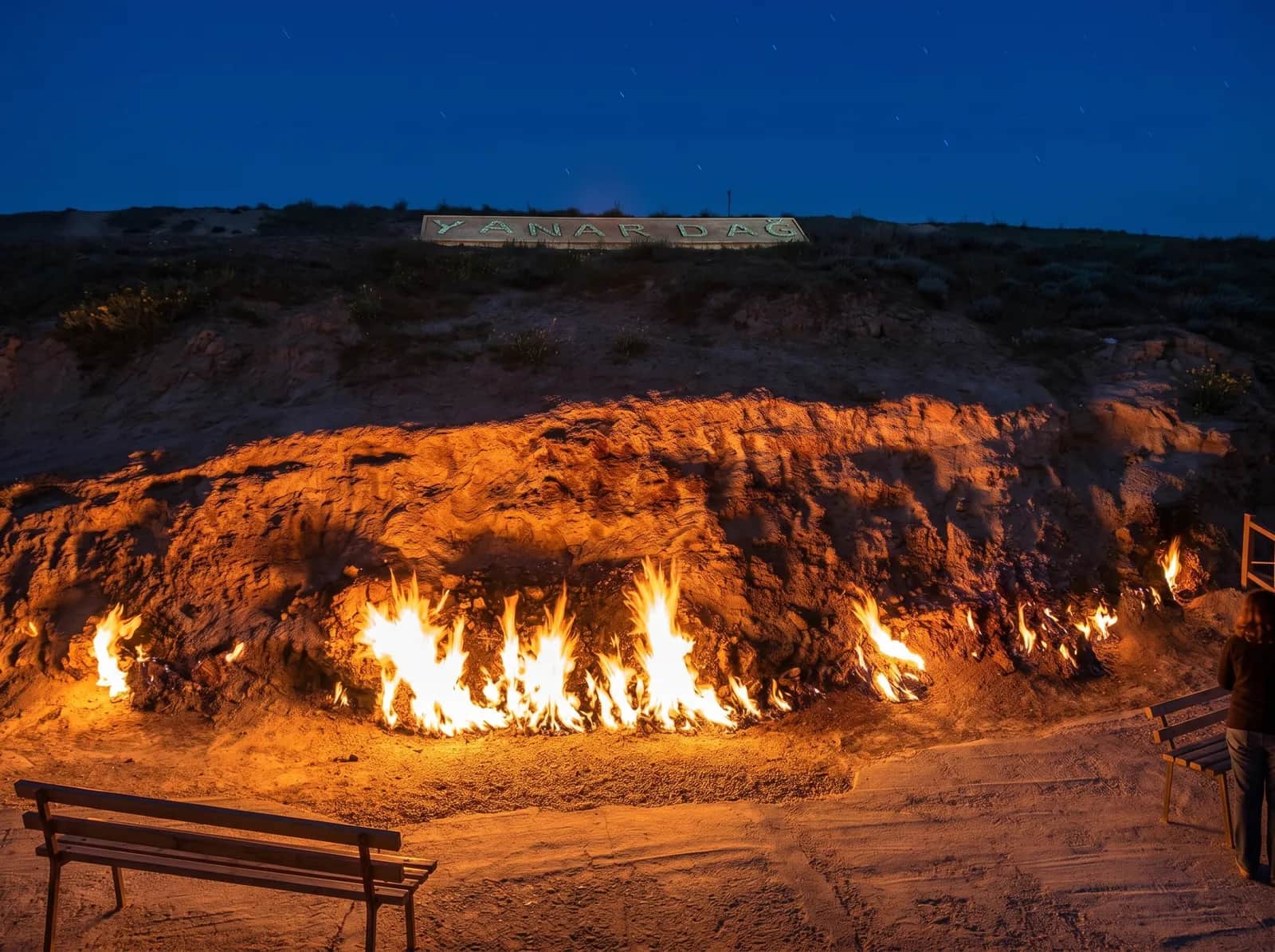
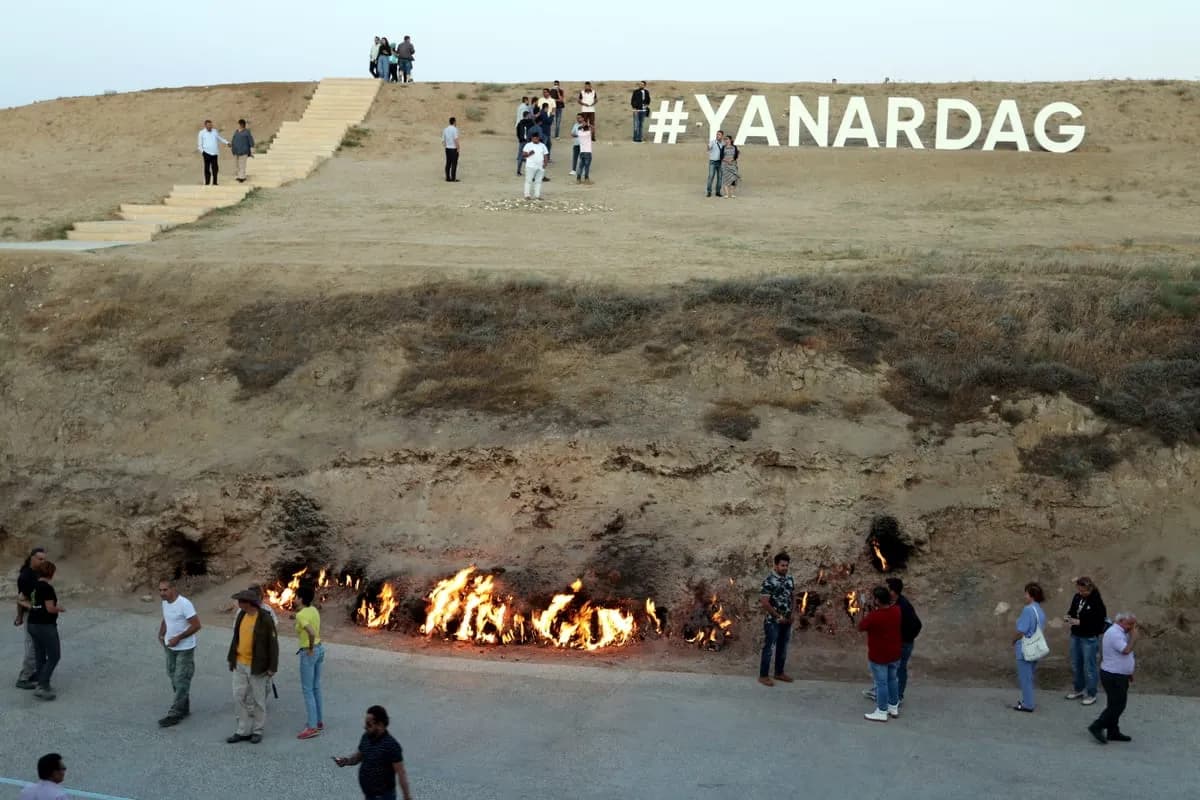
30 minAdmission includedYanar Dag (Burning Mountain)
A hillside where natural gas keeps a wall of flame burning along the ground.
Group or private
- Group
Shared group tour
Price on request
Small-group departures most days. Final price confirmed by quote for your dates and party size.
- Private
Private tour
Price on request
Just your party, with flexible timing and pickup.
- Licensed English-, Russian- or Turkish-speaking guide
- Hotel pickup and drop-off in central Baku
- Air-conditioned vehicle for the full route
- Entry fees for Gobustan National Park, the mud volcanoes, Ateshgah and Yanar Dag
- Lunch (a restaurant stop is built into the day; budget roughly 15–25 AZN)
- Gratuities
Where to meet us
- Location
- Central Baku hotel pickup
- Pickup
- Hotel pickup available on request
- Notes
- Pickup from central Baku hotels, or a confirmed city-center meeting point. Exact time is sent the evening before.
What the day is like
The same guide covers the whole circuit, so the geology at the mud volcanoes and the archaeology at the rock art read as one day, not two handoffs.
The mud-volcano leg crosses open track in a UAZ or old Lada; it is the part most groups talk about afterwards.
Each stop gets its own window: about an hour at the Gobustan panels, half an hour at each fire site, with room to walk on your own.
Pickup time lands by message the evening before, so there is no blanket dawn slot to guess at.
- Free cancellation up to 24 hours before the start time for a full refund.
- Within 24 hours, the booking is non-refundable and cannot be changed.
- If weather closes the mud-volcano track, we run an alternative or offer another date or a refund.
- Carry some cash for lunch and any optional extras; card acceptance is patchy outside Baku.
- The mud-volcano field is reached over rough track and can be skipped in bad weather.
- Since the Mud Volcanoes Tourism Complex opened in 2024, visitors are kept to marked paths rather than walking freely among the cones.
- Yanardag National Reserve requires written permission from its administration for professional photo or video work.
- Dress modestly for the mosque and the fire temple; sun cover helps at the open sites.
- A moderate level of fitness helps, with short walks on uneven ground.
The Gobustan Rock Art Cultural Landscape, inscribed on the UNESCO World Heritage list in 2007, sits 64 km southwest of Baku, with the cold mud volcano field a short drive further south. This day tour from Baku covers both and adds the fire sites of the Absheron peninsula north of the city, joining two geologically separate parts of Azerbaijan in one circuit. The morning takes in the Gobustan rock art and the mud volcanoes; the afternoon turns to the natural-gas flames at Ateshgah and Yanar Dag, which drew Zoroastrian and Hindu pilgrims off the Silk Road. Birtour, a Baku-based DMC operating since 2014, runs the loop in about seven hours door to door, with a licensed guide, admission to every ticketed stop, hotel pickup, and air-conditioned transport throughout.
Why Gobustan and the Absheron fires belong in one day
Gobustan sits 60 to 70 km southwest of Baku; the Absheron fire sites are 25 to 30 km north. Nobody passes both by accident. The pairing works on opening hours: the Gobustan reserve shuts at 17:00 while Ateshgah runs to 20:00, so the southern half must go first and the northern half takes any slippage.
That asymmetry is the whole argument for the running order, and it is the part most self-planned versions of this day get wrong. A group that starts north at Ateshgah because it is closer to the hotel reaches Gobustan around 16:00, with an hour of panels and an off-road leg to squeeze into sixty minutes. We have watched that happen from the car park more than once.
What stops does the Gobustan and fire tour include?
Six stops plus a lunch break, in a fixed order: Bibi-Heybat Mosque on the road south, the mud volcano field, the Gobustan petroglyph reserve, then Surakhany, Ateshgah Fire Temple and Yanar Dag north of the city. Admission is included at the four ticketed sites; lunch is paid on the spot.
Pickup runs from your central Baku hotel, usually early morning. The first stop heading south is Bibi-Heybat Mosque, a Shia mosque on the coast road out of the city. The building you see is not the old one: the original was demolished in 1936 and the present mosque was rebuilt from 1997 on the same site. Twenty minutes is enough, and it sets up Absheron religious geography before the day turns geological.
From there it is about an hour southwest to Gobustan, and the mud volcano field comes first. The last stretch leaves the asphalt for rough track, and a UAZ van usually handles that push, though a Lada or another Soviet-era 4x4 sometimes takes its place depending on what is waiting at the turn-off that morning. The cones are cold, driven by underground gas rather than heat, so what you get is a plateau of cracked grey clay that bubbles and occasionally burps. One correction on the usual description: the field is not inside the rock-art reserve. It is a separate site, managed since 2024 through the Mud Volcanoes Tourism Complex, which means marked paths and a ticket of its own. Both are covered by your tour price.
If the rough-track leg turns out to be your group's favourite hour of the day, that appetite scales. Our 8-day 4x4 self-drive expedition puts you behind the wheel of a Land Cruiser across the Talysh Mountains and the Greater Caucasus.
The longest stop is Gobustan National Park, where the carvings are concentrated. The site museum at the entrance sequences them chronologically before you walk the outdoor sections. Plan on an hour. A guide who knows the specific panels is what separates this from standing in front of boulders.
Lunch follows at a local restaurant on the road back toward the fire sites, and the meal is not in the tour price. Most groups order a mix of grilled meats, bread and salads; budget 15 to 25 AZN a head.
The afternoon crosses to the Absheron peninsula north of the city. Surakhany comes first, a village built over natural gas vents where seeping gas once fed open flames at ground level, and it leads straight into Ateshgah Fire Temple, the pentagonal complex built mostly in the 17th and 18th centuries by Hindu and Sikh merchants trading across the Caspian. The natural flame there went out around 1969, when decades of nearby extraction dropped the underground pressure. What burns in the central altar today is piped utility gas.
The last stop is Yanar Dag, a low hillside on the northern Absheron where a line of natural gas burns along the base of the slope. No shrine, no altar: methane rising through porous sandstone, alight in the open air. Groups reach it in the late afternoon, and the flame reads clearly against the slope at that hour, so there is no waiting around for dark.
What do Gobustan, Ateshgah and Yanar Dag cost at the gate?
We re-read the official channels on 10 August 2026. Gobustan and Ateshgah both sell through iTicket.az in a 1 to 15 AZN band; Yanardag publishes 15 AZN for foreign adults and 2 AZN for residents. All four admissions on this tour are already inside the tour price, so you pay nothing at the gates.
| Site | Published price, August 2026 | Published hours | On this tour |
|---|---|---|---|
| Gobustan National Historical-Artistic Reserve | 1 to 15 AZN band, dated sessions on iTicket.az | 10:00 to 17:00 | Included |
| Ateshgah Temple reserve, Surakhany | 1 to 15 AZN band, dated sessions on iTicket.az | 10:00 to 20:00 | Included |
| Yanardag National Reserve | 15 AZN foreign adult, 2 AZN resident, 1 AZN student | Daily 10:00 to 19:00 (yanardag.az, read 22 August 2026) | Included |
| Mud volcano field, 2024 tourism complex | Sold inside the 35 AZN three-site combo | Daylight only, track-dependent | Included |
Two things are worth knowing if you ever do this route independently. The reserves now sell dated, timed sessions with QR entry rather than a paper ticket at the window, and the Yanardag plus Ateshgah combo at 25 AZN is valid for 72 hours, so those two no longer have to sit in the same afternoon. Yanardag also publishes free entry for under-18s and for foreign visitors under 12, a 10 percent discount for parties of ten or more, and a guided-tour supplement of 3 AZN in Azerbaijani or 10 AZN in other languages.
Why is Gobustan rock art a UNESCO World Heritage site?
UNESCO inscribed the Gobustan Rock Art Cultural Landscape in 2007 under criterion (iii), as exceptional testimony to a prehistoric way of life. The property covers roughly 537 hectares across three outcrops, Boyukdash, Kichikdash and Jingirdagh, and holds thousands of carvings running from the Upper Palaeolithic through to the medieval period.
The carvings include aurochs, deer and lions, reed boats with rowers, rows of dancing figures, and shapes that read as rudimentary maps. A Roman legionary inscription cut into a boulder at Boyukdash, left by a soldier of the Twelfth Legion, confirms the place was already old enough to be visited as a curiosity two thousand years ago.
Why does the Absheron peninsula burn?
Methane escapes through fissures in the rock across the whole peninsula, which sits over one of the oldest worked oil and gas provinces on earth. Where a seep meets air and something ignites it, the flame holds. That is why fire temples were built here, and why Yanar Dag still burns through rain and wind.
Two age claims on this route need trimming, and we would rather trim them ourselves than have a guest read a plaque and lose confidence in the guide. The Ateshgah flame is not an unbroken ancient burn: it went out around 1969 and runs on piped gas today. And Yanar Dag, despite the postcards, is not a fire from antiquity. The Absheron seeps are old, and travellers wrote about open flames here for centuries, but local accounts date this particular hillside flame to a shepherd in the 1950s. The fire is real and self-sustaining. The thousand-year framing is not.
Scale gets inflated too. The flame stands roughly one to three metres high across about ten metres of slope. Wide-angle lenses and long exposures do the rest of the work in the photographs you have seen.
When is the best time to take this tour?
Mid-April to early June and early September to late October. Baku runs 32 to 38 degrees in July and August, and neither the Gobustan panels nor the mud volcano field has any shade. Winter suits the fire sites, where the heat is welcome, but heavy rain can shut the mud-volcano track.
Diffuse light also suits the rock faces better than hard midday sun, which is a second argument for the shoulder months. For operators sequencing group departures across a whole year rather than booking a single day, our month-by-month planner's calendar covers the hotel-squeeze weeks and the khazri wind.
Who is this tour suited to?
We rate the day moderate. There is no climbing, but the open sections at Gobustan mean 20 to 40 minutes on uneven rock, and the mud field turns slippery after rain. Children do well on it; the variety holds attention. Wheelchair users should ask us first, because the mud-volcano leg cannot be adapted.
How does the day run?
One guide covers the whole circuit, so the geology at the mud volcanoes and the archaeology at the petroglyphs read as one day rather than two handoffs. Pickup time arrives by message the evening before. Shared departures cap at 18 people; the private version carries no cap and lets you reorder the stops.
Birtour has run this circuit as a licensed Baku DMC since 2014, and the guide roster on the route has been stable for several seasons. Stops are timed so each one gets a real window: about an hour at the Gobustan panels, half an hour at each fire site, with room to walk on your own. That is a deliberate trade. It means fewer stops than some competing day tours advertise, and we think six done properly beats nine done at a jog.
What we would not recommend
Three things. Do not try this route as a self-drive day: the mud-volcano track eats hire-car suspension, and most rental contracts exclude unpaved surfaces. Do not chase Yanar Dag after dark on this itinerary. And do not buy the 25 AZN Yanardag-plus-Ateshgah combo separately if you are already booked on the tour.
On the self-drive point, the exclusion is the real risk rather than the road. Standard Azerbaijani rental contracts commonly exclude damage sustained off sealed roads, which is exactly where the last kilometre to the cones goes. Our guide to driving in Azerbaijan sets out that clause alongside the International Driving Permit question.
On the dusk point, the flame does read better after sunset. If that is your priority, book Yanar Dag and Ateshgah as a separate evening half-day and keep Gobustan for a full morning. Holding both in one seven-hour day means arriving at the Gobustan reserve after 17:00, when it has closed.
On the combo ticket, every admission on this circuit is already in the tour price. The 25 AZN combo exists for independent travellers, and it only pays for itself if you split the two fire sites across different days inside its 72-hour window.
Do you need a visa, and can you arrive overland?
For a cross-border extension, confirm the passport, purpose and direction. Road entry is restricted, and official advice differs on road-exit permission. The visa-free rail exception is separate. Confirm the actual crossing before booking; see the entry and rail rules.
The Gulf and East Asia changed during 2026. Saudi Arabia, Oman, Bahrain and Kuwait gained unilateral visa-free entry from 15 February 2026, Japan and South Korea from 1 July 2026, Singapore from 1 August 2026, each on three entries of up to 30 days. Read the expiry dates rather than the headline: these are one-year trials that lapse in February, July and August 2027 unless they are renewed. Everyone else should budget the USD 20 single-entry state fee charged by the foreign ministry, plus the portal's service charge, and apply before flying.
Practical notes
Carry cash. Card acceptance outside Baku is patchy and lunch is settled on the spot. Dress modestly for Bibi-Heybat Mosque and Ateshgah, both active religious sites. Bring sun cover and water for the Gobustan sections. Yanardag bars professional photo and video work without written permission from the reserve administration.
If the mud-volcano track is closed by weather, we run an alternative stop or reschedule at no penalty; the fire sites stay accessible whatever the weather does. One more cash note: the roadside vendors near the field and most of the lunch restaurants on that stretch are cash-only in practice, whatever the sticker on the door says.
Shared or private: how to compare the quote
Both options are priced on request. Compare the complete day for the same route and party size before comparing a per-person headline with a private-group total.
| Quote detail | Shared departure | Private departure |
|---|---|---|
| Price basis | Per person; ask for the total for all adults and children | Total for your party; ask for the vehicle type and number of vehicles |
| Timing and pickup | Confirm the departure, meeting point and pickup coverage | Request your pickup address and preferred timing; confirm the agreed route |
| Four admissions | Ask for Gobustan rock art, the mud-volcano site, Ateshgah and Yanar Dag to be itemised | Ask for the same four admissions and any child-rate differences |
| Mud-volcano transport | Confirm whether the local off-road transfer is included or charged separately | Confirm the same transfer, vehicle capacity and any extra charge |
| Lunch | Paid separately under the published programme | Paid separately unless your written quote adds it |
The published programme includes four admissions and central-Baku transport. The mud-volcano entry ticket and the local off-road ride are separate services: the quote must state the ride's cost or inclusion explicitly. Ask which mud-volcano site is planned, what happens if its access road closes, and how any route change affects the total.
How to request a quote
Send three details: your date or flexible date range; the number of adults and children's ages; and your preferred shared or private format with a pickup address. Put the format and pickup address in the form's message field. The quotation should confirm the departure, vehicle allocation, guide language, admissions, off-road transfer and payment/cancellation terms before you book.
Request this Gobustan and Absheron tour. For a longer trip containing this circuit, see the 6-day Azerbaijan cultural tour.
Questions travelers ask
- How long is the Gobustan and Absheron fire tour?
- About seven hours door to door from central Baku, covering Gobustan to the south and the Absheron fire sites to the north of the city in one day.
- Why does the tour visit Gobustan before the Absheron fire sites?
- Opening hours decide it. The Gobustan reserve closes at 17:00 while the Ateshgah reserve runs to 20:00, so the southern half of the circuit has to happen in the morning and the northern half can absorb any delay. Running the day the other way round risks reaching Gobustan after it has shut.
- How much does it cost to enter Gobustan, Ateshgah and Yanar Dag?
- Checked on 10 August 2026: Gobustan and Ateshgah both sell dated sessions through iTicket.az in a 1 to 15 AZN band, and Yanardag National Reserve publishes 15 AZN for foreign adults, 2 AZN for residents and 1 AZN for students. On this tour all of those admissions are already inside the price you pay us.
- Is the Gobustan rock art really a UNESCO site?
- Yes. The Gobustan Rock Art Cultural Landscape was inscribed on the UNESCO World Heritage list in 2007, with engravings that bear testimony to up to 40,000 years of human presence.
- What is included in the Gobustan mud volcanoes and fire tour?
- The tour includes a licensed English-, Russian-, or Turkish-speaking guide, hotel pickup and drop-off in central Baku, an air-conditioned vehicle for the full route, and admission to Gobustan National Park, the mud volcanoes, Ateshgah Fire Temple, and Yanar Dag. Lunch is not included.
- What are the mud volcanoes and how do you reach them?
- They are cold mud cones pushed up by underground gas, not lava. The field sits off-road, so the last stretch is usually done in a Soviet-era 4x4 over rough track. Since the Mud Volcanoes Tourism Complex opened in 2024, the site is ticketed separately from the rock-art reserve and visitors follow marked paths.
- Has the Yanar Dag flame really burned for thousands of years?
- No, and we would rather say so than let a guest read it on a plaque. The Absheron gas seeps are genuinely ancient and travellers described open flames here centuries ago, but local accounts date this particular hillside fire to a shepherd in the 1950s. It is self-sustaining and burns through rain and wind; the thousand-year framing is marketing.
- Do I need a visa for Azerbaijan, and can I arrive by land?
- Saudi, Omani, Bahraini, Kuwaiti, Japanese, South Korean and Singaporean passport holders hold visa-free entry on one-year trials that expire during 2027. For a cross-border extension, confirm the passport, purpose and direction. Road entry is restricted, and official advice differs on road-exit permission. The visa-free rail exception is separate. Confirm the actual crossing before booking; see the entry and rail rules.
- Is lunch included?
- A restaurant stop is built into the day, but the meal itself is paid on the spot. Budget roughly 15–25 AZN per person.
- Can I do this tour privately?
- Yes. A private version runs for just your party with flexible timing and pickup; ask for a quote with your dates and group size.
- What should I wear and bring?
- Comfortable shoes for uneven ground, modest cover for the mosque and fire temple, sun protection for the open sites, and some cash for lunch.
destination
Gobustan Rock Art: petroglyphs, museum, and how to visit
destination
Gobustan Mud Volcanoes: cold mud cones and how to visit from Baku
destination
Ateshgah Fire Temple, Baku: history, the piped flame, and how to visit
destination
Yanar Dag (Burning Mountain): the ever-burning hillside near Baku
tour package
6-Day Azerbaijan Cultural Tour from Baku
itinerary
Azerbaijan 4x4 self-drive expedition: 8 days, Talysh to Greater Caucasus
guide
Driving in Azerbaijan: licences, the IDP question, cameras and insurance