Diri Baba Mausoleum: the 1402 tomb built into a Maraza cliff
Maraza · about 1 hour 25 minutes from Baku
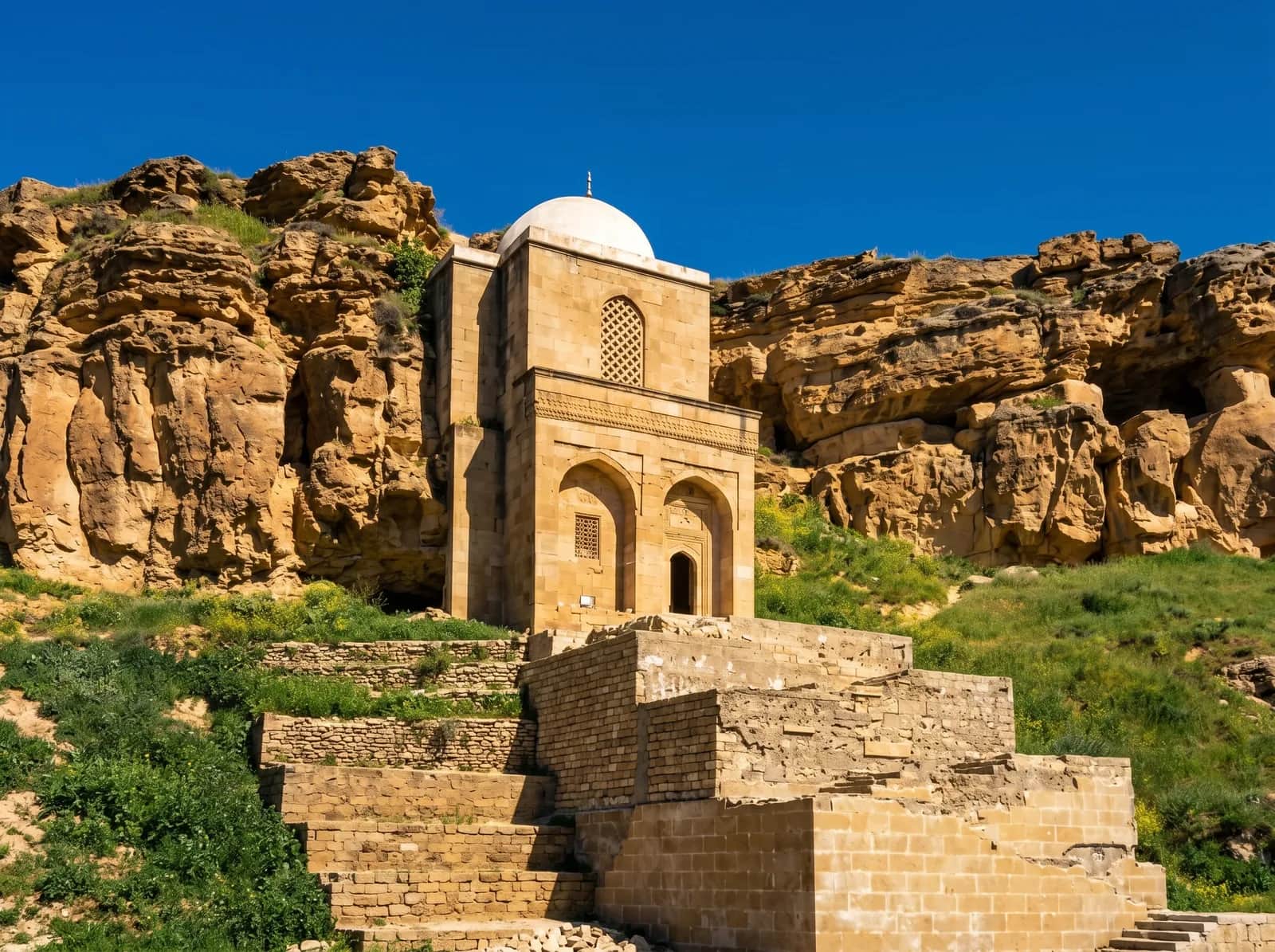
Diri Baba Mausoleum is a two-story rock-cut mausoleum-mosque set into a cliff at Maraza, in Azerbaijan's Gobustan district, on the Baku to Shamakhi road. A dated fragment records its construction in 1402 by order of Shirvanshah Ibrahim I, and it ranks among the finest works of the Shirvan architectural school. A grotto behind the tomb holds the reputed burial of the venerated sheikh known as Diri Baba. Entry for foreign adults rose to 15 AZN on 1 January 2026.
- Region
- Shamakhi
- From Baku
- 95 km · about 1 hour 25 minutes
- Best season
- Spring to autumn
- Time to spend
- 30 to 45 minutes
- Entry
- 15 AZN for foreign adults, checked on iTicket.az 11 August 2026 and up from 9 AZN since 1 January 2026. Local and student rates sit inside an unpublished 3 to 15 AZN band. Sold as a dated iTicket.az session or at the gate.
- Hours
- Daily 09:00 to 19:00 with no day off, read from the iTicket session grid published for 12 August to 30 September 2026 and checked on 11 August 2026.
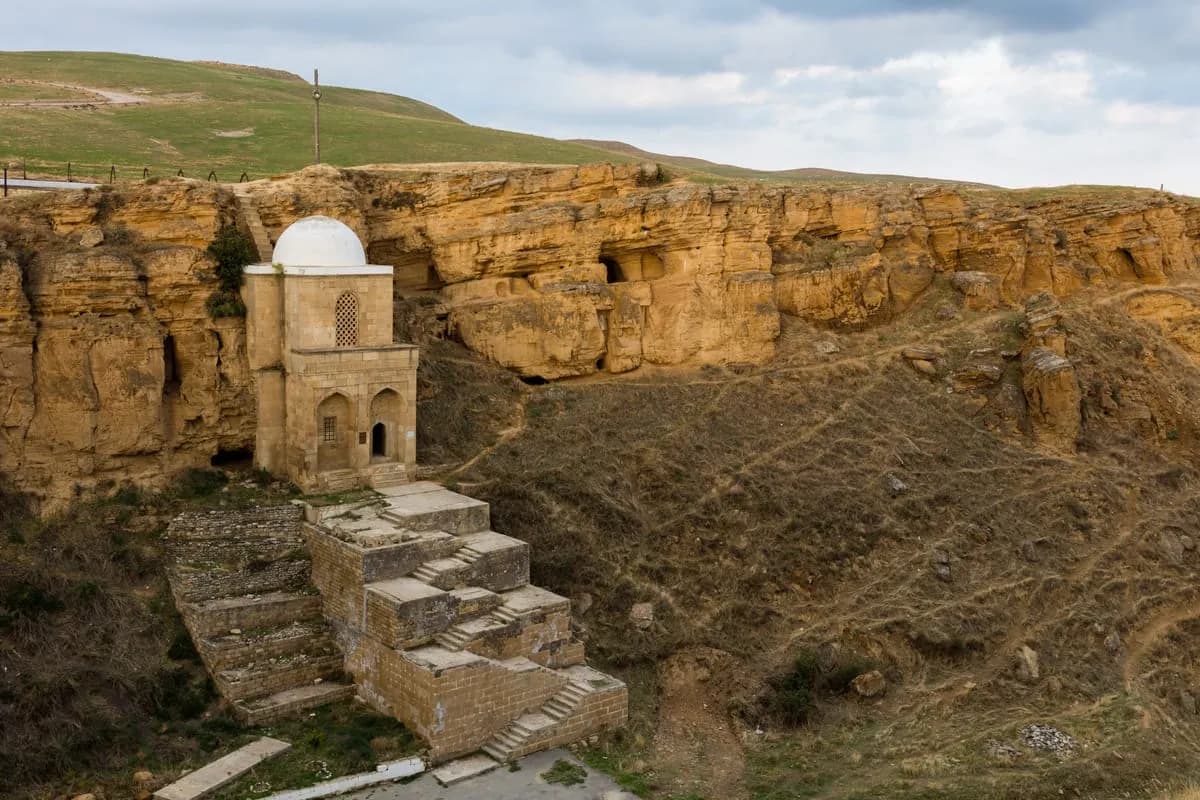
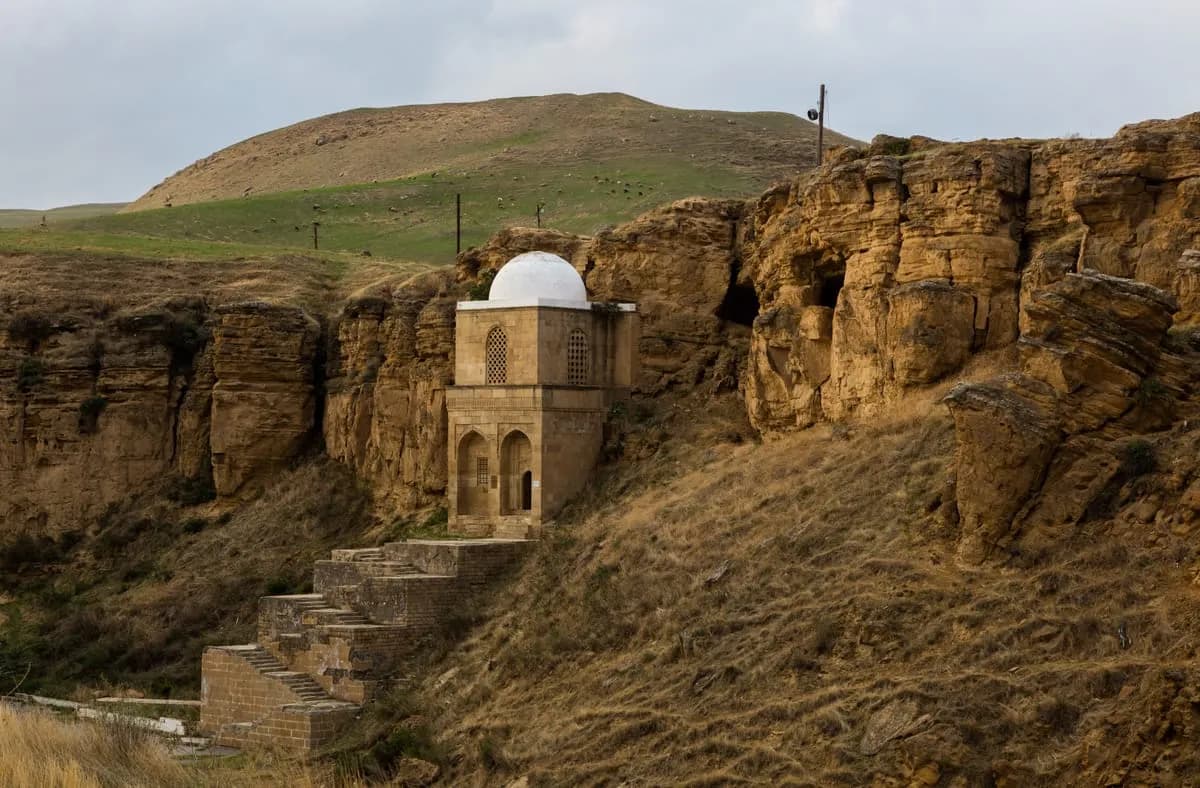
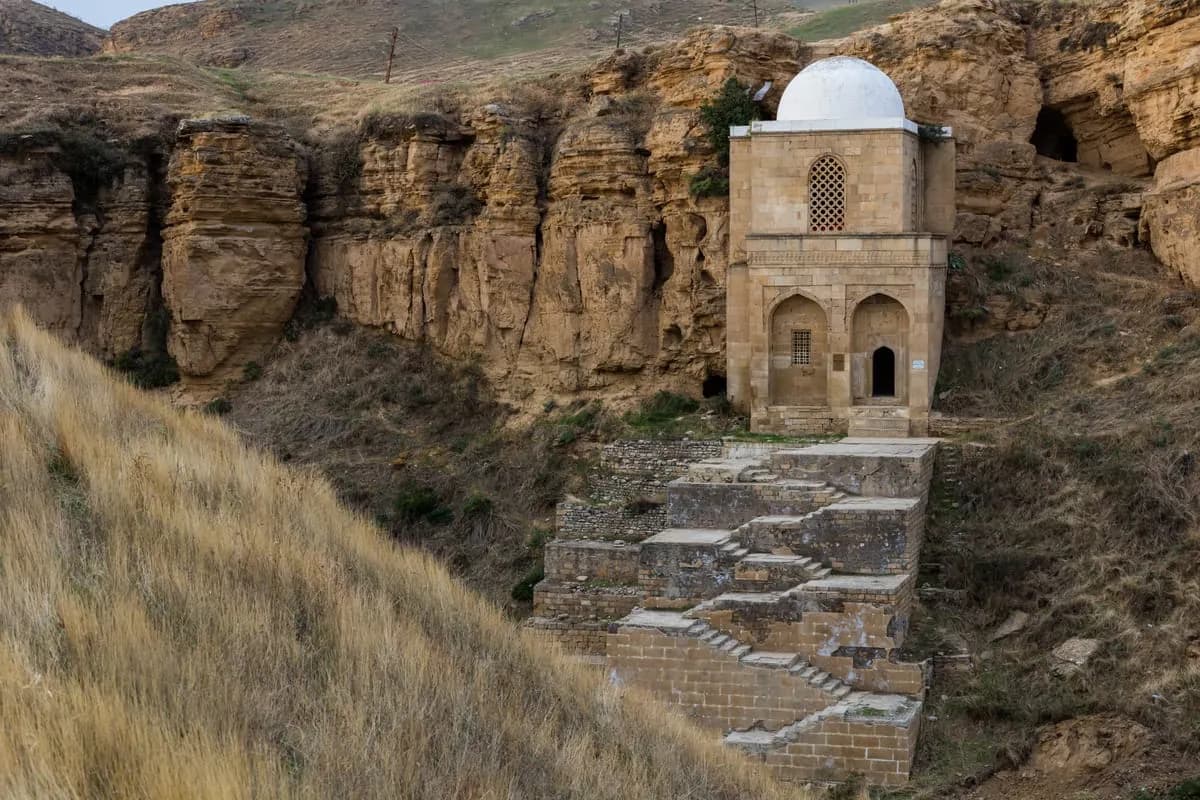
- The whitish stone chamber that reads as fused to the cliff, appearing to hang in the air
- The two-story interior with squinches, an octagonal cupola and carved ornament
- The rock grotto behind the tomb, the reputed burial of the sheikh
- The old cemetery on the slope opposite the mausoleum
- A 09:00 opening, an hour earlier than most Azerbaijani reserves, which suits an early run west
Drivers on the Baku to Shamakhi road often slow down at Maraza without quite knowing why. A small whitish building sits high against a cliff face above a gorge, looking less like it was built there than grown out of the rock. That is the Diri Baba Mausoleum, dated 1402 by its own inscription, 95 km from Baku and 25 km short of Shamakhi. Entry is 15 AZN for a foreign adult and the gate opens at 09:00. Here is what stands there, what it costs in August 2026, and where it belongs in a day heading west.
What is the Diri Baba Mausoleum?
A two-story mausoleum-mosque carved partly into and built partly against a cliff at Maraza. A decorative inscription set between the two floors records the year 805 of the Hijra, which corresponds to 1402, and ties the work to the reign of Shirvanshah Ibrahim I. Architectural historians count it among the finest surviving works of the Shirvan school.
It is a protected national monument rather than a free-standing reserve of its own. Administratively it sits on the balance of the Basqal State Historical-Cultural Reserve, which is why you will not find it under a Shamakhi heading in the state's own lists. That detail matters more than it sounds, because it is the reason the ticketing channel files it somewhere nobody expects.
How much is entry to Diri Baba, and when is it open?
15 AZN for a foreign adult, and daily 09:00 to 19:00 with no day off. We re-read the state ticketing channel iTicket.az on 11 August 2026. The 15 AZN figure is new: foreign-adult entry across the State Tourism Agency's reserve network went from 9 to 15 AZN on 1 January 2026, and local prices did not move.
| Detail | Position on 11 August 2026 |
|---|---|
| Foreign adult | 15 AZN |
| Local adult and student | Not published individually; inside a 3 to 15 AZN band |
| Hours | Daily 09:00 to 19:00, no day off |
| Session calendar checked | 12 August to 30 September 2026 |
| Channel | iTicket.az dated session, or the gate |
Two honest limits on that. The band is real, so we cannot tell an Azerbaijani resident what they will pay at this particular gate, only that it is inside 3 to 15 AZN. And the hours come from the ticketing grid rather than from a reserve page of its own, which is a strong source but not the reserve's own words.
The 09:00 opening is worth planning around. Most of the Absheron reserves near Baku do not open until 10:00, so a group leaving the city at 07:30 can be inside Diri Baba before the day heats up and still reach Shamakhi before lunch.
Where is it, and is it the same Gobustan as the rock art?
No, and this is the single most common mix-up on the western road. Maraza is the main town of Azerbaijan's inland Gobustan district, in the hills 95 km from Baku. The Gobustan rock-art reserve is a separate place 64 km south of Baku, near the Caspian coast. They share a name and nothing else.
The confusion is baked into the booking channel too. iTicket geolocates the Diri Baba listing to "Gobustan city", meaning the town in the inland district, and travellers who search that phrase land on petroglyph content 100 km away in the wrong direction. If someone in your group books their own ticket, tell them to check the map pin rather than the name.
Why is it built into the cliff?
The originality is structural. The architect set the burial chamber directly against the rock so the whole building seems to hang above the ravine, an effect that still surprises visitors who reach the top of the steps. Behind the tomb, a grotto cut into the cliff and reached through a narrow passage in the northern wall is what local tradition treats as the real grave.
The name Diri Baba means the living elder, after a sheikh whose body was believed to have stayed uncorrupted, and the grotto was a place of pilgrimage long before the 1402 building rose around it. The site appears in the accounts of early European and Ottoman travellers, including Adam Olearius and Evliya Çelebi, which puts a foreign visitor at these steps four centuries ago doing roughly what you are doing.
What do you actually see there?
A short flight of steps, the two-story interior with its squinches and octagonal cupola, carved ornament on the stone, and the grotto behind. Outside, the old cemetery spreads across the slope opposite, its weathered headstones part of the same scene. Allow 30 to 45 minutes. There is no museum and no interpretation to speak of.
The building rewards a slow look rather than a long one. It reads best on a clear day, when the pale stone separates sharply from the ochre cliff behind it; in flat overcast light it flattens into the rock and the photographs disappoint. That is a real limitation of the stop and worth telling a group before they climb.
What is the best time of day to visit?
Early morning, in the first hour after the 09:00 opening. The cliff faces so that the low sun catches the white stone while the gorge below is still in shade, which is the contrast that makes the building look suspended. It is also the coolest hour on a summer climb up the steps.
Late afternoon is the second-best window and the one most itineraries actually get, because groups reach Maraza on the way back east rather than the way out. That works, but the light is harsher and the car park is busier. Midday in July and August is the one to avoid: the steps are exposed and there is no shade at the top.
How does Diri Baba fit a day on the Shamakhi road?
It is the first stop, not a detour. Maraza sits directly on the M4 at 95 km, Shamakhi is 25 km further at 120 km, and Yeddi Gunbaz is 1.5 km south of Shamakhi. Three sites, one road, in order, with the same road carrying on to Sheki.
That sequence is how we run it on our 6-day Azerbaijan cultural tour: Diri Baba on the run west, then the Juma Mosque and Yeddi Gunbaz in Shamakhi, then the long pull toward Sheki. It also sets the cost expectation for the corridor, because Diri Baba is the only one of the three with a gate at all. The mosque and Yeddi Gunbaz are both free.
The M4 to Shamakhi is good asphalt the whole way and needs no special vehicle. If you are driving yourself rather than being driven, our guide to driving in Azerbaijan covers the International Driving Permit question and the rental-contract clauses that catch people out on the mountain roads further north.
What we would not recommend
Three things. Do not quote the 9 AZN entry price you will still find on most travel pages. Do not send a self-booking traveller to search "Gobustan" for this ticket. And do not schedule Diri Baba for the middle of a July afternoon.
On the price, the January 2026 increase hit five state reserve sites at once and the internet has largely not noticed. A client who has budgeted 9 AZN and is asked for 15 at the window loses a little confidence in everything else on the itinerary, which is a poor trade for a 6 AZN surprise.
On the search, the two Gobustans are 100 km apart and on opposite sides of Baku. A traveller who buys the wrong ticket finds out at a gate in the wrong district with a two-hour drive between them.
On the timing, the climb is short but fully exposed, and the stop is 30 to 45 minutes of standing still on white stone. Take it early or take it late.
- What is the Diri Baba Mausoleum?
- It is a two-story stone mausoleum-mosque built into a cliff at Maraza, dated 1402 by a surviving inscription and commissioned under Shirvanshah Ibrahim I. A grotto behind the tomb is the reputed burial of a venerated sheikh, and the building is a noted example of the Shirvan architectural school.
- How much is entry to the Diri Baba Mausoleum?
- 15 AZN for a foreign adult, re-checked on the state ticketing channel iTicket.az on 11 August 2026. That is up from 9 AZN: the State Tourism Agency's Reserves Management Center raised foreign-adult entry across its sites on 1 January 2026 and left local prices alone. Local and student rates are not published individually and sit inside a 3 to 15 AZN band.
- What are the opening hours of the Diri Baba Mausoleum?
- Daily 09:00 to 19:00, with no day off. That comes from the iTicket session grid published for 12 August to 30 September 2026, read on 11 August 2026. The 09:00 opening is an hour earlier than the Absheron reserves near Baku, which is useful if you are running west early.
- Where is the Diri Baba Mausoleum located?
- It stands at Maraza, the main town of Azerbaijan's Gobustan district, about 95 km from Baku on the road toward Shamakhi. Note this is the inland Gobustan district, not the Gobustan rock-art reserve south of Baku. The two share a name but sit in different parts of the country.
- Why is it built into the rock?
- The architect set the chamber directly against a cliff face so the building appears fused to the rock and almost suspended above the gorge. A grotto carved into the cliff behind the tomb, reached through a narrow passage, is the part treated as the sheikh's actual burial place.
- Who was Diri Baba?
- Diri Baba, meaning the living elder, was a venerated holy man whose name attached to the site. Local tradition holds his body stayed uncorrupted, and the grotto behind the tomb became a place of pilgrimage. The 1402 building was raised over and around that revered spot.
- Is the Diri Baba Mausoleum a UNESCO World Heritage Site?
- No. It is a protected national monument, held on the balance of the Basqal State Historical-Cultural Reserve, but it is neither inscribed on the World Heritage List nor on Azerbaijan's tentative list. The country's four inscribed properties are the Walled City of Baku, Gobustan rock art, the Historic Centre of Sheki and the Khinalig cultural landscape.
- Can you visit it on the way to Shamakhi or Sheki?
- Yes. Maraza sits directly on the Baku to Shamakhi road, so the mausoleum is an easy 30-minute stop without a detour. Shamakhi is 25 km further on, which puts the Juma Mosque and Yeddi Gunbaz within half an hour of here, and the same road carries on to Sheki.
Tour package
6-Day Azerbaijan Cultural Tour from Baku
Tour package
VIVANT2 Filming Locations & Azerbaijan Highlights: 4 Days
Destination
Juma Mosque of Shamakhi: history, three halls, and how to visit
Destination
Yeddi Gunbaz, Shamakhi: the Seven Domes of the Shirvan khans
Guide
Driving in Azerbaijan: licences, the IDP question, cameras and insurance