Things to do in Sheki: the UNESCO old town, fortress and caravanserais
Sheki · about 4.5 hours via the M2 from Baku
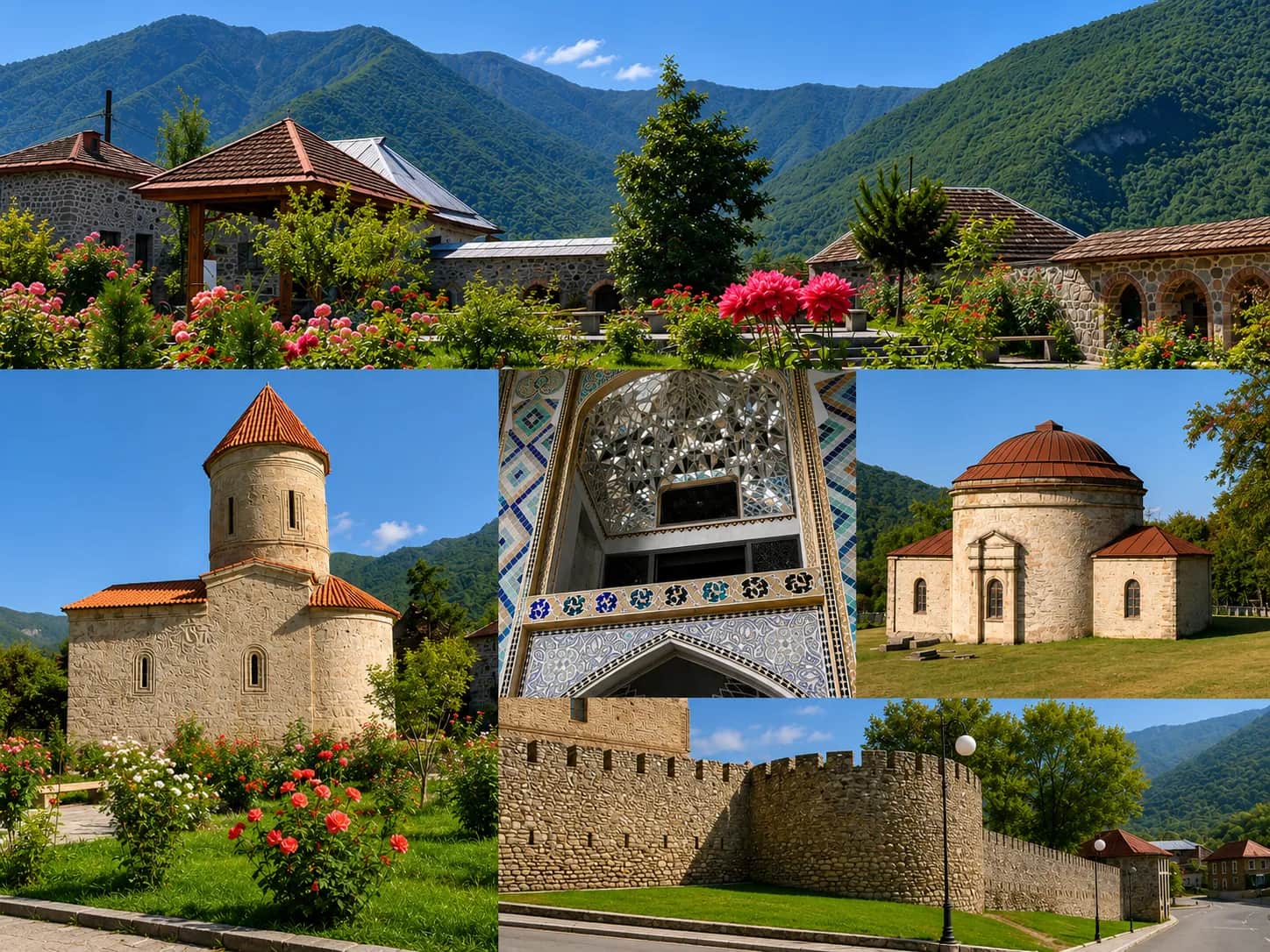
Sheki is a historic silk-trade town in northwest Azerbaijan, in the southern foothills of the Greater Caucasus, about 300 km from Baku by the Shamakhi road or 360 km on the faster M2. Its Yukhari Bash old quarter, fortress, caravanserais and Khan's Palace were inscribed by UNESCO in 2019 as the Historic Centre of Sheki. Called Nukha until 1968, it was rebuilt as a planned garden city after an 18th-century flood.
- Region
- Sheki
- From Baku
- 300 km · about 4.5 hours via the M2
- Status
- UNESCO World Heritage (2019)
- Best season
- Late spring to autumn
- Time to spend
- Half a day
- Entry
- The old quarter and the fortress gate are free to walk through. The Khan's Palace inside the walls is ticketed at 15 AZN for foreign adults since 1 January 2026, sold on iTicket.az or at the palace door.
- Hours
- The quarter is an inhabited neighbourhood with no gate hours. The palace inside it sells daily 09:00 to 19:00 sessions.
- The walled Yukhari Bash old quarter with cobbled lanes and merchant houses
- The mid-18th-century fortress walls and gates that enclose the Khan's Palace
- An 18th-century caravanserai you can walk into or stay overnight in
- Craft workshops for shebeke stained glass and silk
- Sheki halva and the old bazaar
Sheki rewards the long drive north. The town sits high in the southern foothills of the Greater Caucasus, far enough from Baku that day-trippers thin out, and the old quarter has the slow, lived-in feel of a place that earned its money on the Silk Road. Almost all of it is free to walk. The one ticket inside the walls is the Khan's Palace, which went from 9 to 15 AZN for foreign adults on 1 January 2026. Here is what to see, what it costs, how to reach it, and how long to give it.
What is Sheki famous for?
Silk, and then a UNESCO listing. Sheki was a major silk-production centre on the trade route through northwestern Azerbaijan, and that money paid for the merchant houses, mosques and caravanserais standing today. UNESCO inscribed the Historic Centre of Sheki with the Khan's Palace in 2019. The town also names Sheki halva.
The inscription came at the 43rd session of the World Heritage Committee, which was held in Baku, under criteria (ii) and (v). It covers the planned old quarter and the painted palace together, which is why the two pages on this site keep pointing at each other.
There is a second reason people ask for Sheki now, and it comes from one market. Sheki is the one Azerbaijani location named among the eight where the second season of the TBS drama VIVANT filmed from August 2025. Hankyu Travel's Japanese itinerary labels the historic centre one of six filming locations, on its own authority. Who has named which places, on whose authority, and what a trip built around the season involves are set out on our VIVANT in Azerbaijan page.
Do you pay to enter the Sheki old town?
No. Yukhari Bash is an inhabited historic quarter, not a gated site, and the fortress gate is free to walk through. The one ticket inside it is the Khan's Palace, 15 AZN for a foreign adult since 1 January 2026. Craft workshops, the bazaar and the streets cost nothing.
| What | Position, August 2026 |
|---|---|
| Yukhari Bash old quarter and lanes | Free, inhabited neighbourhood, no gate |
| Fortress walls and gates | Free to walk through |
| Khan's Palace | 15 AZN foreign adult, daily 09:00 to 19:00, iTicket.az or the gate |
| Upper Caravanserai | Working hotel; courtyard walk-in, no published tariff |
| Lower Caravanserai | Reported closed for restoration, no reopening date |
| Church of Kish, 15 minutes north | 15 AZN foreign adult, daily 09:00 to 19:00 |
Two of those lines changed this year. The palace and Kish both moved from 9 to 15 AZN for foreign visitors on 1 January 2026, under the same State Tourism Agency decision that raised Ateshgah, Yanar Dag and Diri Baba. Local prices did not move. Most travel pages still quote 9.
Why is the old town a planned "garden city"?
After an 18th-century flood damaged the earlier settlement, Sheki was rebuilt to a deliberate layout on higher ground, and that plan is part of why UNESCO recognised it. The result is Yukhari Bash: a walled quarter of cobbled lanes, brick and river-stone houses, hammams and small mosques climbing the hillside.
The town carried the name Nukha until 1968, when it reverted to Sheki, so older maps and books still use the earlier name. If you are searching for archive photographs, search Nukha.
What is the fortress, and how does it relate to the palace?
The fortress is the walled enclosure around the upper town, raised in the mid-18th century under Haji Chelebi Khan. The Sheki Khan's Palace is the building inside it, not the wall. Reports put the circuit near 1.3 km with around 21 towers, though those figures are only partly confirmed.
Inside the gates you find the palace, a mosque, and the grounds with their old plane trees, all within an easy walk and all free until the palace door.
What are the two caravanserais, and can you go in?
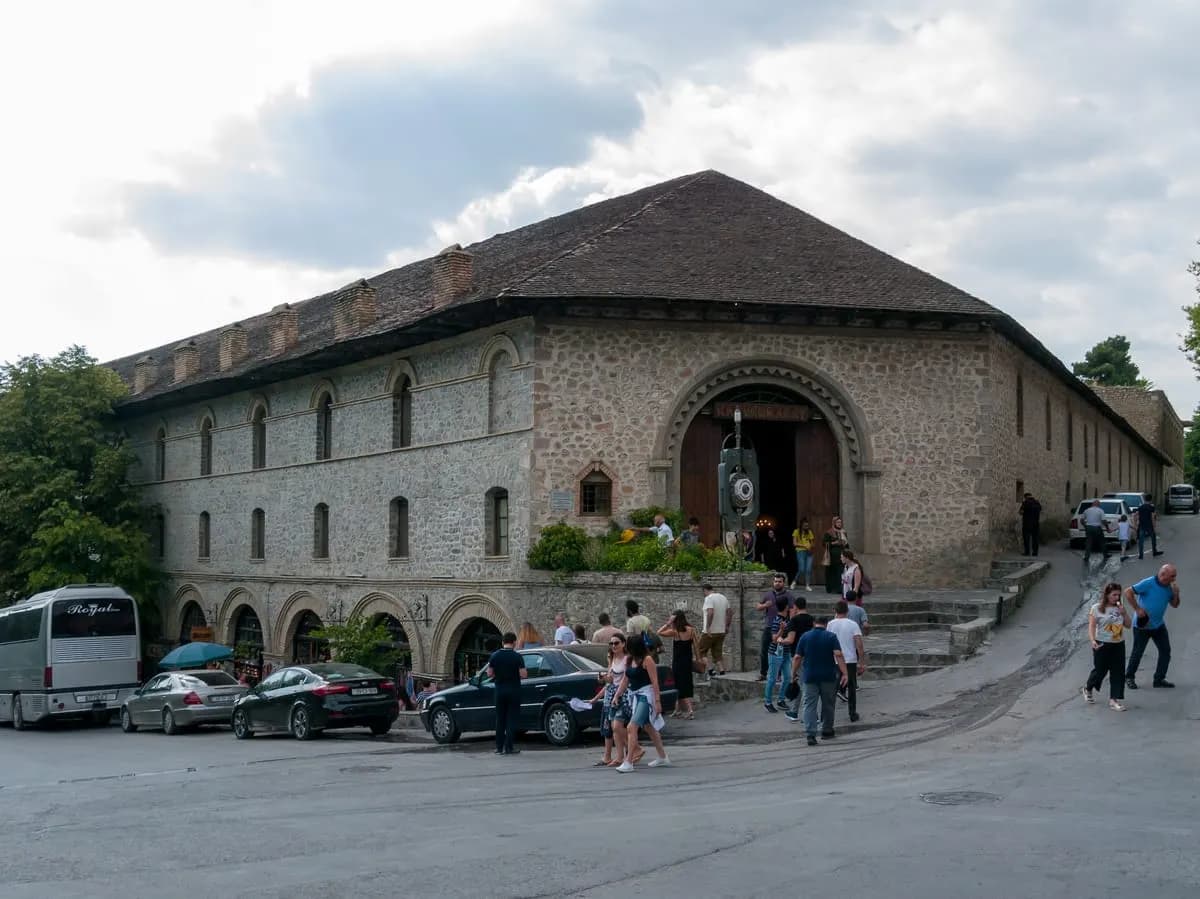
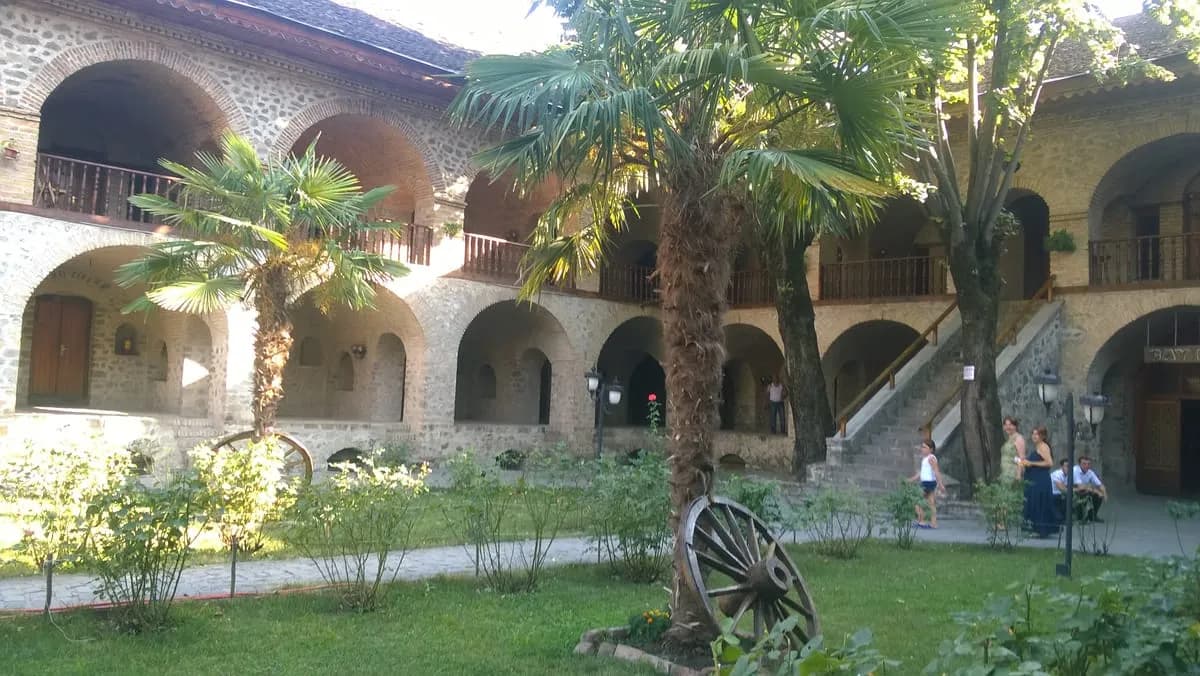
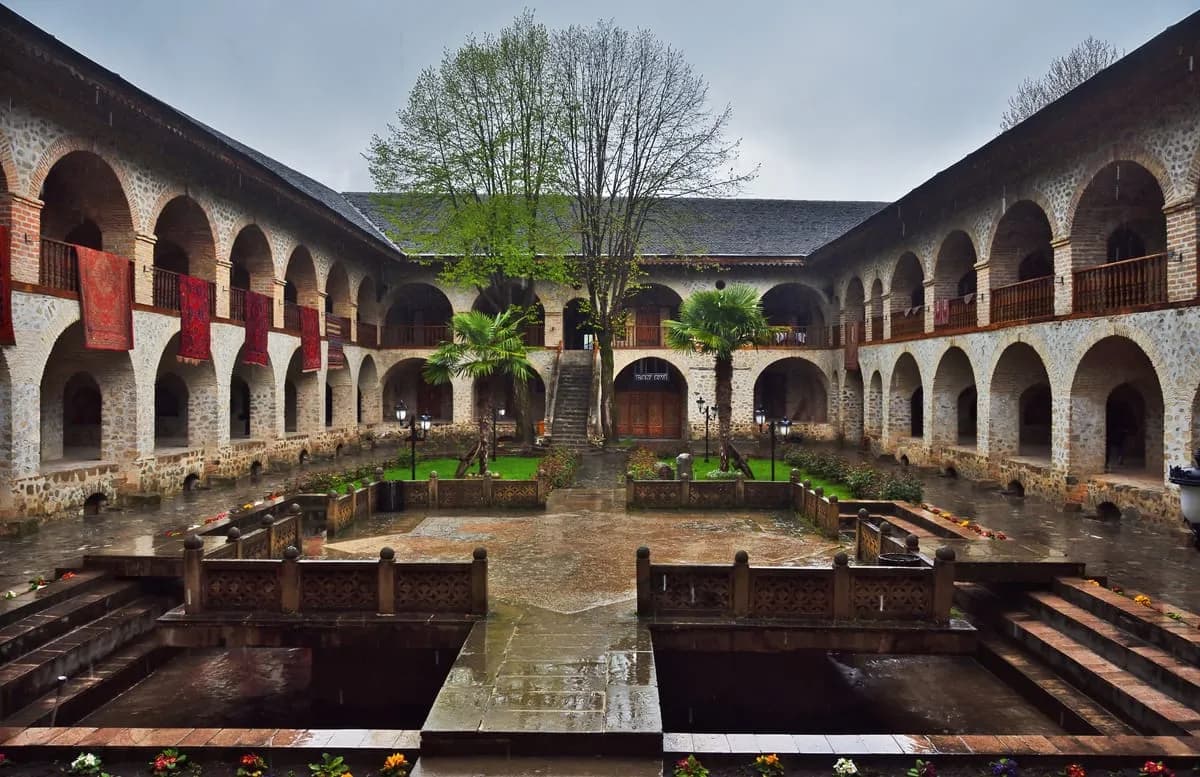
One of them, yes. Sheki keeps two 18th-century caravanserais on Akhundzade Avenue, built for traders crossing between Tbilisi and Baku. The Upper Caravanserai runs as a hotel with a public courtyard you can walk into. The Lower one is reported closed for restoration, with no reopening date published anywhere.
That asymmetry matters for planning. Neither building appears on any state ticket list, so nobody publishes hours or a price for either, and a group arriving with the Lower Caravanserai on the sheet is arriving at a hoarding. We route groups to the Upper courtyard for tea and treat the Lower one as a photograph of a façade.
Is Sheki halva the same as the halva you know?
No, and the confusion costs people a good pastry. Sheki halva is not sesame paste. It is a lattice of fine rice-flour threads layered over a crushed-nut filling, baked, then soaked in saffron-tinted syrup and cut into diamonds. It is sold fresh by the slice across the bazaar.
Buy it warm, eat it there, and do not carry it four hours back to Baku expecting the same thing. Craft workshops in the same lanes keep the older local trades going, shebeke stained glass and silk among them.
How do you get to Sheki from Baku, and how long do you need?
Two roads. The M2 runs about 360 km and takes roughly four and a half hours; the Shamakhi and Gabala road is about 304 km but nearer five, with Diri Baba and Shamakhi on it. Give the town half a day for the palace, fortress and old quarter, a full day with an overnight to add Kish.
The 300 km figure quoted almost everywhere, including the quick facts above, is that second road. Shorter on the map, longer in the car. We use it westbound for the stops and the M2 eastbound to get people home, which is how it sits on our 6-day Azerbaijan cultural tour. Late spring through autumn is the most comfortable window, with the hillside greenest after the snowmelt.
When is the best time of day in the old quarter?
Early. The lanes above the fortress are residential, so between 07:00 and 09:00 you have them to yourself and the light comes down the hillside rather than flattening it. The palace opens at 09:00 and the first coaches out of Baku and Gabala reach town between 11:00 and 14:00.
What else pairs with Sheki?
The Church of Kish a short drive north, tied to ancient Caucasian Albania and open daily 09:00 to 19:00, and the Khalkhal Waterfall in the neighbouring Oghuz district. Khalkhal is routinely placed in Gakh or Zagatala online; it is in Oghuz, and no authority publishes a tariff or hours for it.
What we would not recommend
Two things. Do not attempt Sheki as a day trip from Baku: nine hours in a car for a half-day town puts you in the quarter exactly when everyone else is. And do not plan around the Lower Caravanserai, or around a caravanserai opening time found online, because no official source publishes one.
The day-trip version costs more than the driving. You reach the palace inside the coach window and spend the visit looking at a queue rather than at a wall.
For travellers who want the palace itself in detail, tickets, hours, the photography question and what the shebeke actually is, see the Sheki Khan's Palace page.
- What is Sheki famous for?
- Sheki is known for its UNESCO-listed old town and the Sheki Khan's Palace with its shebeke stained glass. It was a major Silk Road silk-trade centre, and it gives its name to Sheki halva, a layered nut pastry. The 18th-century caravanserais and craft workshops round out the draw.
- Do you have to pay to enter the Sheki old town?
- No. Yukhari Bash is an inhabited historic quarter rather than a gated site, and the fortress gate is free to walk through. The one ticket inside the walls is the Khan's Palace, 15 AZN for a foreign adult since 1 January 2026. The lanes, the bazaar and the craft workshops cost nothing.
- How do you get from Baku to Sheki?
- Two roads. The M2 runs about 360 km and takes roughly four and a half hours. The Shamakhi and Gabala road is about 304 km but nearer five hours, and it carries Diri Baba and Shamakhi. Trains and intercity buses also run, but a car gives you the flexible day the route rewards.
- How many days do you need in Sheki?
- Half a day covers the Khan's Palace, the fortress and the old town. With a full day you can add Kish village and a caravanserai lunch, and an overnight lets you slow down and see the bazaar. Many itineraries give Sheki one night before moving west.
- Where should you stay in Sheki?
- The standout option is the 18th-century Upper Caravanserai, now run as a hotel, where rooms open onto an arcaded courtyard that once held traders' camels. Confirm current rates and availability directly. The old town also has guesthouses and small hotels within walking distance of the palace.
- Are both Sheki caravanserais open?
- One of them. The Upper Caravanserai on Akhundzade Avenue works as a hotel and its courtyard is open to walk into. The Lower Caravanserai is reported closed for restoration with no published reopening date, and no official channel publishes hours or an entry price for either building.
- What is Sheki halva made of?
- Not sesame paste. Sheki halva is a lattice of fine rice-flour threads layered over a crushed-nut filling, baked, then soaked in saffron-tinted syrup and cut into diamonds. It is a different sweet from the tahini halva sold across the Middle East, and it is sold fresh by the slice in the bazaar.
- What else is there to see in Sheki besides the palace?
- Plenty. The fortress walls, the caravanserais, the central Juma Mosque, the bazaar and craft workshops for shebeke and silk all sit in or near the old quarter. Nearby you can add the Church of Kish, about 15 minutes north, and the Khalkhal Waterfall in the Oghuz district.
- Is Sheki worth visiting?
- Yes. It is one of Azerbaijan's most rewarding stops outside Baku, combining a UNESCO old town, the Khan's Palace, living crafts and mountain scenery. The long drive puts off some day-trippers, which keeps it calmer than the capital. Pair it with Kish and the Sheki region for a full two-day loop.
Tour package
6-Day Azerbaijan Cultural Tour from Baku
Tour package
VIVANT2 Filming Locations & Azerbaijan Highlights: 4 Days
Destination
Sheki Khan's Palace: shebeke glass, frescoes, and how to visit
Destination
Sheki Caravanserai: the silk-road merchants' inn, and how to visit
Destination
Church of Kish: the Caucasian Albanian temple near Sheki
Destination
Khalkhal Waterfall: how to visit the Oghuz forest cascade near Sheki