Palace of the Shirvanshahs: the 15th-century royal complex in Baku's Old City
Baku · In central Baku from Baku
The Palace of the Shirvanshahs is the 15th-century seat of the rulers of Shirvan, standing at the highest point of Icherisheher, the walled Old City of Baku, Azerbaijan. It is a group of buildings rather than one palace, laid out over three stepped terraces: the residence and the octagonal divankhana above, the royal burial vault and the palace mosque below them, and the excavated bathhouse at the bottom. It is a component of the World Heritage property UNESCO inscribed in 2000 as the Walled City of Baku with the Shirvanshah's Palace and Maiden Tower, and it works today as a museum inside the Icherisheher state reserve.
- Region
- Baku
- From Baku
- In central Baku
- Status
- UNESCO World Heritage (2000)
- Best season
- Year-round; spring and autumn are kindest on the terraces
- Time to spend
- About 1.5 hours
- Entry
- Ticketed, separately from the Maiden Tower, and paid at the museum desk rather than through iTicket.az. Reserve price table re-read 11 August 2026: 24 AZN foreign adult, 12 AZN foreign child aged 5 to 17, 7 AZN local adult, 3 AZN local student, 2 AZN local child, covering the palace and the treasury together. No combined ticket with the Maiden Tower is published.
- Hours
- Every day, 10:00 to 19:00, with no day off (icherisheher.gov.az, re-read 11 August 2026). The 10:00 to 18:00 and closed-Mondays listings still in wide circulation are out of date.
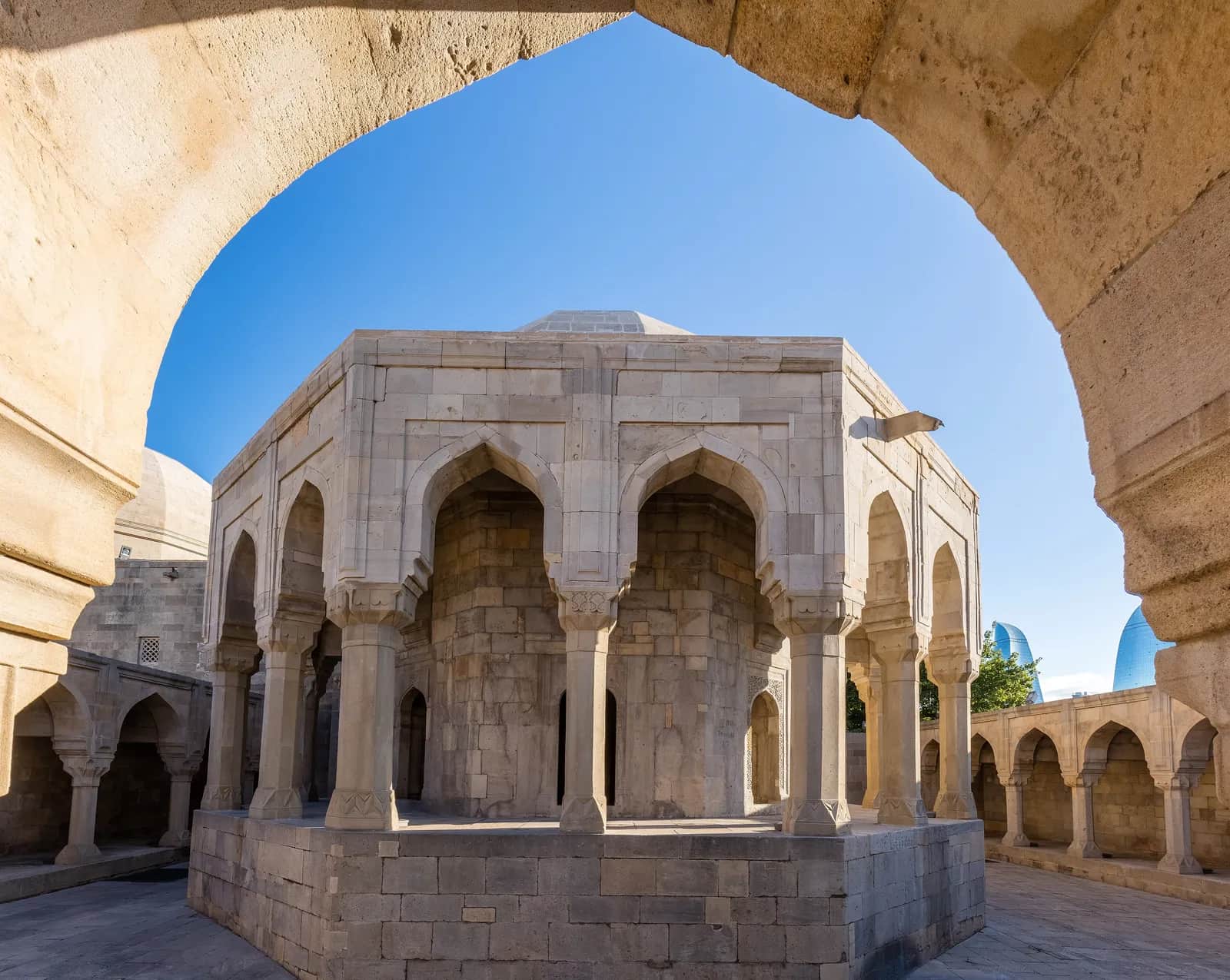
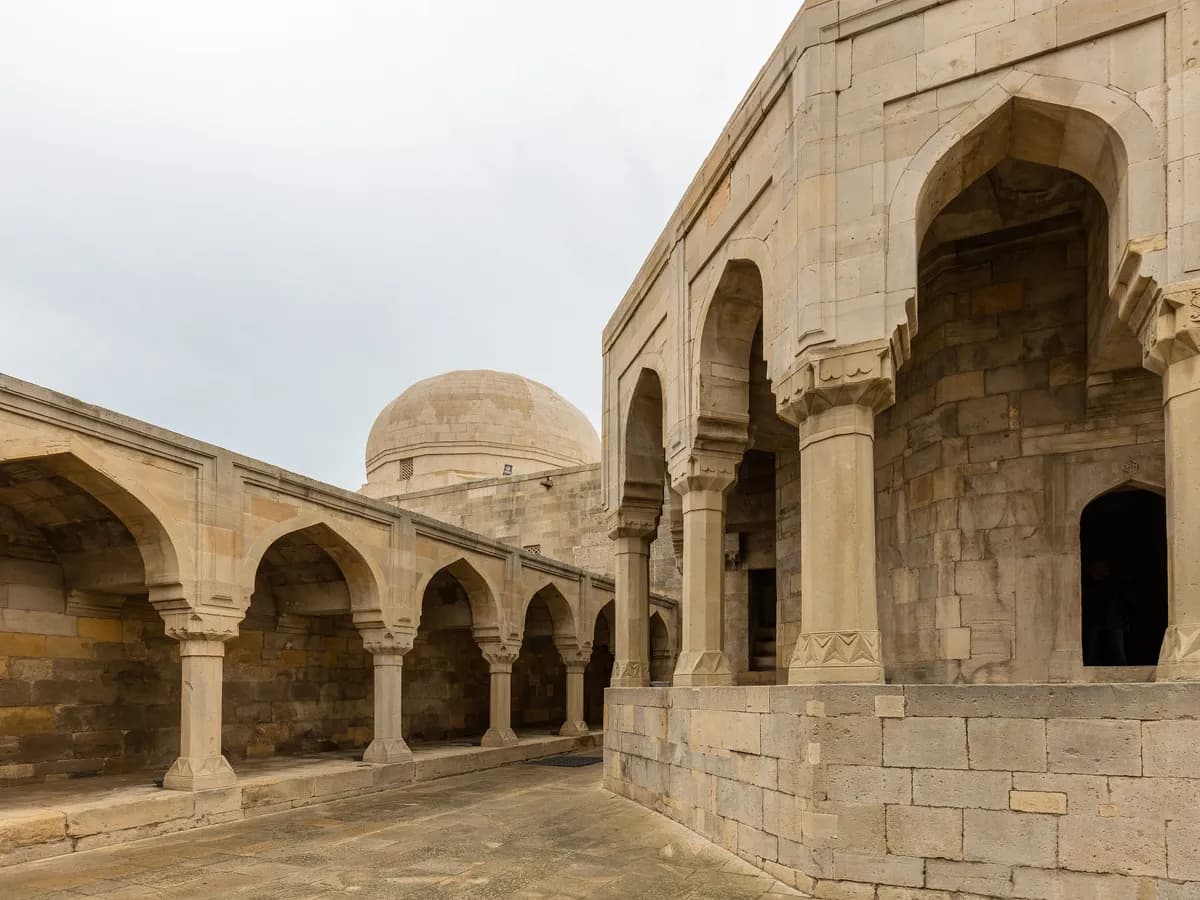
- The divankhana, an octagonal domed rotunda standing free inside its own arcaded courtyard
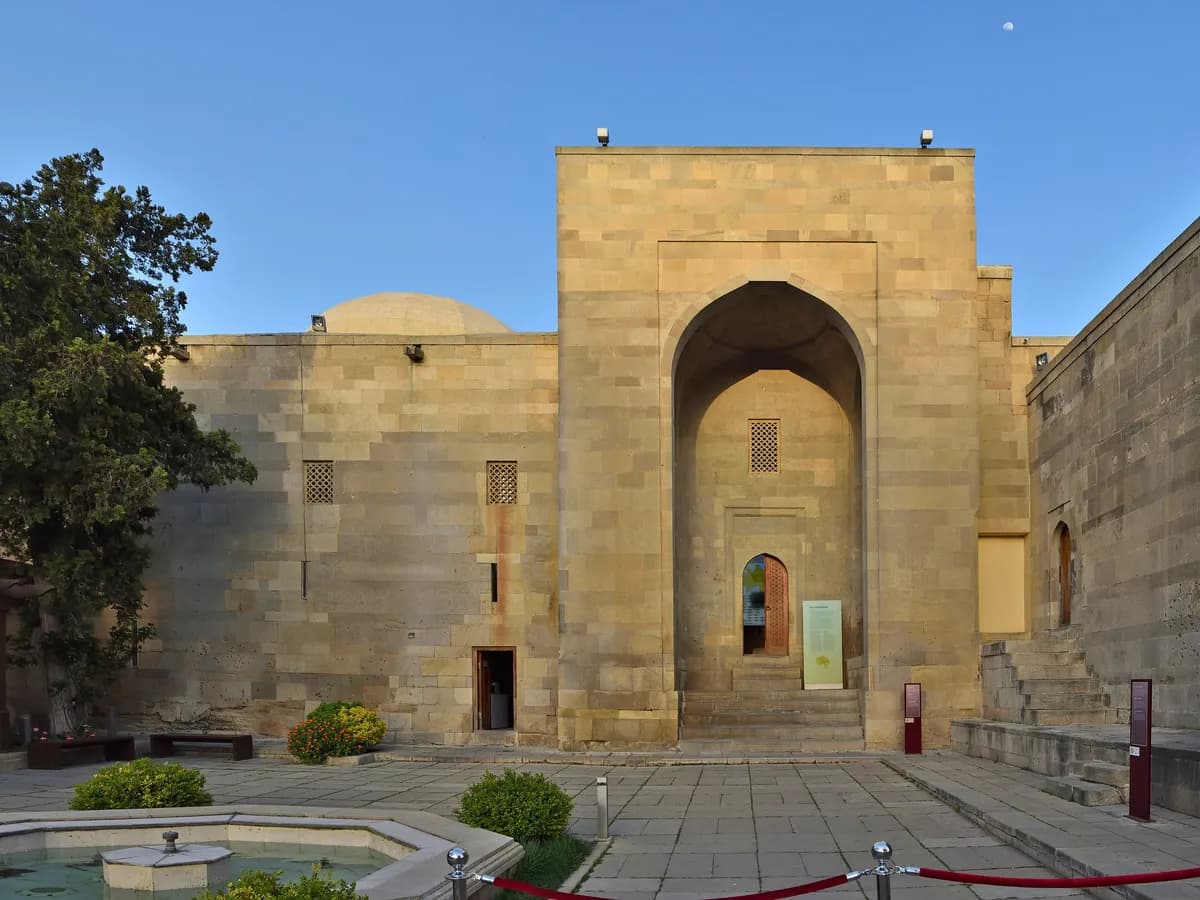
- The burial vault portal, whose inscription dates it to AH 839, 1435 or 1436, and names Khalilullah I
- The minaret of the palace mosque, inscribed AH 845, 1441 or 1442, in the name of the same ruler
- The domed mausoleum of Seyid Yahya Bakuvi, court scholar to Khalilullah I
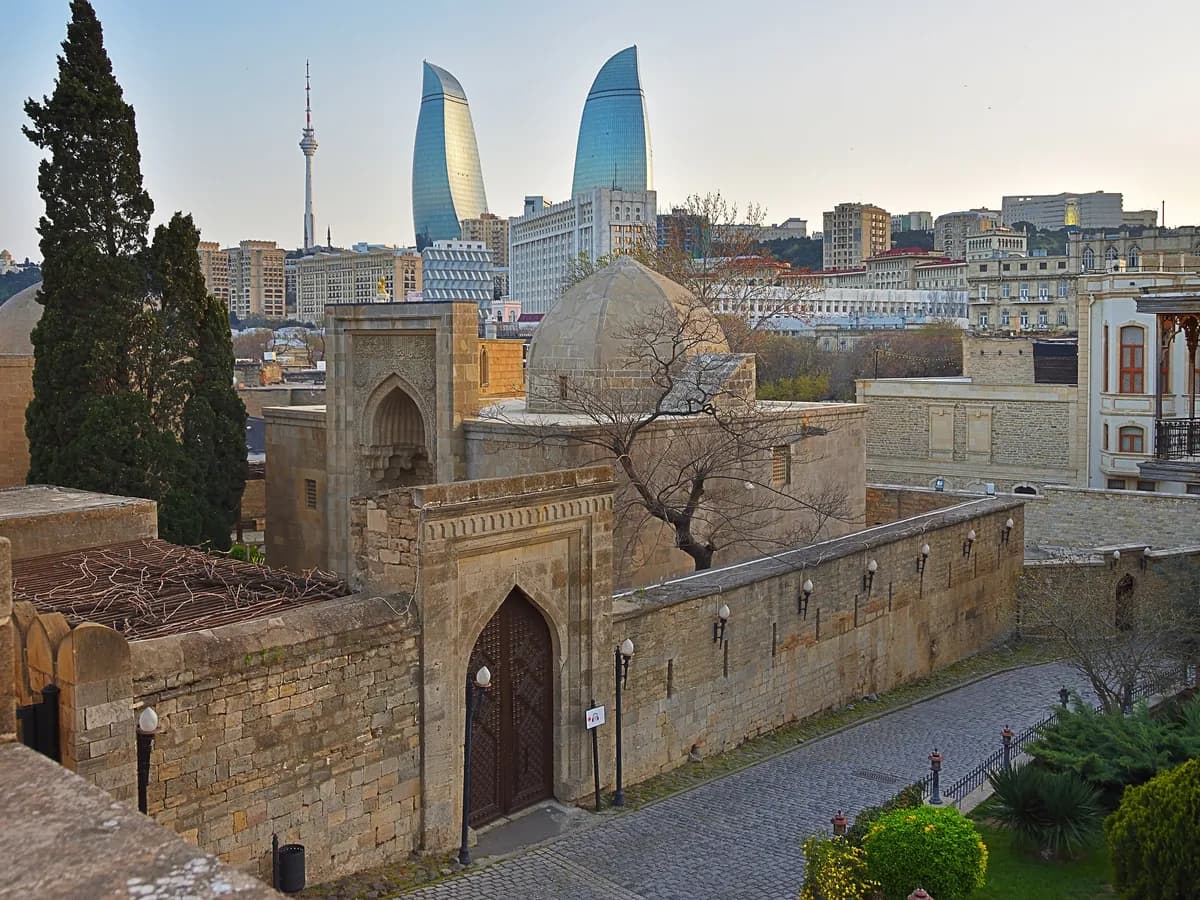
- The Murad Gate of 1585 or 1586, the only 16th-century building in the complex
- The bathhouse, found in 1939 under a vineyard and conserved at its lower wall courses
Most people meet this building as a line on a list. It is the second ticket inside Baku's walled quarter after the Maiden Tower, and it is usually described in one sentence as a 15th-century palace. That undersells it in one specific way: it is not a palace, it is six or seven buildings stepped down a hillside, and the two of them that carry dates carry them in stone. Here is what each part is, which claims about it are attested and which are estimates, and what a visit costs and takes in August 2026.
What is the Palace of the Shirvanshahs?
It is the 15th-century seat of the Shirvanshahs, the rulers of Shirvan, built on the highest ground inside the walled town of Baku. It is a group of buildings across three stepped terraces rather than one palace: the residence and the divankhana above, the burial vault and the palace mosque in the middle, the excavated bathhouse below. It is a museum today.
The Shirvanshahs ruled the region north and west of the Absheron peninsula for centuries from Shamakhi. In the 15th century Shamakhi was finally given up as the capital in favour of Baku, and this complex is what they built when they arrived. ICOMOS, in its evaluation of the World Heritage nomination, describes it as extending over three superimposed terraces, and that is the clearest way to hold it in your head.
The upper terrace has the residence itself, a two-storey block around a courtyard, and the divankhana, an octagonal stone rotunda standing free on a plinth in the middle of its own arcaded court. The middle level holds the burial vault of the Shirvanshahs and the palace mosque with its minaret. Below them again is the bathhouse, which nobody knew was there until 1939, when excavation in a vineyard turned it up and it was conserved at its lower wall courses so you read it as a plan rather than a building. The mausoleum of Seyid Yahya Bakuvi, court scholar to Khalilullah I, stands in what was once the palace cemetery, and the Murad Gate stands apart from all of it.
The palace sits at the top of the hill, which is why ICOMOS notes it is visible from the sea and from the heights around the city. Walk the Old City for an hour and you keep catching its domes above the rooflines.
Which dates on the palace are inscribed, and which are estimates?
Two buildings carry dated inscriptions: the burial vault portal, AH 839, which converts to 1435 or 1436, and the minaret of the palace mosque, AH 845, which is 1441 or 1442. Both name Khalilullah I. Everything else in the complex, including the residence and the divankhana, is dated by style and reign rather than by anything written on the wall.
It is worth knowing which two, because published dates for the rest vary a great deal. The vault was built by Khalilullah I for his mother and his son. ICOMOS gives the mosque as 1441 and the vault as 1434 to 1435, which is close enough to the inscriptions to be the same story told with a different calendar conversion.
The main palace building carries no dated construction inscription at all. Neither does the divankhana: the text over its entrance is a passage from the Qur'an, not a foundation date. So the residence and the divankhana are dated by association with the reigns of Khalilullah I and his son Farrukh Yasar, who was killed in battle in 1501. Some of the divankhana's carving was never finished, and that unfinished state is usually read as the Safavid conquest of that year arriving before the masons did. Treat any single year you see attached to the divankhana as somebody's estimate rather than a reading off the wall.
The one date that is not 15th century belongs to the Murad Gate, inscribed AH 994, which is 1585 or 1586, in the name of Sultan Murad. It is the only 16th-century building in the complex, and it appears to have been the entrance to something that was either never built or has not survived.
The burial vault was excavated in 1945 and 1946. Seven burials were found, and the grave goods went to the Museum of History of Azerbaijan.
Is the Palace of the Shirvanshahs a UNESCO World Heritage Site?
It is part of one, which is a distinction worth keeping. UNESCO inscribed the property in 2000 under the name Walled City of Baku with the Shirvanshah's Palace and Maiden Tower, on criterion (iv). It covers 21.5 hectares with a 12-hectare buffer zone. The palace is named in the title but what is inscribed is the walled city as a whole.
The property spent six years on the List of World Heritage in Danger, from 2003 to 2009, and came off it once conservation work satisfied the committee. Since 2007 the site has been the responsibility of the Icherisheher State Historical-Architectural Reserve Administration, which is the body that runs the palace as a museum today and sets its price.
How much is entry to the Palace of the Shirvanshahs in 2026?
The reserve's own table, re-read on 11 August 2026, gives 24 AZN for a foreign adult and 12 AZN for a foreign child aged 5 to 17, covering the palace and the treasury together. Local adults pay 7 AZN, local students 3 AZN and local children 2 AZN. Tickets are sold at the museum desk, not through iTicket.az.
| Ticket | Published price, August 2026 |
|---|---|
| Foreign adult | 24 AZN |
| Foreign child, 5 to 17 | 12 AZN |
| Local adult | 7 AZN |
| Local student | 3 AZN |
| Local child, 5 to 17 | 2 AZN |
The foreign adult price is up from 20 AZN in the last widely-circulated survey, published in July 2024, and the foreign child price from 9 AZN. Any page still quoting those has not been re-checked in two years. Hours are 10:00 to 19:00 every day, with no day off, which is also a correction: the 10:00 to 18:00 listing and the closed-on-Monday claim that dominate search results are both wrong, and that is the correction that catches out visitors who planned around a Monday closure.
Does the ticket cover the Maiden Tower?
No. The Maiden Tower is a separate museum with its own desk and its own 19 AZN foreign-adult price, and the Icherisheher reserve publishes no combined ticket covering the two. A foreign adult doing both pays 43 AZN. This is the single thing visitors to the walled quarter get wrong most often.
The idea of a combo has an obvious source: the Absheron reserves do sell one, 25 AZN for Yanar Dag plus Ateshgah, valid 72 hours. Those sites sit under the State Tourism Agency and sell through iTicket.az. Icherisheher is an independent administration that sells at its own desks. Two different systems inside one city.
Why is the palace on the VIVANT itinerary?
Because a Japanese tour operator put it there, not because any production source has confirmed a scene was shot here. Hankyu Travel's itinerary labels six sites as filming locations for the second season of the TBS drama, on its own authority. The palace is the sixth. Azerbaijani state media named eight cities and districts and no individual site.
TBS began the second season of VIVANT on 26 July 2026. Filming in Azerbaijan ran from August to the end of October 2025 in Baku, Sumgayit, Ganja, Nakhchivan, Shamakhi, Gabala, Sheki and Guba, with Baku Media Center handling permits, logistics and coordination, as reported by Report.az on 15 November 2025 and by the state news agency AZERTAC the same day. That report names cities and districts. It names no site inside any of them.
Hankyu's page numbers its labels ロケ地1 to ロケ地6, describes the trip as a tie-up with the drama, names no licensor for the labels, and does not say what was filmed at any of the six. A separate piece of Japanese expert commentary, Sasaki Masaaki writing for Yahoo News Japan on 24 July 2026, reports eight locations inside the country and names Sheki; it does not name the palace either.
So the honest position, as of 22 August 2026, has two layers. No production source has confirmed a scene here: neither TBS nor the production committee has named the palace, and Hankyu's label remains the company's own. But since episode 13 aired on 9 August 2026, the fan location database location.la.coocan.jp has placed the episode's ending and the bathhouse scenes at the palace and its hamam ruins with coordinates, loca.ash.jp reads the same scenes the same way, and a travel.co.jp compilation updated on 17 August 2026 ties the same ending to the palace. Coordinate-backed fan identification with travel-media agreement is still inference rather than an announcement, and our episode-by-episode location log records it as exactly that. None of it changes what the building is. It has been the anchor of the Old City for six centuries and it was worth an hour and a half before any of this. Where the named places sit relative to each other is set out on our VIVANT in Azerbaijan page, and the sites our four-day filming-locations tour actually visits are listed there with the same attribution.
How long do you need at the Palace of the Shirvanshahs?
About an hour and a half for all three terraces plus the inside of the divankhana, the vault and the mosque. An hour covers the upper courtyard and the residence. Less than that and you walk past the two buildings whose inscriptions are the reason the complex is dated at all, which is the visit people describe afterwards as old stone.
The terraces mean stairs and uneven cut stone throughout, worth knowing in advance if anyone in the group is unsteady on their feet. There is no step-free route between the upper and lower levels.
When is the best time of day to visit?
Early. The desk opens at 10:00 and the first 45 minutes are the quietest of the day, before the coach groups reach the top of the hill. The upper courtyard has almost no shade, so in July and August a 10:00 start is a comfort decision as much as a crowd one. Late afternoon light on the portal carving is the other good window.
How do you get to the Palace of the Shirvanshahs?
Walk. It is in the middle of Baku, at the top of the Old City, so most people come in through one of the walled quarter's gates and climb. The Icherisheher metro station sits at the main gate below, one stop from the seafront at Sahil, and the walk up through the lanes takes about ten minutes.
Our guide to riding the Baku Metro covers the fare and the card. A car is no help: the lanes inside the walls are narrow, largely residential and restricted for parking. Coming up from the water, the Baku Boulevard side is the gentler approach; the seaward gates are the steeper one.
What we would not recommend
Two things. Do not budget for a combined Old City ticket, and do not arrive at 18:15 expecting a full visit. Closing is 19:00, and 45 minutes on three terraces means seeing the courtyards and none of the interiors.
We would also skip the palace entirely for a group that has only two hours in the walled quarter and a strong preference for views. In that case the Maiden Tower at 19 AZN gives you the rooftop and the Caspian, and the palace can wait for a trip with a proper morning in it. The building rewards time and punishes a rush more than most museums of its size.
Disclosure
Birtour is not affiliated with TBS, with the VIVANT production committee, or with the travel companies selling packaged VIVANT departures. We are a destination management company based in Baku. This page describes the palace complex itself and what is known about its dating.


Frequently asked
- What is the Palace of the Shirvanshahs?
- It is the 15th-century seat of the Shirvanshahs, the rulers of Shirvan, at the highest point of the walled Old City of Baku. It is a complex rather than a single building: the residence and the octagonal divankhana on the upper terrace, the royal burial vault and the palace mosque with its minaret below them, the mausoleum of the court scholar Seyid Yahya Bakuvi, a bathhouse, and a 16th-century gate. It is a museum today, run inside the Icherisheher state reserve.
- How much is entry to the Palace of the Shirvanshahs in 2026?
- The reserve's own price table, re-read on 11 August 2026, gives 24 AZN for a foreign adult and 12 AZN for a foreign child aged 5 to 17, covering the palace and the treasury together. Local adults pay 7 AZN, local students 3 AZN and local children 2 AZN. Tickets are sold at the museum desk, not on iTicket.az.
- Does the Palace ticket include the Maiden Tower?
- No. They are separate museums with separate desks, and the Icherisheher reserve publishes no combined ticket. A foreign adult doing both pays 24 AZN here and 19 AZN at the tower, so 43 AZN in total. The 25 AZN combined ticket travellers have read about covers Yanar Dag and Ateshgah out on the Absheron peninsula, under a different agency.
- What are the Palace of the Shirvanshahs opening hours?
- Every day from 10:00 to 19:00, with no day off, per the reserve's own site re-read on 11 August 2026. The 10:00 to 18:00 hours and the closed-on-Monday claim that dominate search results are both out of date. If you are arriving in the last hour, confirm at the desk rather than trusting any published page.
- Is the Palace of the Shirvanshahs a UNESCO World Heritage Site?
- It is part of one. UNESCO inscribed the property in 2000 under the name Walled City of Baku with the Shirvanshah's Palace and Maiden Tower, on criterion (iv), covering 21.5 hectares with a 12-hectare buffer zone. The palace is named in the property title but is a component of it, not a separate listing. The whole property sat on the List of World Heritage in Danger from 2003 to 2009.
- When was the Palace of the Shirvanshahs built?
- The 15th century, over the reigns of Khalilullah I and his son Farrukh Yasar, who died in battle in 1501. Two buildings in the complex carry dated inscriptions: the burial vault, AH 839, which is 1435 or 1436, and the minaret of the palace mosque, AH 845, which is 1441 or 1442. The main palace building carries no dated construction inscription, so any single year you see printed for it is an estimate.
- Was the Palace of the Shirvanshahs in VIVANT?
- No production source has said so, but fan databases now do. Hankyu Travel's Japanese itinerary labels six sites as filming locations for the second season of the TBS drama, with the palace sixth, on the company's own authority. Since episode 13 aired on 9 August 2026, the fan location database location.la.coocan.jp has tied the episode's ending and the bathhouse scenes to the palace and its hamam ruins with coordinates, loca.ash.jp reads the same scenes the same way, and a travel.co.jp compilation updated on 17 August 2026 ties the same ending to the palace. Those are identifications by fans and travel media, not by TBS or the production. Birtour arranges visits here as part of a Baku itinerary: guide, vehicle and tickets.
- How long do you need at the Palace of the Shirvanshahs?
- About an hour and a half if you walk all three terraces and go inside the divankhana, the burial vault and the mosque. An hour is enough for the upper courtyard and the residence alone. Add it to the Old City rather than treating it as a separate outing, since the walled quarter is free to walk and the palace is at the top of it.
- What is the divankhana?
- An octagonal stone rotunda, open on its sides through pointed arches, standing on a raised plinth in the middle of its own arcaded courtyard on the upper terrace. Its purpose is not settled: a council hall, a court, and a mausoleum have all been argued. The inscription over its entrance is a passage from the Qur'an rather than a date, and some of its carving was left unfinished, which is usually put down to the Safavid conquest of 1501.
Related
Tour package
6-Day Azerbaijan Cultural Tour from Baku
Tour package
VIVANT2 Filming Locations & Azerbaijan Highlights: 4 Days
Destination
Old City of Baku (Icherisheher): walls, Maiden Tower, and how to visit
Destination
Baku Boulevard: the Caspian seafront promenade and what to do there
Guide
How to ride the Baku Metro: fares, BakıKart, and the two halls worth a stop