How to ride the Baku Metro: fares, BakıKart, and the two halls worth a stop
how-to · 12 min read
How the Baku Metro works for a visitor in 2026: a flat 0.60 AZN per journey since 1 October 2025, the BakıKart and QR and contactless ways to pay it, trains from 06:00 to midnight, three colour-named lines and 27 stations, and the two station halls people actually go down to look at. Includes the fare history most pages have not caught up with, and the operator's published rule on photography.
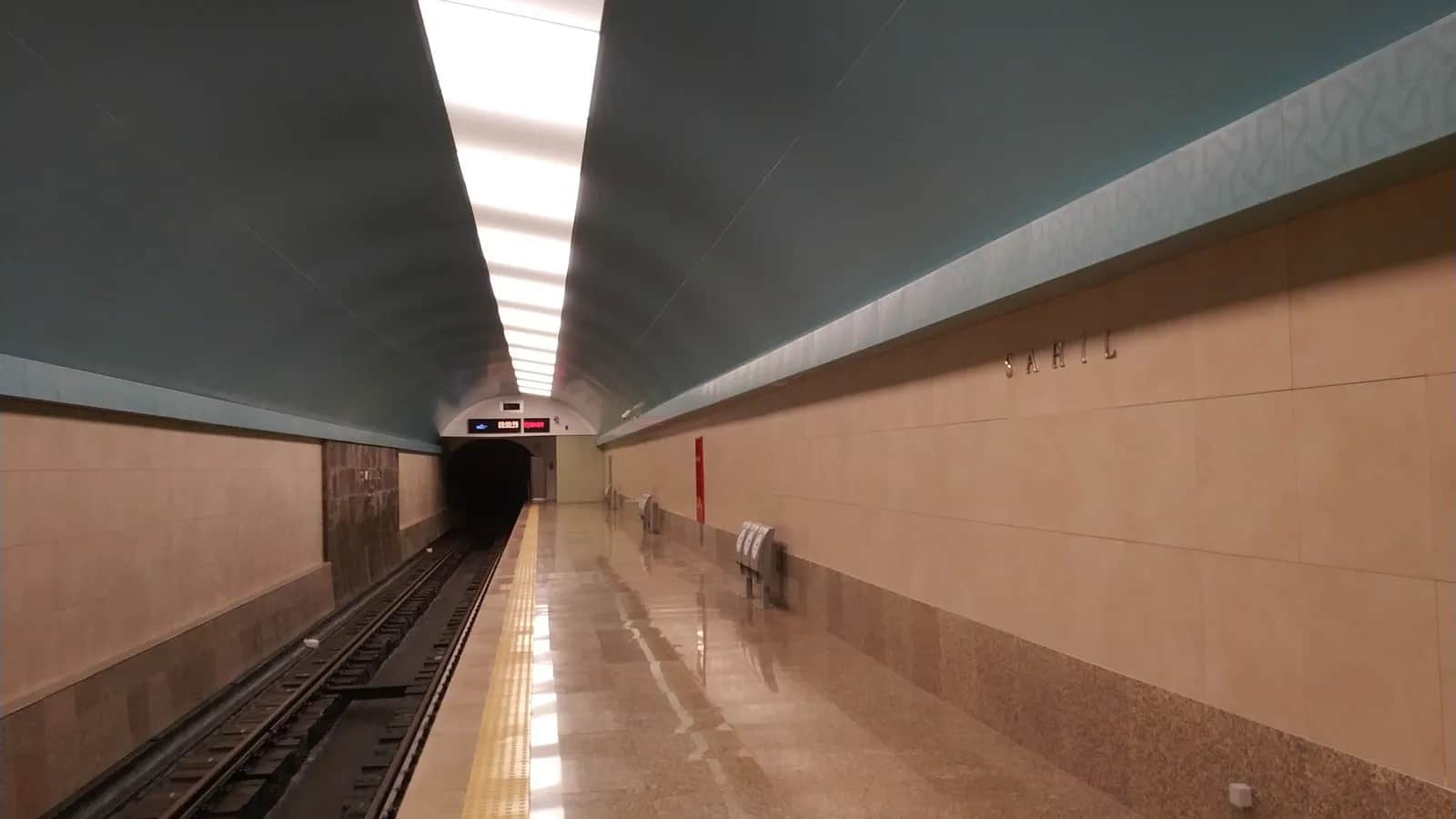

An itinerary sold in Japan lists riding the Baku Metro among six numbered filming locations for a television drama. Putting a commuter railway on a sightseeing list is an odd move, and on its own terms a defensible one. The network opened in 1967, seven of its stations sit deep underground, and one hall is lined with eighteen mosaic panels of scenes from a 12th-century poem. This page covers what a ride costs in August 2026, how you pay for it, which halls are worth stopping in, and the published rule about photography that most travel pages skip.
Why the metro is worth 0.60 AZN of a visitor's time
Two of its halls are built as public art rather than as infrastructure, and standing in either costs one flat fare of 0.60 AZN with no zones and no distance bands. The network is also the quickest way across central Baku in the evening peak. We route groups by vehicle and put clients on the metro for one deliberate leg.
What the Baku Metro is
Bakı Metropoliteni is the underground railway of Azerbaijan's capital, run by a state joint-stock company of the same name. The operator publishes three lines, 27 stations and 40.7 kilometres of route, with seven stations built at depth. Trains first ran on 6 November 1967. Published working time for the network is 06:00 to 00:00.
The operator also describes itself as the first metro in the Turkic and Islamic countries and the Near East, which is its own claim and is worth reading as one. Five stations opened on that first day in 1967. All five are still on the map, though not under all of the same names: the Old City station spent its first forty years as Bakı Soveti and was renamed İçərişəhər by a Cabinet of Ministers decision in April 2007.
Count the stations on the operator's own site and you will get 26, not 27. Memar Ajami is listed once for its green-line platforms and once for its purple-line platforms, which is how the two figures reconcile. If a source hands you 26 stations, it has counted names rather than stations, and neither number is wrong.
Two things about the layout catch visitors out. The lines have no numbers. The operator names them red, green and purple, and route maps that hand out a Line 1 and a Line 2 are applying a convention the operator does not use. And the red and green lines meet on a single level at 28 May, so trains from that station continue along what looks on a map like the other line. Read the destination on the front of the train rather than trusting the platform.
The map is not finished. One further station is due to open during 2026, and design work is close to complete on ten more under the 2025 to 2030 state programme for Baku's transport infrastructure, as reported by the news agency APA citing the Ministry of Digital Development and Transport. Treat that as a plan with a budget behind it rather than a set of opening dates.
How much does a Baku Metro ride cost?
One journey costs 0.60 AZN, flat, with no zones and no distance bands, so a morning of hopping between central stations costs about what a bottle of water does. That figure is the live tariff on Baku Metro's own fare page, which we re-checked on 11 August 2026. It has not always been that number, and the gap between what the fare is and what travel pages say it is has been open for months.
| In force from | Single ride |
|---|---|
| Before August 2018 | 0.20 AZN |
| 1 August 2018 | 0.30 AZN |
| 3 February 2023 | 0.40 AZN |
| 1 July 2024 | 0.50 AZN |
| 1 October 2025 | 0.60 AZN |
The last row is the one that trips people up, and the operator is part of the reason. Its fare-history text still ends at the July 2024 decision that set 0.50 AZN, while the live tariff on the same site reads 0.60 AZN. Believe the tariff. Any guide still quoting 0.50 AZN is describing a fare that stopped applying on 1 October 2025, and if a page quotes 0.50 AZN it is probably stale about the payment methods as well.
How do you pay for it?
Four ways: the BakıKart, a QR ticket, NFC from a local bank card, and Apple Pay or Google Pay at the turnstile. The BakıKart is the reloadable plastic card from the machine in the station vestibule, and it is the one that always works. QR tickets have been accepted at every station and every turnstile since 30 December 2023.
A reusable BakıKart costs 2 AZN according to the airport’s public transport page, checked on 19 September 2026. Buy and load it at a ticket machine; the same card works on the metro and the H1 airport bus. Carry small cash and follow the machine’s displayed payment instructions.
Two rules published by the operator matter more than they look. The same card cannot pass the same turnstile twice within ten minutes, though it can use a different turnstile immediately, which is what you need to know if you are travelling as a couple on one card. And a bank card with no balance is let through once, then blocked until it is topped up, at which point the fare owed comes off and the card works again.
The operator does not say which foreign card schemes are accepted at which gates, and the contactless rollout has been extended line by line rather than switched on everywhere at once. Carry a BakıKart. It costs 2 AZN to be certain, and it carries over to the buses: the card has been part of the integrated transport payment system since August 2015 and works on BakuBus, which is why the H1 from the airport takes the same card as the metro.
Which halls are worth going down for
Two: Nizami on the green line and İçərişəhər at the western end of the red. Nizami holds 18 mosaic panels from Nizami Ganjavi's Khamsa; İçərişəhər is a 2008 glass and metal pyramid built to the height of the Old City walls. Both are worth a stop on the way to something else rather than a trip of their own.
Nizami opened on 31 December 1976. It is a deep-level station designed by the architect Mikayıl Huseynov, and its middle hall carries a portrait of Nizami Ganjavi in mosaic against a background of sun rays, with 18 panels along the pylon walls illustrating scenes from the poet's Khamsa. The panels are the work of Mikayıl Abdullayev. The operator lists the scenes by name, from the death of Dara through Leyli and Majnun to Farhad on Mount Bisitun. A fragment of Uzeyir Hajibeyli's setting of Nizami's ghazal "Sənsiz" plays as trains come in.
İçərişəhər is the one you will use anyway. Its interest is above ground and after 2008 rather than Soviet: the reconstruction reopened on 29 December 2008 with an entrance built as a pyramid of metal and clear glass, and the upper hall stands 14 metres high, matched to the height of the Old City fortress walls next to it. Sixteen panoramic views of old Baku, made in France, are mounted in the middle hall and along both platform walls, and a sculpted fragment of the fortress wall carries the station name. The escalators have a lifting height of 45 metres, which is the only vertical figure the operator publishes for the station. That is escalator rise, not platform depth. We have found no published depth in metres for any station in Baku, so we are not printing one.
Why the metro is on the VIVANT itinerary
Because a Japanese tour company put it there. Hankyu Travel's trip page numbers six sites as filming locations and the fourth of them is riding the metro in Baku. Those labels are Hankyu's own. The production side named eight regions, Baku among them, and named no station. We are not going to guess which platform for you.
TBS began the second season of the drama VIVANT on 26 July 2026. Filming in Azerbaijan ran from August to the end of October 2025 in Baku, Sumgayit, Ganja, Nakhchivan, Shamakhi, Gabala, Sheki and Guba, with Baku Media Center handling permits, logistics and coordination, as reported by Report.az on 15 November 2025 and by the state news agency AZERTAC the same day. Baku is named. No station is. Separately, Sasaki Masaaki writing for Yahoo News Japan on 24 July 2026 reports eight locations inside the country and names Sheki; that column does not mention the metro at all.
Hankyu's page labels its six sites ロケ地1 to ロケ地6, and the fourth is riding the metro in Baku, described there as heavy Soviet-era stations. Their page states a tie-up with the drama, names no licensor for the labels, and does not say what was filmed at any of the six. No source we have found names a station.
So the honest version is short. A tour company has put the metro on a list of filming locations on its own authority; nobody has said which platform, and we are not going to guess for you. What we can tell you is that a station hall which is genuinely worth seeing costs 0.60 AZN to stand in. The regions that were named, and how far apart they are, are set out on our map of the eight VIVANT filming regions.
What the rules say about photographs
Item 5.20 of Baku Metro's published prohibitions bans taking photos, video or film without the permission of the Baku Metro administration. That is on the operator's own site, in both Azerbaijani and English, and it was live when we re-checked on 11 August 2026. Assume it applies to you and ask staff first.
We are deliberately not telling you how that plays out in practice for a phone camera. Every account of enforcement we found sits in forum threads and blog comments, which is not a source we will put our name to on a page about somebody else's rules. If photographs in the Nizami hall are the reason you are going down there, ask the staff at the vestibule or write to the operator first, and note that the same rule is why any film crew working in the network would have needed the administration's permission.
What we would not recommend
Do not put a group of twenty with luggage through a turnstile at 08:30. Do not plan an airport transfer around the metro, because the network does not reach the airport. Do not rely on a card issued outside Azerbaijan as your only way through the gate. And do not photograph freely on the strength of a blog post that says nobody minds.
The group rule is the one we enforce on our own programmes. Published ridership for 2024 runs to 229.6 million journeys, a daily average of 627,279, figures collected from the operator on the network's Wikipedia entry rather than on a page of the operator's own. A morning peak carrying that load is not a place to count heads and hand out cards. We route arrivals and day programmes by vehicle and put clients underground for one deliberate leg, usually İçərişəhər to Nizami and back up, with a guide who has already dealt with the tickets.
We would also not send a visitor down purely to photograph a hall. The rule above says permission, the enforcement picture is unresearchable, and a guide who is standing there to be asked is worth more than a rumour about how relaxed the staff are.
How a metro ride fits a day in Baku
İçərişəhər station puts you at the walls of the Old City, one stop from the seafront at Sahil. From the gate it is an uphill walk of a few minutes through the lanes to the Palace of the Shirvanshahs at the top of the quarter, so the metro is a reasonable way to arrive at both.
For the Nizami mosaics, the practical route is to change at 28 May, the station that also connects to the Central Railway Station and is the city end of the H1 Airport Express. If you are coming in from the airport, that bus and its BakıKart fare are covered in our Baku airport transfers guide.
For operators and planners building a Baku day around one underground leg rather than a full metro tour, the pairing that has held up for us is a morning at the Old City gate and a single ride out to Nizami before lunch. Anything more than that and you are selling a commuter railway as an attraction, which it will not carry.
Disclosure
Birtour is not affiliated with TBS, with the VIVANT production committee, or with the travel companies selling packaged VIVANT departures. We are a destination management company based in Baku. This page describes a public transport network and what it costs to use, and we have no commercial relationship with its operator.
Frequently asked
- How much does the Baku Metro cost?
- One journey costs 0.60 AZN, and the fare does not change with distance. That is the live figure on Baku Metro's own fare page, which we re-checked on 11 August 2026. A reusable BakıKart costs 2 AZN on top of the fares you load onto it, bought from the machines in the station vestibule.
- Did the Baku Metro fare go up?
- Yes. The single ride went from 0.50 to 0.60 AZN on 1 October 2025, in the same decision that moved bus fares. Any page still quoting 0.50 AZN is out of date, including the fare-history text on the operator's own site, which stops at the July 2024 change. The live tariff on that same site reads 0.60 AZN.
- How many stations does the Baku Metro have?
- Twenty-seven, on three lines over 40.7 kilometres of route. The operator's own station selector lists 26 names, because Memar Ajami appears once for its green-line platforms and once for its purple-line platforms. One further station is planned to open during 2026.
- Can you pay for the Baku Metro with a bank card?
- The operator's NFC page lists payment by any local bank card that supports NFC, plus Apple Pay and Google Pay, at the turnstiles. It does not say which foreign card schemes work at which gates, so carry a BakıKart as a fallback rather than counting on your card from home. Turnstiles also take QR tickets, at every station since 30 December 2023.
- What are the Baku Metro opening hours?
- Baku Metro publishes its working time as 06:00 to 00:00. Individual first and last train times per station are published as separate schedules on the operator's site, which is worth checking if you are relying on Bakmil or Xocəsən late in the evening.
- Which Baku Metro station is the Old City?
- İçərişəhər, the western terminus of the red line, with its single exit at İstiqlaliyyət Street 2 by the walls. It opened on 6 November 1967 under the name Bakı Soveti and was renamed İçərişəhər in April 2007. The glass and metal pyramid over the entrance is built to 14 metres, the height of the Old City fortress walls.
- Which Baku Metro station has the mosaics?
- Nizami, on the green line, opened 31 December 1976. Its underground hall holds 18 mosaic panels of scenes from Nizami Ganjavi's Khamsa, plus a mosaic portrait of the poet against sun rays, by the artist Mikayıl Abdullayev. The station was designed by the architect Mikayıl Huseynov.
- Can you take photos in the Baku Metro?
- Not without permission. Item 5.20 of Baku Metro's published prohibitions bans taking photos, video or film without the permission of the Baku Metro administration. We are not going to tell you how strictly that is enforced on a phone camera, because we have found no source on enforcement that we would put our name to. Assume the rule applies to you and ask staff if it matters to your trip.
- Is there a metro to Baku airport?
- No. The network does not reach Heydar Aliyev International Airport. The H1 Airport Express bus connects the airport to the 28 May metro station by the Central Railway Station, and it also takes a BakıKart, because the card has covered BakuBus as well as the metro since it was introduced in August 2015.
Related
Destination
Old City of Baku (Icherisheher): walls, Maiden Tower, and how to visit
Destination
Palace of the Shirvanshahs: the 15th-century royal complex in Baku's Old City
Guide
Baku airport to the city: the H1 bus, Bolt, taxis, and private transfers (2026)
Guide
The eight VIVANT filming regions: distances, drive times and how they connect