Gobustan Mud Volcanoes: cold mud cones and how to visit from Baku
Gobustan town · about 1 hour 20, per the complex's own figure from Baku
The Gobustan mud volcanoes are a field of small geological cones south of Baku that erupt cold grey mud, water and methane rather than lava. Since 2024 the visited field has been managed as the Mud Volcanoes Tourism Complex, with its own gate, its own ticket and its own access road off the E119, and it is not part of the neighbouring UNESCO rock-art site.
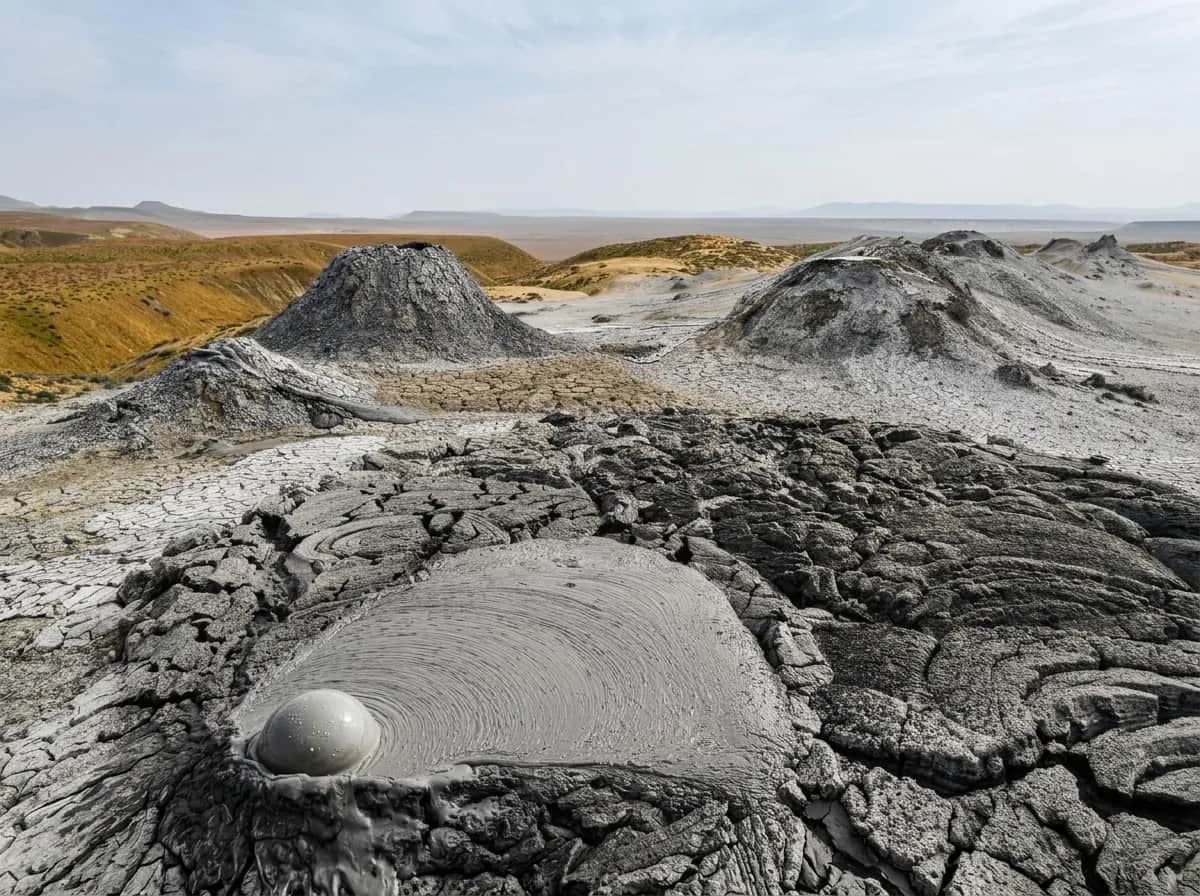
- Region
- Gobustan
- From Baku
- 70 km · about 1 hour 20, per the complex's own figure
- Best season
- Spring and autumn
- Time to spend
- About 1 hour at the field
- Entry
- Ticketed. Checked 11 August 2026: iTicket.az publishes a 3 to 15 AZN band by visitor category without breaking out the split, and the ticket covers the info room and museum. Also sold inside the 35 AZN three-site combo with Ateshgah and Yanar Dag, valid 72 hours from first use, one person, non-refundable.
- Hours
- The complex's own site publishes daily 10:00 to 19:00 with no day off; iTicket.az sells sessions running to 20:00. Both checked 11 August 2026, and the two channels disagree, so plan against the 19:00 close
- Clusters of knee-to-waist-high grey cones that bubble and burp cold mud
- A bare, lunar-looking plateau of cracked grey clay with views toward the Caspian
- The 2024 Mud Volcanoes Tourism Complex, with an info centre, museum and a managed circuit
- Electric quad bikes and golf carts for hire at the info centre for the last stretch to the cones
- A 35 AZN combined ticket with Ateshgah and Yanar Dag, valid 72 hours from first use
A lot of visitors picture lava when they hear "volcano" here, and that is the first thing to set straight. The cones at Gobustan are cold. They push up grey mud, water and methane gas, not molten rock, and the field looks more like a patch of another planet than anything fiery. The second thing to set straight is how you get there, because the advice most people arrive with was written before 2024. Here is what the site is, what it costs and when it opens in August 2026, and how it fits with the rock art down the road.
What are the Gobustan mud volcanoes?
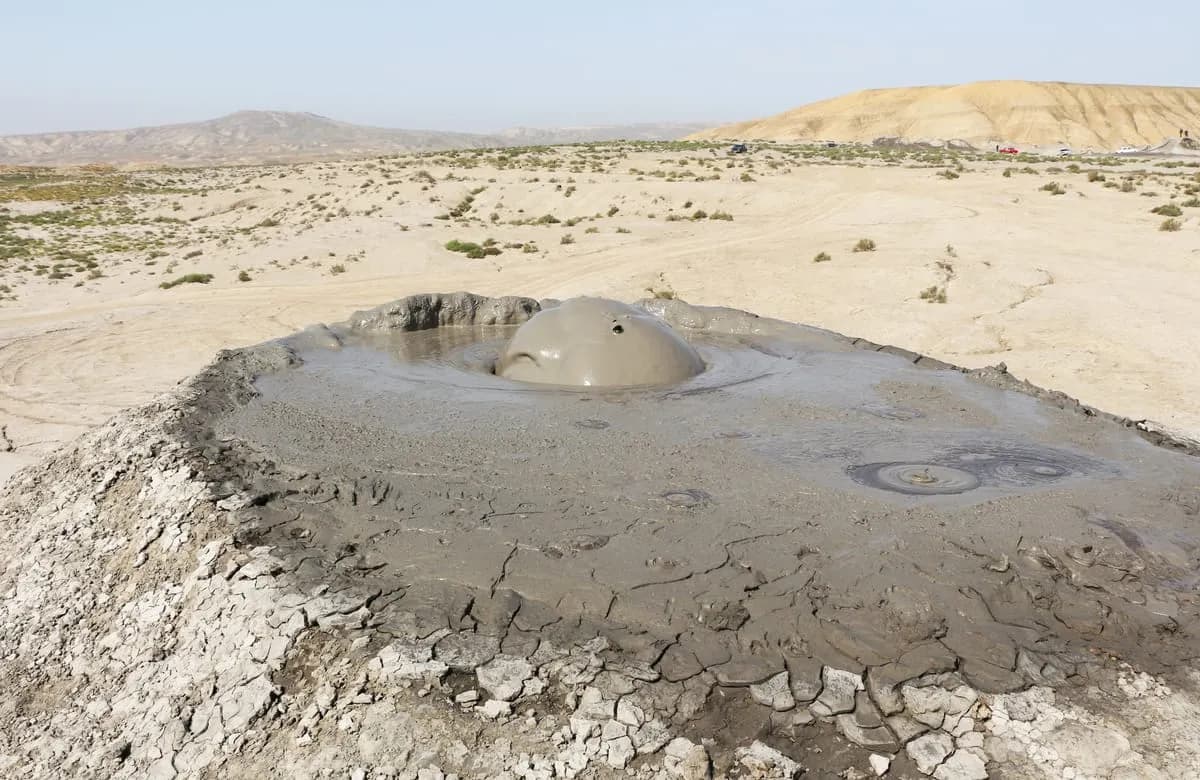
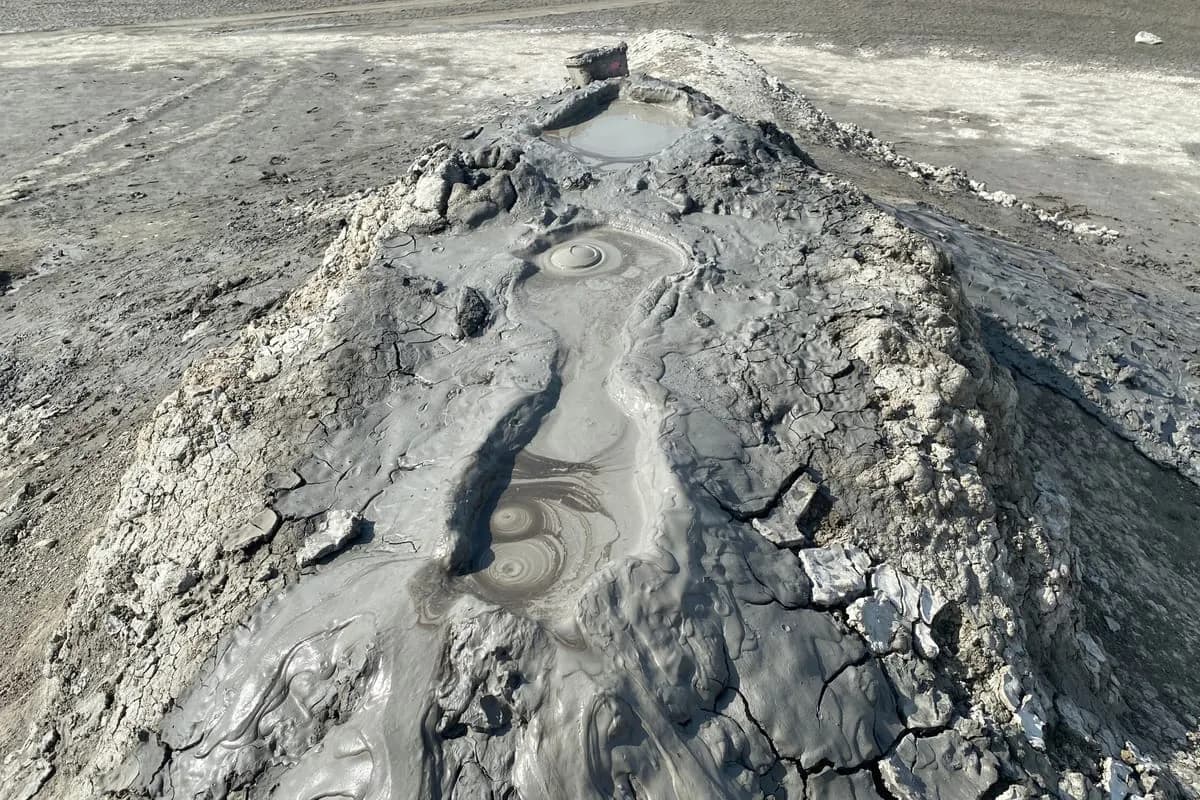
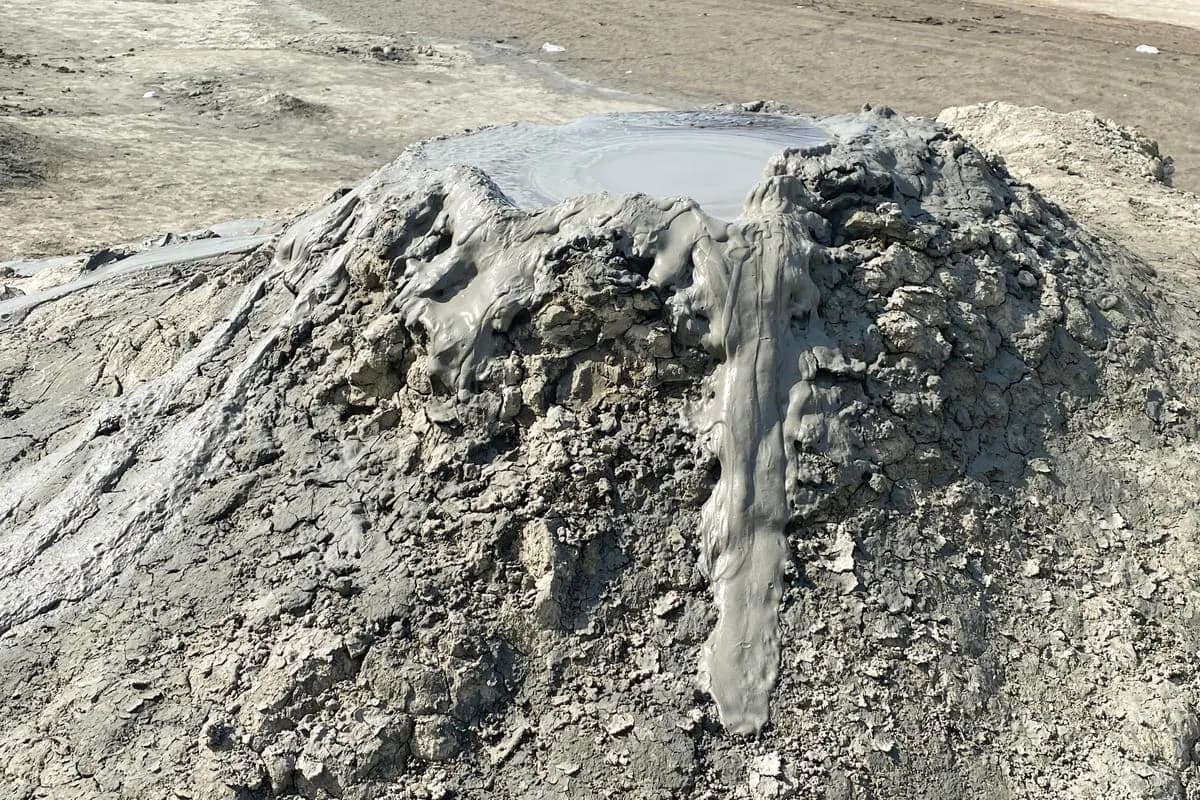
They are geological cones, not igneous volcanoes. Underground pressure forces a cold slurry of clay, water and gas to the surface, where it dries into low cones that bubble, gurgle and occasionally burp. Most stand knee to waist high. The gas is mostly methane, which on rare occasions ignites, though what you see is slow cold mud.
Azerbaijan holds one of the highest concentrations of mud volcanoes on earth, with hundreds onshore and more out under the Caspian, and the Gobustan area is the easiest place to stand next to one. Since 2024 the visited field has been managed as the Mud Volcanoes Tourism Complex, with an info centre, a small museum and a marked circuit.
How do you get to the mud volcanoes from Baku?
South on the E119, past the turn for the Gobustan rock-art reserve. The complex publishes about 80 km and roughly 1 hour 20 from Baku, and says a personal vehicle reaches the site. Electric quad bikes and golf carts are rented at the info centre for the last stretch. No bus goes there.
That is the correction worth carrying, because the received wisdom on this site is a decade out of date. For years the drill was to stop at a turn-off near the reserve, hand cash to a driver waiting with a battered Lada or a UAZ, and be bounced across open track to the cones. Plenty of tour pages, our own included in places, still describe the day that way. The 2024 complex changed it: there is now a gate, a ticket, a car park and a managed circuit, and the Soviet-shuttle stage is no longer the only way in. If you have booked a tour that promises the old off-road ride, ask what vehicle actually turns up.
One honest gap. The quick-facts panel on this page still carries the older 70 km figure while the complex's own site says roughly 80 km. We have flagged that for re-measurement rather than quietly overwriting it. Plan your timing against the operator's 1 hour 20.
We run the field on the same morning as the carvings in our 6-day Azerbaijan cultural tour, and as a 7-hour day tour from Baku that adds Ateshgah and Yanar Dag in the afternoon with every admission inside the price.
The field has also started appearing on Japanese trip plans, for a reason that has nothing to do with geology. VIVANT, the TBS drama, filmed its second season in Azerbaijan and put the country in front of an audience that had rarely considered it. Baku Media Center named eight filming regions, and the mud volcanoes are not among them; they are an hour from Baku, where those trips start and finish, so the first day on the ground of our ten-day VIVANT-regions tour comes here straight after the rock art. Who has named which places, and on whose authority, is set out on our VIVANT in Azerbaijan page.
What does it cost, and when is it open?
iTicket.az publishes a 3 to 15 AZN band across visitor categories and does not break out the split; the ticket covers the info room and museum. The complex's own site publishes daily 10:00 to 19:00 with no day off, while iTicket sells sessions to 20:00. We re-read both on 11 August 2026 and they disagree.
| Item | Published position, August 2026 |
|---|---|
| Price band | 3 to 15 AZN by visitor category, per iTicket.az |
| What the ticket covers | Field circuit, info room, museum |
| Hours, operator's own site | Daily 10:00 to 19:00, no day off |
| Hours, iTicket session grid | Sessions running to 20:00 |
| Combined ticket | 35 AZN with Ateshgah and Yanar Dag, valid 72 hours from first use |
| Managing body | State Tourism Agency, Reserves Management Center |
Plan against 19:00. When an operator's own site and its ticketing channel disagree about a closing time, the conservative reading is the one that does not leave you at a locked gate. On the per-category split, we are publishing the band rather than a confident foreign-adult figure, because the complex does not publish one. The widely repeated 15 AZN foreigner and 5 AZN local reading is consistent with the band and with what the neighbouring reserves charge, but it is secondary sourcing and we will not present it as a checked fact.
The 35 AZN combo is the genuinely useful number. It covers this field plus Ateshgah and Yanar Dag, stays valid 72 hours from first use, covers one person, and is non-refundable and non-exchangeable. Because of that 72-hour window the three sites no longer have to sit in the same day, which is new for 2026 and quietly reshapes how an independent Absheron itinerary can be built.
What do you see at the field?
A bare, cracked plateau of pale grey clay dotted with small cones that quietly bubble cold mud. Some ooze, some spit, and the surface around them is slick. On a clear day the views run long and empty toward the Caspian with almost nothing else in sight, which is why people reach for words like lunar.
It is a short visit. Under an hour is normal, and an hour is generous. What holds people is the sound rather than the sight: the field burps and gulps at irregular intervals, and groups tend to stand around waiting for the next one.
Can you walk up to the cones or touch the mud?
The mud itself is cold and safe to touch. Access is the part that changed. The 2024 complex put in a managed circuit, and visitors now follow marked paths rather than wandering freely among the cones. Wear shoes you do not mind ruining, and stay off soft ground near active vents, where the dried crust gives way.
The freedom to climb whichever cone you liked is the thing regular visitors miss, and it is a fair trade for a car park, a toilet and a gate that does not depend on who is loitering at a turn-off. If your priority is unmanaged access to a mud field, this is no longer the site for it.
Are the Gobustan mud volcanoes a UNESCO site?
No, and the confusion is worth killing outright. They are not on the World Heritage list and not on Azerbaijan's tentative list either. The 2007 inscription next door covers the Gobustan rock art alone, and the two sites sit under different government bodies with separate gates and separate tickets.
The one Azerbaijani mud volcano with any UNESCO standing is the Lok-Batan Mud Cone, which has been on the country's tentative list since 1998. Tentative is not inscribed, and Lok-Batan is a different feature in a different place from the field visitors actually go to. Any page that calls the Gobustan mud volcanoes a World Heritage Site is repeating a mistake, not a fact.
When is the best time of day to go?
Late morning or the last two hours before the 19:00 close. The plateau has no shade at all, so a July midday is punishing, and low sun picks out the texture of the cracked clay in a way that flat overhead light flattens completely. Spring and autumn beat both summer and a wet winter.
Rain is the real constraint rather than temperature. Wet clay turns the surface greasy and the approach track heavy, and a downpour the night before will show in what you are allowed to walk on. If the day is going to be wet, the fire sites north of Baku hold up better; our month-by-month planner's calendar sets out the same trade-off across the year.
How do the mud volcanoes relate to the Gobustan rock art?
Two different sites that happen to sit close together. The Gobustan rock art is a UNESCO cultural landscape of prehistoric carvings under the Ministry of Culture. The mud volcanoes are a natural site further south under the State Tourism Agency. Neither is part of the other, and neither ticket covers the other.
Their nearness is exactly why almost every day trip from Baku covers both. Do the carvings first, because the rock-art reserve closes at 17:00 and this field runs to 19:00, so the site with the earlier gate has to go first.
What we would not recommend
Three things. Do not build the day around hiring an old Lada at a turn-off. Do not treat the mud as a spa treatment. And do not put this field last on a day that also has to fit the Gobustan petroglyphs.
On the vehicle, the 2024 complex has its own access and its own car park, and the informal shuttle economy that used to define this stop has thinned out. A tour still selling the ride as the headline experience is selling you a memory of 2019.
On the mud, this is not Naftalan and it is not a therapeutic bath. It is cold gassy clay on a managed circuit, and the complex expects you to stay on the paths. People who arrive in swimwear expecting to get in are disappointed, and the staff are not the ones being unreasonable.
On the sequencing, the rock-art gate shuts at 17:00 and this one does not. Reversing the order to save fifteen minutes of driving is the single commonest way to lose the petroglyphs entirely.
For travel agents building a Baku day that has to hold the petroglyphs, this field and the Absheron fires inside their published hours, the running order and the four admissions are laid out on our Gobustan and fire-sites day tour.
- Do you still need a Soviet-era Lada or a 4x4 to reach the mud volcanoes?
- No, and this is the detail most guidance is out of date on. Since the Mud Volcanoes Tourism Complex opened in 2024 the field has its own access off the E119 past the Gobustan reserve turn, and the complex's own site says a personal vehicle gets you there. Electric quad bikes and golf carts are rented at the info centre for the last stretch.
- What are the opening hours at the Gobustan mud volcanoes?
- The complex's own website publishes daily 10:00 to 19:00 with no day off. iTicket.az sells sessions running to 20:00. We re-read both on 11 August 2026 and the two channels disagree, so plan your arrival against the earlier 19:00 close rather than the later one.
- How much does it cost to visit the Gobustan mud volcanoes?
- iTicket.az publishes a 3 to 15 AZN band across visitor categories, checked 11 August 2026, without saying which category pays what. The ticket covers the info room and the museum. A 35 AZN combined ticket adds Ateshgah and Yanar Dag and stays valid 72 hours from first use for one person.
- How do you get to the mud volcanoes from Baku?
- By road south on the E119, past the turn for the Gobustan rock-art reserve. The complex publishes about 80 km and roughly 1 hour 20 from Baku. There is no public transport to the gate, so it is a private car, a taxi or a guided day trip, almost always combined with the petroglyphs.
- Can you go in or touch the mud at Gobustan?
- The mud is cold, not hot, so it is not dangerous to the touch. Since the 2024 complex opened, visitors follow a managed circuit and marked paths rather than walking freely among the cones. Wear shoes you do not mind ruining, and stay off soft ground near active vents, where the crust gives way.
- Are the Gobustan mud volcanoes a UNESCO site?
- No. They are not inscribed on the World Heritage list and they are not on Azerbaijan's tentative list either. The 2007 inscription next door covers the Gobustan rock art alone. The only Azerbaijani mud volcano with any UNESCO standing is the Lok-Batan Mud Cone, on the tentative list since 1998, which is a different feature elsewhere.
- How far are the mud volcanoes from the Gobustan rock art?
- A short drive further south, but administratively they are two different places. The rock art is a UNESCO cultural landscape under the Ministry of Culture; the mud volcanoes are a natural site under the State Tourism Agency. Separate gates, separate tickets, no combined ticket between them. Almost every day trip covers both anyway.
- What makes a mud volcano different from a normal volcano?
- A mud volcano is geological, not igneous. Instead of molten rock, pressure underground pushes up a cold slurry of clay, water and gas, mostly methane. The cones build slowly from drying mud, and on rare occasions the escaping methane can ignite. Nothing here erupts as lava, and nothing here is hot.
Tour package
6-Day Azerbaijan Cultural Tour from Baku
Destination
Gobustan Rock Art: petroglyphs, museum, and how to visit
Destination
Yanar Dag (Burning Mountain): the ever-burning hillside near Baku
Destination
Ateshgah Fire Temple, Baku: history, the piped flame, and how to visit
Experience
Gobustan, Mud Volcanoes & Absheron Fire Tour from Baku
Guide
The eight VIVANT filming regions: distances, drive times and how they connect