Nizami Ganjavi Mausoleum near Ganja: visitor guide
Ganja · about 4 hours; on the Ganja approach from Baku
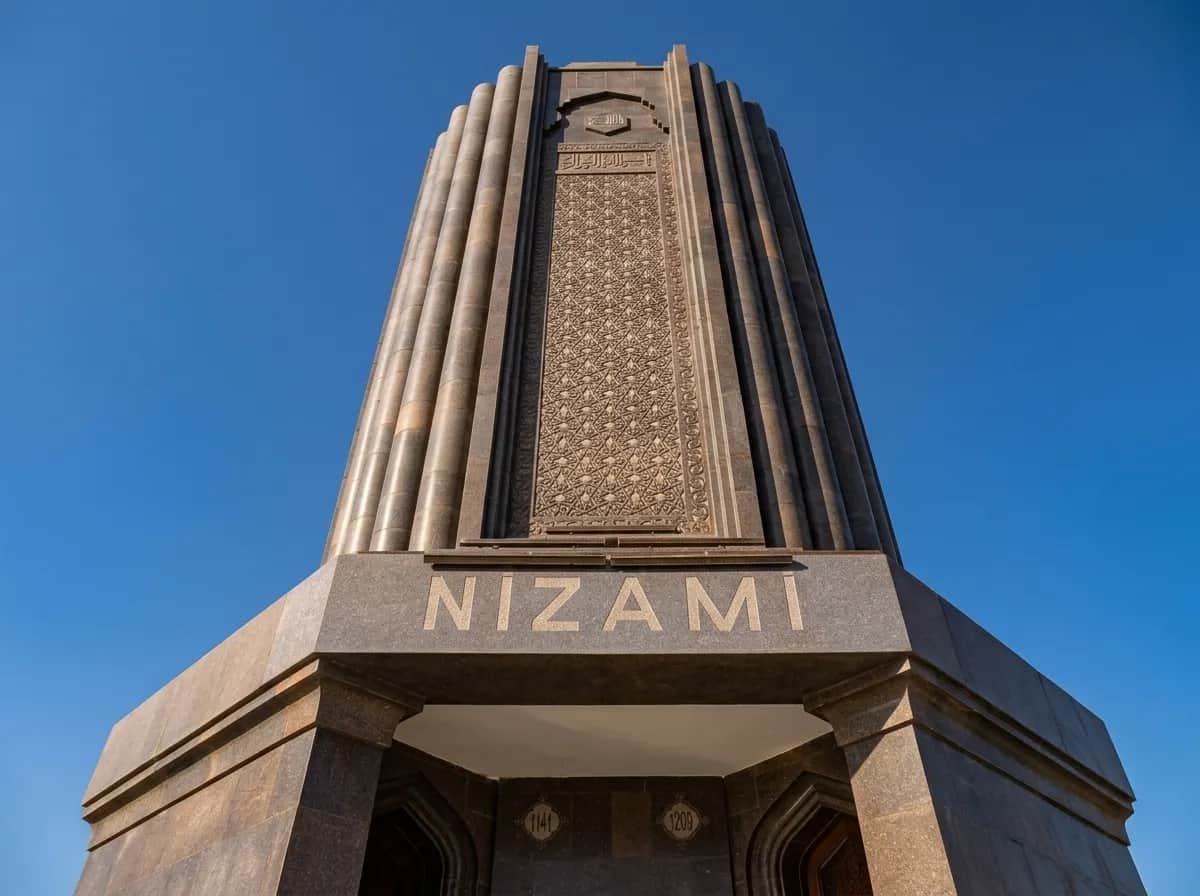
The Nizami Ganjavi Mausoleum is a roughly 20-metre cylindrical red-granite tower on the eastern approach to Ganja, Azerbaijan, marking the presumed grave of the 12th-century poet Nizami Ganjavi (born about 1141, died 1209), author of the Khamsa. The present monument dates to 1991, with granite shipped from Ukraine, and replaced a 1947 building.
- Region
- Ganja
- From Baku
- 350 km · about 4 hours; on the Ganja approach
- Best season
- Year-round; it is an outdoor monument
- Time to spend
- 20 to 40 minutes
- Entry
- The monument and its plaza are free at any hour. The site museum charges separately at the door; a figure of about 2 AZN circulates but the reserve publishes none, so confirm it on arrival.
- Hours
- The plaza is open air. The parent Ganja State Historical-Cultural Reserve publishes 09:00 to 18:00 across all days of the week, which is the window to plan the museum around.
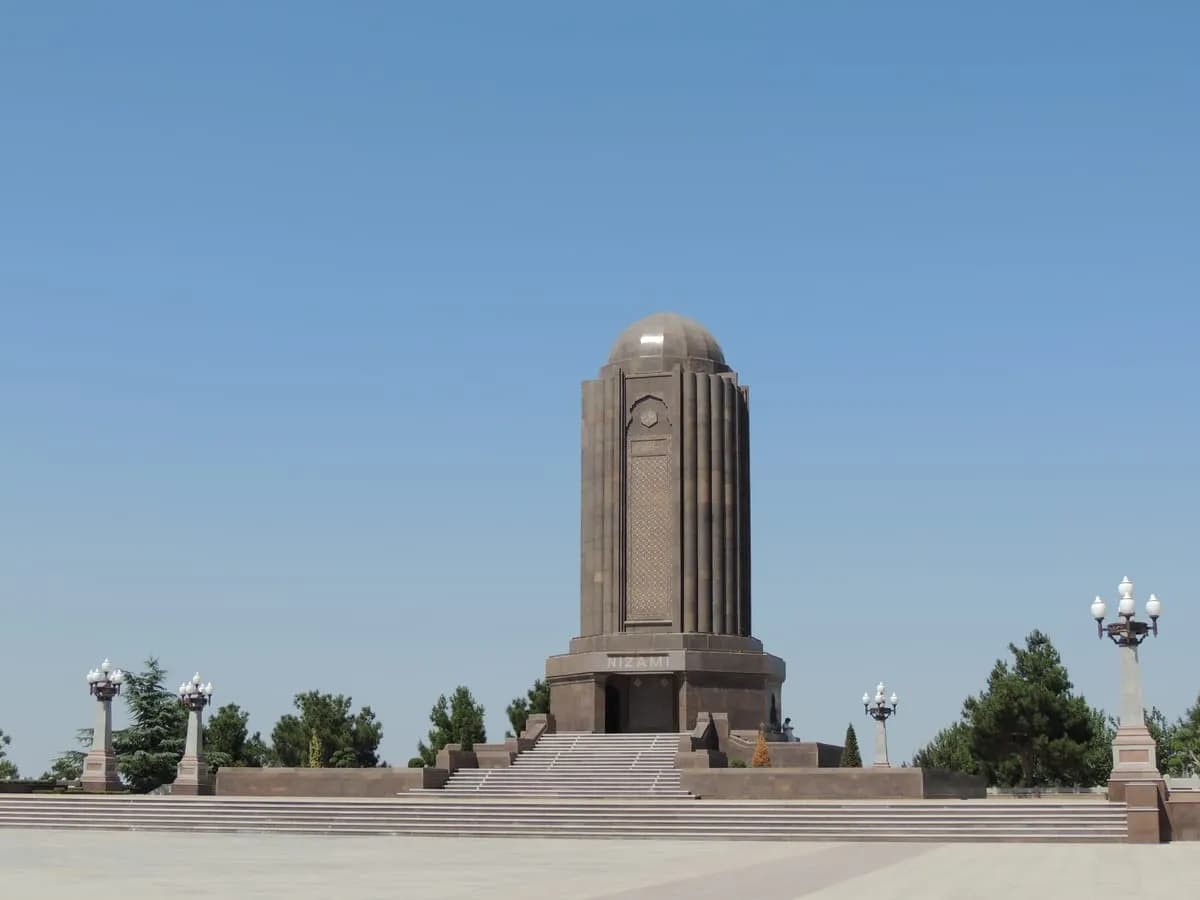
- The 20-metre red-granite tower in its plaza, polished smooth and inscribed with lines of Nizami's verse
- The bronze sculptural group depicting scenes and characters from the Khamsa, the poet's five long poems
- The small museum at the site covering Nizami's life and work
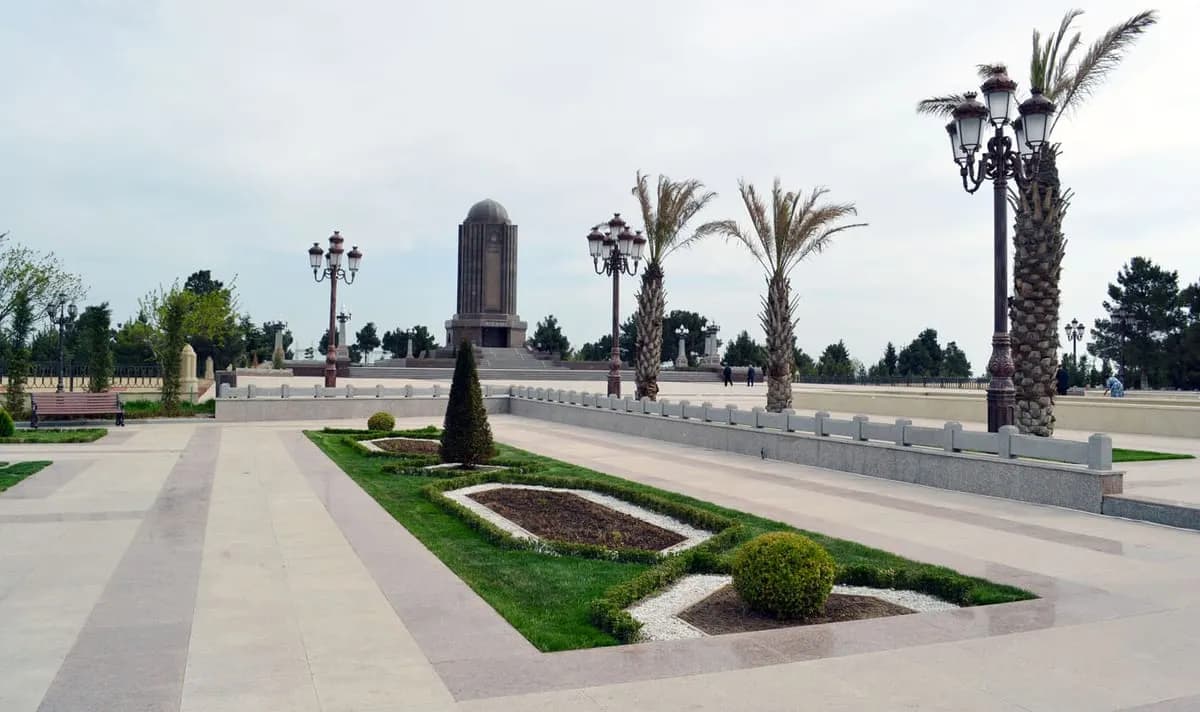
- The open square on the Ganja approach, an easy stop on the way into the city
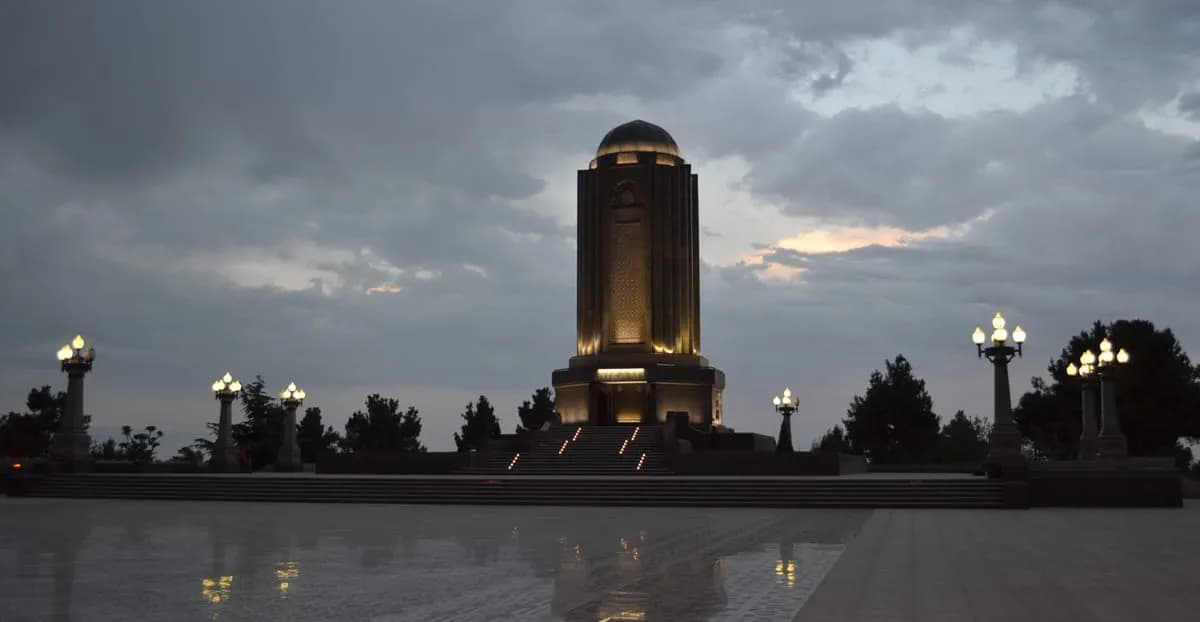
- Floodlighting after dark, which the free open plaza lets you see long after the museum has shut
The road into Ganja from the Baku direction passes this monument before it reaches the city, and it pays to stop. The tall red tower on the eastern approach honours Nizami Ganjavi, the 12th-century poet who gave Ganja most of its name recognition abroad. The plaza is free and open at any hour. The tower itself, despite what half the listings imply, went up in 1991. Below: who Nizami was, what actually stands here, what it costs, when the museum is open, and how the stop fits a Ganja day. Birtour has run this approach as a Baku-based DMC since 2014, on both our western circuits.
Who was Nizami Ganjavi?
A poet who lived in Ganja through the 12th century, born around 1141 and dead in 1209. He wrote in Persian and Ganja was his home for his whole life. His lasting work is the Khamsa, five long narrative poems that include Layla and Majnun and Khosrow and Shirin.
Both of those facts sit here plainly because sources frame his identity differently and the truth holds either way: the language was Persian, the city was Ganja. The Khamsa was read across the Persian-speaking world and well beyond it for centuries, which is why the sculptures in the plaza assume you know who Layla is.
How old is the mausoleum you see today?
The tower is from 1991, not the Middle Ages. It is roughly 20 metres of polished red granite shipped in from Ukraine, and it replaced a 1947 structure damaged by pollution drifting from a nearby aluminium plant. The grave beneath it is described as presumed: the first written record of a tomb here dates to 1606.
This is the correction worth making before your guide has to. Listings that call this an ancient tomb are selling the poet's dates as the building's. Nothing on the site is older than 1947, and the current tower is younger than most of the people reading this page. What is old is the association of the spot with Nizami's burial, and even that is attested no earlier than 1606, almost four centuries after he died.
What is there to see at the site?
A cylindrical granite tower carrying lines of Nizami's verse, a group of bronze sculptures of figures from the Khamsa around its base, a small museum on his life and work, and an open plaza with the city behind it. Twenty to forty minutes covers the whole stop.
The sculptures are the part that rewards a slow walk. They are scenes rather than portraits, so a guide who can name the story behind each one turns a photo stop into something a guest remembers by dinner. The granite is polished smooth enough to throw a reflection, which is worth knowing if you are shooting into afternoon sun.
Is there an entrance fee, and what are the hours?
The monument and its plaza are free, day or night. The site museum charges at the door. Plan around 09:00 to 18:00: the Ganja State Historical-Cultural Reserve, which took this complex onto its books in 2019, publishes those hours across every day of the week.
| What | Tariff, August 2026 | Hours |
|---|---|---|
| The tower and the plaza | Free | No gate; floodlit after dark |
| The site museum | Charged at the door; no official tariff published | Reserve hours, 09:00 to 18:00 |
| Parking on the approach | No charge published | Daylight in practice |
The administrative detail behind those hours is worth two lines. The mausoleum complex was folded into the Ganja State Historical-Cultural Reserve by Presidential Order No. 1498 of 22 October 2019, and the Ministry of Culture publishes 09:00 to 18:00 for that reserve, every day, with no listed day off. The site sells nothing through iTicket.az, the state ticketing channel that handles Gobustan, Ateshgah and the Sheki Khan's Palace, so there is no online session to book and no QR code to hold at a gate. A museum fee of about 2 AZN gets quoted around the internet. We are not printing it as a fact, because no official channel publishes any tariff for this site at all. Carry a few manat and ask at the desk.
The best time of day depends on which half you want. The museum needs the 09:00 to 18:00 window. The tower does not: the plaza is unfenced and floodlit, so an evening arrival still gets the monument, and the granite reads better under the lamps than under a flat midday sun. Groups coming west off the M2 in the late afternoon usually take the mausoleum that evening and the city the next morning.
Is the Nizami Ganjavi Mausoleum a UNESCO site?
No, and it is not on the tentative list either. Azerbaijan's inscribed properties are the Walled City of Baku, the Gobustan rock art landscape, the historic centre of Sheki with the Khan's Palace, the Khinalig cultural landscape, and its share of the transnational Hyrcanian Forests. This monument appears on neither list.
That is not a criticism of the place. It is a correction to the copy that circulates about it, and the same correction applies to Ateshgah, which sits on the tentative list and is routinely described as inscribed. A World Heritage badge is a specific administrative fact, not a compliment, and we would rather a guest hear the real status from us than notice the gap themselves.
How do you get there from Baku?
By road, as part of a Ganja day rather than on its own. The mausoleum stands on the eastern approach, so a car coming from Baku reaches it before the city. Baku to Ganja is 360 km on the M2, about four hours by car and five by coach with stops.
Because it comes first on the way in and last on the way out, it costs almost nothing to include: 20 to 40 minutes on a leg you were already driving. We treat it exactly that way on our 6-day Azerbaijan cultural tour from Baku, where Ganja and Lake Goygol share the last day. If you are heading on to a Naftalan course afterwards, the connections through Ganja and Goran station are set out in our guide to reaching Naftalan and Gabala from Baku.
What else can you combine it with?
Ganja itself, a quarter of an hour on. The Shah Abbas Mosque, Javad Khan Street and Heydar Aliyev Park fill the rest of a day, and Lake Goygol lies 15 to 30 minutes south of the city at a flat 2 AZN a head. Tomb, city, lake is a full day and no more.
One sequencing note that saves an hour: Goygol admits ecotourists only until 18:00, while the mausoleum plaza never closes. So if the day is running late, drop the tomb to the evening and take the lake while the park is still letting people in. Naftalan sits about 50 km on from Ganja if the trip continues into a treatment stay.
What we would not recommend
Three things. Do not drive from Baku for this monument alone. Do not arrive after 18:00 expecting the museum. And do not book it as a highlight in its own right.
On the first, eight hours of road for a 30-minute stop is not a trip, and no operator should sell it as one. On the second, the plaza is always open but the museum keeps reserve hours, and a group that arrives at 18:30 gets the tower and nothing else. On the third, this is a strong 30 minutes inside a good day, not a destination that carries a day by itself. Anyone telling you otherwise has not stood in the plaza.
For operators building a western circuit, the mausoleum is the free stop that costs you nothing but the pull-in, and Ganja is the overnight that makes the rest of the west reachable.
- Who was Nizami Ganjavi?
- Nizami Ganjavi was a poet who lived in Ganja in the 12th century, born around 1141 and died in 1209. He wrote in Persian and is best known for the Khamsa, five long narrative poems including Layla and Majnun. He is one of the major figures of medieval Persian-language literature.
- Where is the Nizami Ganjavi Mausoleum?
- The mausoleum stands just outside Ganja, Azerbaijan's second-largest city, on the road approaching from the Baku direction. Ganja itself sits about 350 km west of Baku, roughly a four-hour drive. The monument is set in its own plaza a short distance from the city centre.
- Is there an entrance fee?
- The outdoor monument and its plaza are free at any hour, so you can walk up to the tower and the sculptures at no cost. The small museum at the site charges at the door. A figure of about 2 AZN circulates online, but the reserve publishes no tariff, so treat that as unconfirmed and ask at the desk.
- What are the opening hours of the Nizami Ganjavi Mausoleum?
- The plaza has no gate and no hours. The complex was folded into the Ganja State Historical-Cultural Reserve by Presidential Order No. 1498 of 22 October 2019, and the Ministry of Culture publishes 09:00 to 18:00 for that reserve across all days of the week. Plan the museum inside that window; the tower itself is floodlit and visible long after.
- How old is the Nizami Ganjavi Mausoleum?
- The tower you see is from 1991, not the Middle Ages. It replaced a 1947 structure that had been damaged by pollution drifting from a nearby aluminium plant. The grave beneath is described as presumed rather than documented: the first written record of a tomb on this spot dates only to 1606, almost four centuries after Nizami died.
- Is the Nizami Ganjavi Mausoleum a UNESCO World Heritage Site?
- No, and it is not on the tentative list either. Azerbaijan's inscribed properties are the Walled City of Baku, the Gobustan rock art landscape, the historic centre of Sheki with the Khan's Palace, the Khinalig cultural landscape, and its share of the transnational Hyrcanian Forests. This monument appears on neither list.
- How far is it from central Ganja?
- About a quarter of an hour by road, on the eastern edge of the city along the main approach from Baku. Most visitors fold it into a half-day of Ganja sightseeing or pass it on the way in or out. A taxi or a guided trip handles it easily.
- What can you see at the site?
- The centrepiece is the cylindrical red-granite tower, about 20 metres tall, carrying lines of Nizami's poetry. Around it stand bronze sculptures of figures from the Khamsa, his five poems, and a small museum covers his life and writing. The open plaza gives views back toward Ganja.
Tour package
6-Day Azerbaijan Cultural Tour from Baku
Destination
Things to Do in Ganja, Azerbaijan: a one-day city guide
Destination
Lake Goygol & National Park: the earthquake-formed alpine lake near Ganja
Destination
Naftalan: Azerbaijan's medicinal crude-oil spa town
Guide
How to Get to Naftalan and Chenot Gabala from Baku (2026)