Azerbaijan ground partner for wedding planners: the guest-logistics layer
how-to · 14 min read
What an international wedding planner gets when it contracts a Baku ground partner: guest visas at scale, airport arrival waves, room blocks, inter-venue transport, real seated-banquet capacities, and the legal-versus-symbolic marriage question answered straight. For Indian, GCC, and European planners running a destination wedding in Azerbaijan, white-label to your studio.
Birtour is a Baku-based DMC and the on-ground production partner international wedding planners contract to run the logistics of a Baku wedding: guest visas at scale, airport arrival waves, contracted room blocks, transport between venues, and a named operations manager on site. You own the design and the couple; we own the ground, white-label to your studio or run in the background. This is the operational layer, written for the planner who has sold Baku to a client and now has to move 200 guests through it.
What does a wedding ground partner actually handle?
The division of labour is the whole point. A destination wedding has a creative layer (concept, design, decor, the client relationship) and a ground layer (the hundred operational things that have to happen in a country whose language, suppliers, and rules you do not run). The planner owns the first. Birtour owns the second, so the studio can promise a client Baku without opening an office there.
What that ground layer covers: visa guidance for the full guest list, airport meet-and-greet with staged transfers, room-block negotiation and management across the wedding nights, transport between venues, permit handling, vendor contracting and payment in-country, State Migration Service registration for anyone staying past 15 days, and a named manager reachable around the clock for the event window. It is the same operation we run for corporate groups, pointed at a wedding. The one thing we do not do is put our name in front of your client unless you want us to.
Can foreign couples legally marry in Azerbaijan, or is it symbolic?
Only a civil marriage registered with the state carries legal weight in Azerbaijan. A religious or symbolic ceremony, however beautiful, has no legal standing on its own. The registration runs through the registry office (ZAGS) via ASAN Xidmət, and the parts of it that are settled in statute are these: Article 9.1 of the Family Code puts one month between the application and the registration, extendable or shortenable by no more than a month; Article 13 requires both parties to have passed a pre-marriage medical examination; Article 12.0.3-2 bars marriage where a party is unlawfully present in the country; and the state fee at ASAN is 5 manat. Foreign civil documents need an apostille from the issuing state and a translation into Azerbaijani.
Two things are not settled, and a planner should hear both. The US Embassy in Baku states that a foreign national needs a temporary residence permit for the marriage to be registered and puts the end-to-end process at about two months; that requirement does not appear in the Family Code, which bars only unlawful presence, and the embassy page was last updated in August 2024. And whether ASAN in practice registers a marriage between two foreign nationals, neither of them Azerbaijani, is genuinely unresolved. The Code is drafted for "a foreigner" concluding marriage in the territory and sets no citizenship condition; secondary sources say otherwise. We are not going to publish an answer we cannot source in either direction.
What is settled is the workable route. Article 148.2 recognises a marriage concluded between foreigners abroad under their own law, so a couple legally married at home is married in Azerbaijan too. For most destination couples that is the honest answer: complete the legal marriage at home, then hold the ceremony in Baku as the celebration. We coordinate either path and we tell planners the residence question up front rather than after the deposit. We do not issue legal opinions on Azerbaijani marriage law; for a couple set on registering here, we bring in a local lawyer to confirm the route before anyone promises a date.
What visa does each wedding guest need?
Visa handling for a wedding party is a per-passport exercise, and it is where a ground partner earns its place. The routes below cover almost every Indian and Gulf guest list in 2026, and all four were re-read against the government sources on 10 August 2026.
| Guest passport | Route in 2026 | Notes |
|---|---|---|
| India | ASAN e-visa | USD 29 (USD 20 state fee + USD 9 service fee), 3 working days; urgent 3-hour lane at an unpublished extra fee; single entry, 90-day validity, 30-day stay |
| India, with UAE residence | Visa on arrival | Residence visa valid 6+ months and passport valid 4+ months, per the Azerbaijan embassy in the UAE |
| UAE | Visa-free | Up to 90 days |
| Qatar | Visa-free | Up to 30 days |
| Saudi, Kuwait, Oman, Bahrain | Visa-free window | 30 days per entry, 3 entries, running 15 February 2026 to 15 February 2027 |
Four planner notes. The e-visa is single entry and the portal takes family applications of 2 to 10 people and group applications of 10 to 300, which is what makes a 200-guest filing one workflow rather than 200. Standard issue is three working days and the portal will not date a visa to start earlier than three working days after submission, so a late RSVP goes into the urgent lane or misses. The four-country GCC window expires in February 2027, so a wedding dated after that needs the regime re-checked rather than assumed. And any guest staying past 15 days must be registered with the State Migration Service, which the hotel does free of charge and which we verify was actually filed, because the liability sits with the guest. The full country-by-country detail sits in our GCC entry-rules guide and the batch mechanics in the e-visa and flights guide. The one clause we push every planner to get into the DMC contract is a visa-denial provision, so a guest refused entry does not become the planner's financial problem.
How do you move 100 to 300 guests from the airport?
As staged waves, not one pickup, and every wave arrives by air. Azerbaijan's land borders are closed to inbound passenger traffic, currently extended to 1 October 2026, so the Tbilisi drive-in is not available. Heydar Aliyev International (GYD) sits about 25 km and 30 to 40 minutes from central Baku, and the workable model is meet-and-greet plus coach staging matched to each flight bank, with hosts holding name boards in arrivals and coaches called from the dedicated lot as each wave clears customs. The mechanics of that arrival are in our Baku airport transfers guide.
Direct access is a genuine selling point, and in 2026 it is also a constraint worth naming to a client before the guest list closes:
| From | Nonstops per week, August 2026 | Carriers | Block time |
|---|---|---|---|
| Delhi | 7 | AZAL, with the Air India code from 29 July 2026 | ~4h 40m |
| Mumbai | 7 | AZAL, with the Air India code from 29 July 2026 | ~5h 20m |
| Dubai | 16 | flydubai and AZAL | 2h 55m fastest |
IndiGo's Baku service is suspended over Iranian-airspace routing and shows an October 2026 restart in filed schedules only, so through September the entire India market runs on one daily from Delhi and one from Mumbai. For a 200-guest list that means three or four arrival days, or routing part of the party through Dubai. Doha, Riyadh and Kuwait all have direct service too, and we confirm the live schedule per origin when we build the manifest rather than quoting a timetable that has moved twice this year.
The baraat is the one transport line that is not a standard hotel offering: an open procession vehicle with dhol, or a horse, is a bespoke vendor arrangement we book separately rather than something the venue provides. Name it early so it is a planned line, not a scramble.
Which Baku venues hold a large wedding, and what do they actually seat?
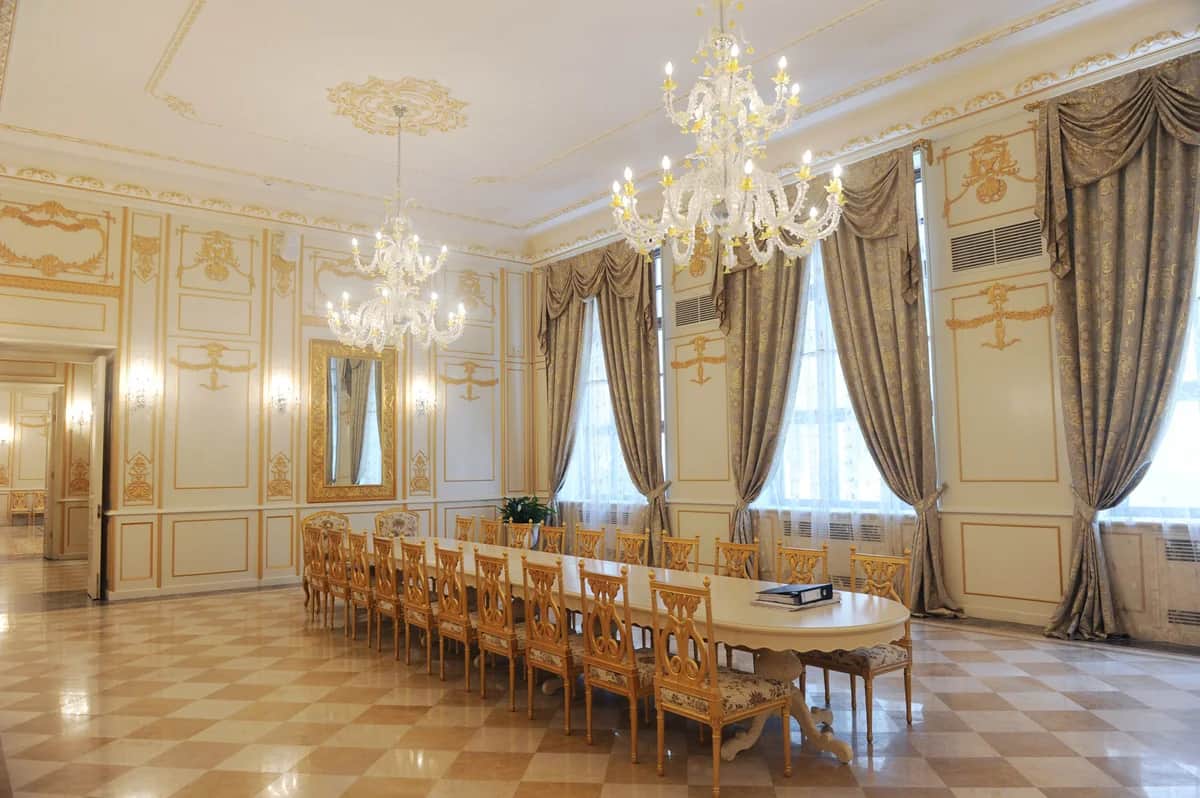
A hotel's headline capacity is the standing-reception or theatre maximum. The seated-banquet number, the one that matters for a plated dinner, is lower, and a wedding then eats into that: place a mandap or a stage, a dance floor and a buffet line and you are working with roughly two-thirds to three-quarters of the published banquet figure. Size on the published number, then subtract for your production. Here is what each brand published as of 10 August 2026.
| Venue | Room, as the brand publishes it | Published banquet | Plated working figure |
|---|---|---|---|
| JW Marriott Absheron Baku | 13 event rooms, 1,957 m² total | largest room capacity 1,000 | 650 to 750 |
| The Ritz-Carlton, Baku | 14 event rooms, 1,362 m² total | largest room capacity 500 | 325 to 375 |
| Fairmont Baku, Flame Towers | Nizami Ganjavi Ballroom, 1,014 m² | 350 | 230 to 260 |
| Four Seasons Baku | Segah Grand Ballroom, 640 m² | 300 banquet / 500 reception | 200 to 225 |
| Bilgah Beach Hotel | Closed for renovation | reopening stated as summer 2027 | not contractable |
Three cautions on that table, all of them from the properties' own pages. Fairmont's wedding page states 350 in the capacity chart, 400 in the intro and 600 in the FAQ; 350 is the defensible figure and the one we plan against. The Ritz-Carlton's page gives 1,362 m² and a 500 largest-room capacity in the stats block, then "more than 2,202 square meters" and a 280-person ballroom in the prose beside it. And the JW Marriott's 1,000 is a largest-room figure rather than a seated-dinner guarantee, so we confirm it against the venue's capacity chart before it goes into a plated proposal. The Marriott Boulevard is the same building as the property some directories still list as the Boulevard Hotel Baku, so do not shortlist it twice. For the full stack across the city, our 14-venue catalogue has the operational detail on each room, and the Indian-wedding venue matrix reconciles it against mandap and baraat feasibility.
The Bilgah closure is the single biggest inventory change since 2025. It was the only branded beachfront ballroom on the Absheron coast, and its own site now carries nothing but a renovation notice and a summer 2027 reopening. Beach-side closings for 2026 and early 2027 go to Sea Breeze on the Nardaran coast or to a city-hotel terrace, with a covered fallback contracted in parallel.
How do room blocks and inter-venue transport work?
A multi-night wedding needs every room block held at once, across the anchor hotel and any second property, or the program falls apart when one hotel releases rooms early while the couple is still collecting RSVPs. Through our standing hotel agreements Birtour holds synchronised blocks for the wedding nights, and manages the rooming list, the upgrades for the couple's families, and the late changes that always come. Between venues, a wedding that moves from a city-hotel ceremony to a coastal closing runs on a contracted coach fleet timed to the run of show, the same staggered-wave logic as the airport arrivals rather than a taxi scramble for 200 people.
What about catering: halal, vegetarian, Jain, and alcohol?
Baku suits both the Gulf and Indian ends of a guest list, with two caveats worth putting in writing. Halal is the standing default across the hotels, and since April 2026 there is a national standard behind it, AZS OIC/SMIIC 9:2026 "Halal Tourism Services", adopted by the Azerbaijan Standardization Institute and covering accommodation, tour packages and guides. No public register of certified properties exists, so we confirm certification per hotel in writing rather than citing the standard and moving on. Vegetarian and vegan Indian catering is well established through the city's Indian-restaurant estate. Jain cooking, with no onion, garlic, or root vegetables, is the specialist case and runs through a dedicated Indian caterer on a satellite kitchen, which depends on the host hotel agreeing in writing to an outside kitchen; no Baku property publishes that policy, so it is negotiated per venue and contracted early.
On alcohol, the accurate statement is narrower than the one the destination usually gets. Azerbaijani law is not sharia-based, alcohol is sold and served openly, and the UK FCDO's Azerbaijan advice carries no restriction on consumption or sale, only a warning that any alcohol in a driver's system draws a severe penalty. What nobody publishes is event-level licensing, corkage or service-hour rules, so we treat those as a per-venue contract question and get the answer in the banquet agreement. A dry section for observant guests is arranged rather than required.
When should a Baku wedding run?
May and the late September to October window are the defensible outdoor slots. The table below is the 1991 to 2020 normals for the Maştağa station on the Absheron peninsula, which is the right station for coastal venues rather than the city centre, with mean wind from a separate 1999 to 2020 series.
| Month | Mean daily max | Rain days ≥1mm | Mean wind | Outdoor verdict |
|---|---|---|---|---|
| March | 10.9 °C | 5 | 21.6 kph | Windiest month of the year. Do not sell an outdoor set-up. |
| April | 16.8 °C | 4 | 20.0 kph | Cool and still windy. Indoor ceremony, outdoor photography. |
| May | 23.4 °C | 3 | 17.9 kph | Best spring window. |
| June to August | 28.0 to 30.6 °C | 1 to 2 | ~20 kph | Reliably dry, UV 8 to 9. Evening functions only. |
| September to October | 19.5 to 25.8 °C | 2 to 6 | 17.0 to 17.2 kph | Calmest months of the year. Best autumn window. |
| November to February | 7.3 to 13.4 °C | 6 | 17.5 to 20.1 kph | Cold, wet by local standards, low sun. Indoor only. |
Baku is windy all year because of its peninsula position, with the Khazri off the north alternating with the Gilavar off the south. Mean wind never drops below about 17 kph in any month, which is why we hold an indoor fallback on every outdoor function regardless of season. The month-by-month planner's calendar for groups is in our group-travel calendar.
What we won't promise
The honest limits, because a planner is scanning for them:
- A same-trip legal marriage for a fly-in couple. The one-month statutory wait and the unresolved residence question make it impractical for most, and we will not promise a legal ceremony we cannot deliver on a tourist visa. We coordinate the legal route only when the couple genuinely meets the requirements, and we bring in a local lawyer to confirm it rather than issuing an opinion of our own.
- A guaranteed outdoor ceremony in the Old City. Icherisheher is a UNESCO reserve, and a commercial ceremony or shoot inside it is arranged case by case with the reserve administration, not a permit we can promise on a timeline. We pursue it where a couple wants it and hold a backup.
- An outside Jain kitchen inside a hotel, booked late. The specialist caterer needs contracting well ahead, and the host property has to agree to the outside kitchen in writing. Neither is a final-weeks conversation.
- A venue capacity we have not read off the property's own chart. Two of the five anchors publish figures that contradict themselves on the same page. We reconcile before we shortlist, not after.
For planners scoping a program, the Indian wedding cost breakdown shows how the ground layer prices out, and the Mumbai planner's guide covers the design and timeline side. To discuss white-label ground partnership for a specific wedding, the destination weddings in Baku page is where a brief comes in.
- Can foreign couples legally marry in Azerbaijan, or is it symbolic?
- Only a civil marriage registered with the state (ZAGS, via ASAN Xidmət) is legally recognised in Azerbaijan; a religious or symbolic ceremony carries no legal standing on its own. The Family Code sets a one-month statutory wait between application and registration, requires a pre-marriage medical examination, and bars marriage where a party is unlawfully present. The US Embassy in Baku states that a foreign national additionally needs a temporary residence permit, which a tourist e-visa does not provide; that requirement is not in the Family Code, so treat it as indicative and confirm with ASAN or a local lawyer. Most destination couples marry at home, which Azerbaijan recognises, and hold the ceremony in Baku.
- What visa do wedding guests need for Azerbaijan?
- It depends on the passport. Indian guests need the ASAN e-visa: USD 29, a USD 20 state fee plus a USD 9 service fee, issued in three working days, single entry, 30-day stay, with an urgent 3-hour lane at an extra fee the portal does not publish. An Indian national holding a UAE residence visa with six months or more left may instead take a visa on arrival. UAE nationals travel visa-free for 90 days, Qatari for 30, and Saudi, Kuwaiti, Omani and Bahraini nationals under a window running to 15 February 2027 at three entries of 30 days. Any wedding dated after that needs the regime re-checked.
- What does a wedding ground partner in Baku actually handle?
- The operational layer under the design: guest visa guidance, airport meet-and-greet and staged transfers, contracted room blocks across the wedding nights, transport between venues, permits, supplier management, State Migration Service registration for anyone staying past 15 days, and a named operations manager on site for the event window. The planner owns the creative and the client relationship; the ground partner owns the ground, white-label to the studio or run in the background.
- How many guests do Baku's 5-star ballrooms actually seat?
- Size on the seated-banquet figure, not the reception maximum hotels lead with, then subtract for production. As each brand publishes it in August 2026: Fairmont's Nizami Ganjavi ballroom is 1,014 m² at 350 banquet, JW Marriott Absheron lists a largest room capacity of 1,000 across 1,957 m² of event space, the Ritz-Carlton Baku lists 1,362 m² and a largest room capacity of 500, and Four Seasons' Segah ballroom is 640 m² at 300 banquet or 500 reception. Bilgah Beach Hotel is closed for renovation until summer 2027 and cannot be contracted.
- Is vegetarian, Jain, and halal catering available in Baku?
- Halal is the standing default across Baku hotel kitchens, so a GCC guest list needs no special arrangement, only per-property confirmation in writing. Azerbaijan adopted a national halal tourism standard, AZS OIC/SMIIC 9:2026, in April 2026, though no public register of certified hotels exists. Vegetarian and vegan Indian catering is well established through the city's Indian-restaurant estate. Jain cooking, with no onion, garlic, or root vegetables, is specialist and runs through a dedicated Indian caterer, subject to the host hotel agreeing to an outside kitchen in writing.
Guide
How to plan an Indian wedding in Azerbaijan: a Mumbai planner's guide
Guide
Azerbaijan entry rules for GCC groups (2026): the visa-free pilot, the fourth-entry catch, and registration
Guide
Baku airport to the city: the H1 bus, Bolt, taxis, and private transfers (2026)
Pricing
Indian wedding in Baku: cost breakdown (200 guests, 3 days)
Wedding
GCC 3-day Baku wedding: 150-guest Khaleeji signature
Guide
Getting 200+ Wedding Guests to Baku: Azerbaijan e-Visa, Group Handling and Direct Flights (2026)