Event logistics company in Azerbaijan: production, permits, crew, AV supply and the rules foreign teams miss
explainer · 17 min read
What event logistics means in Azerbaijan once the coaches are parked: production and run-of-show, the permit clocks Birtour has measured since 2019, the work-permit and drone rules a foreign crew walks into, who actually rents LED and interpretation booths in Baku, how suppliers get paid, and the 2026 to 2027 dates to avoid. Ground handling is on a separate page.

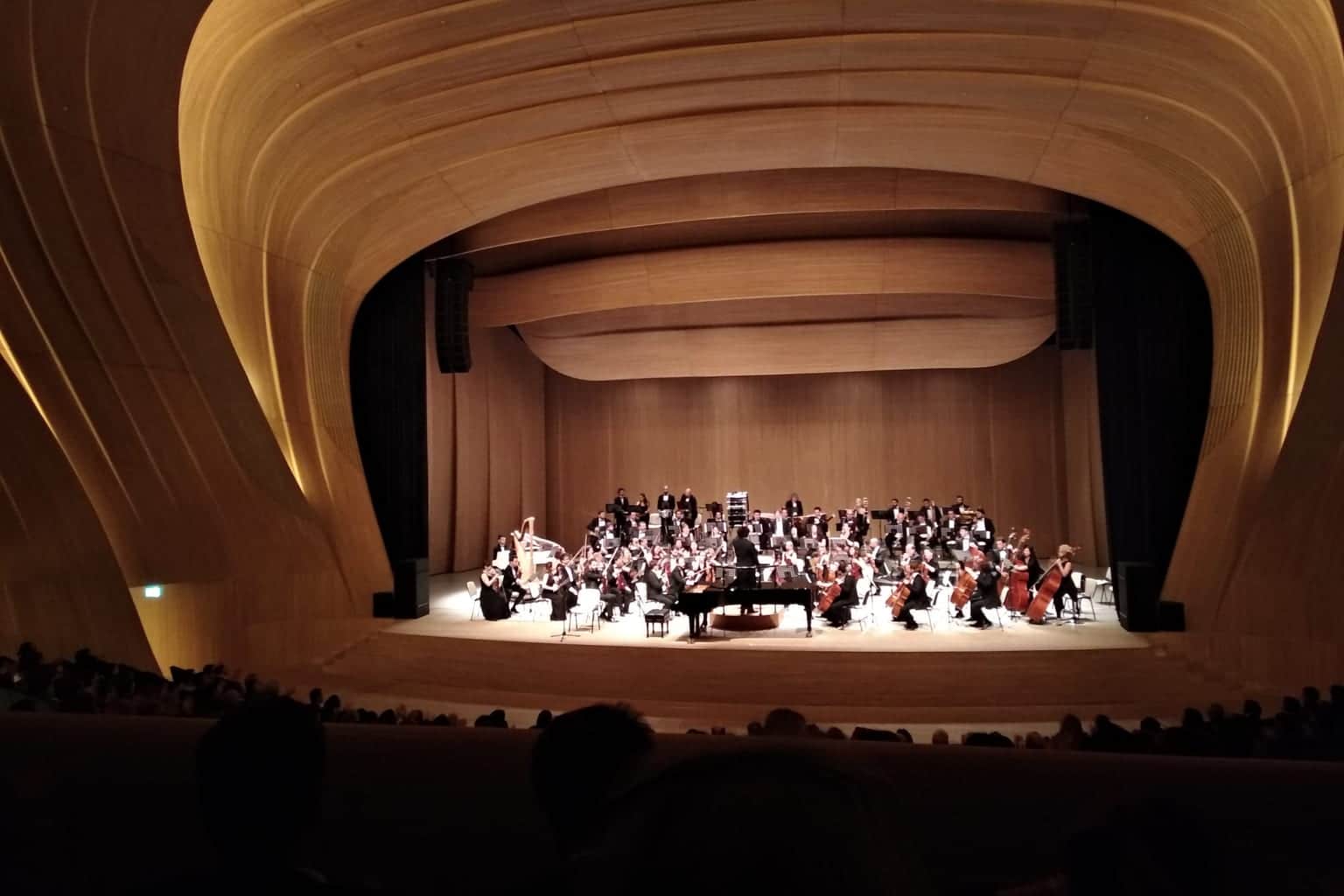
Photo: Emin Allahverdi, CC BY-SA 4.0, via Wikimedia Commons
Birtour is a Baku-based DMC and MICE production company, and event logistics is the part of our work foreign buyers understand least before they land. Across several hundred permit applications filed since 2019, drone permits clear in 8 to 14 working days and Cabinet-level blackout windows in 4 to 6 weeks. This page covers production, permits, foreign crew and drone rules, the local AV supply chain, payments and the calendar. Arrivals and coaches live on a separate page.
Why event logistics in Azerbaijan is a different job from event logistics in Lisbon
Three things make Baku different for a production team, and none of them is the venue. Almost nothing an event needs from the state has a published clock or tariff, so the only usable lead times are the ones a local applicant has measured. The visa pilots and the drone rules changed in 2025 and 2026, and most briefs still describe the old regime. And the AV rental market is small, held by a handful of houses, so integration matters more than procurement.
Where a fact below comes from a law, a decree or a company's own page, we say which. Where a number is ours, we say it is a median from our own filings and not a rule you can cite back to a ministry. The agencies, organisers and rental houses that make up the market are mapped on who does what in Azerbaijani MICE; this page is about the work itself.
What does "event logistics" cover in Azerbaijan, and what does a DMC actually run on the day?
Event logistics, as we sell it, is everything between the signed venue contract and the last truck out: run-of-show, permit files, specification and integration of AV, staging and interpretation, crew calls, hybrid streaming, temporary import of foreign kit, supplier contracts and payment, and the calendar. Airport handling and coach fleets are a separate discipline with their own page.
On the day, the DMC is the one entity every supplier reports to. We hold the run-of-show, the radio channels, the venue's technical manager, the rental house's crew chief and the client's producer in one room, and the client's own team keeps the content. For a hybrid conference the same structure carried a 320-person plenary and 1,400 remote attendees across 18 time zones at 99.97% stream uptime over 22 hours, on fibre with dual-carrier LTE failover, in the EU SaaS summit. For an outdoor reveal it carried a 12-minute city blackout, a projection rig under temporary import bond and a 38 km closed road in the DACH auto launch.
A realistic backwards calendar for a Baku event with production content looks like this. The permit rows are our medians, described in more detail further down; the rest is how we schedule.
| Weeks before show day | What has to be done | Who owns it |
|---|---|---|
| 12 | Brief frozen; permit calendar built from the hardest item (pyrotechnics, blackout, boulevard closure) | Birtour with the client producer |
| 10 | Venue technical survey; AV, staging and interpretation specified against the venue's own inventory | Birtour and the rental house |
| 8 | Drone, road-closure and sound files lodged; foreign crew list reviewed with counsel | Birtour |
| 6 | Blackout or pyrotechnics application in; temporary import list to the customs representative | Birtour, freight forwarder |
| 4 | First run-of-show issued; supplier contracts and 40% payment tranche settled | Birtour, client finance |
| 2 | Temporary import bond cleared; crew calls and radio plan issued; 30% tranche settled | Birtour |
| 0 | Load-in, rehearsal, show, load-out; re-export paperwork lodged | Birtour on site |
Fewer weeks are possible without a blackout or pyrotechnics in the brief; with either of them, fewer weeks is where we start saying no.
Can my foreign production crew and speakers work in Baku without a work permit?
Often, in practice, yes; in law, less tidily than agencies assume. The Migration Code requires a work permit for every foreigner an employer employs (Article 63.2), and Article 64.0.8 exempts seconded missions of up to 90 days a year only in spheres set by the relevant executive authority. Event production is not a named exemption in the English text.
The distinction that matters is who employs and pays the person. A lighting designer, show caller or keynote speaker who stays on a foreign payroll and is in Baku for four days on a business e-visa is treated as a visiting business traveller working for a foreign company. A work permit is triggered by employment by an Azerbaijani entity. HelloTeamUp's employer-of-record guide describes the 90-day mission exemption as narrowly scoped to fields determined by the Cabinet of Ministers and not a general short-term assignment exemption, and we have not found the Cabinet's sector list published in English.
So we do two things with every crew list. We check each person against the visa route that fits their passport and their role, and we send the list to counsel when a foreign crew member will be on site for more than a few days, will be paid by an Azerbaijani company, or will be invoiced through one. We do not promise an exemption that the statute does not spell out, and we do not put a crew member in the country on a tourism pilot when the job is plainly business.
Can we fly a drone for the opening film, and who applies for it?
You can have the aerial shot; you should not plan to fly the aircraft yourselves. Since the presidential decree of 3 August 2026, reported by APA, civilian unmanned aerial vehicles circulate in Azerbaijan only under a special permit. On our filing history a drone permit for event cinematography clears in 8 to 14 working days at most Baku locations.
Two layers sit underneath that. The first is the item itself: drones are a restricted-circulation item, and per Global Voices' account of 18 October 2024 the special permit is granted only to legal entities and sole proprietors by the Ministry of Digital Development and Transport, after consultation with six security and defence bodies. A foreign agency is neither a local legal entity nor a sole proprietor, which is why the applicant on every drone file we run is a locally licensed operator who holds the aircraft and the pilot credential. The second layer is the flight. The June 2026 amendments to the Law on Aviation, as news.az reported on 4 June 2026, require registration certificates, operator certificates and operational permits, and restrict flights to designated zones approved by the competent bodies. A flight request has to go in at least three hours before the planned operation, and a coordination centre approves it within that window.
For a run-of-show that means the aerial unit is a local supplier line with its own day rate, the permit is a file lodged under that supplier's name, and the three-hour flight request is a fixed item on the show-day timeline. Restricted sites add time: the DACH auto launch was declined over National Flag Square airspace on first application and approved on re-application with a 50 m perimeter exclusion in 5 working days, while the rooftop drone show for the SaaS summit cleared in 11 working days. Do not fly kit in as hand luggage expecting to use it; a grounded aircraft on shoot day costs more than the local operator did.
How do permits for closed roads, blackouts, sound and pyrotechnics work, and how long do they take?
Through written applications to a district or city authority, or to the Cabinet of Ministers for the biggest items, with no published clock or tariff. On our medians since 2019, non-central road closures clear in 9 working days, sound past 23:00 in about 4, and blackout windows in 4 to 6 weeks. The full table is on how Baku event permits work.
What this page adds is the legal shape behind the medians, because that is what foreign procurement asks about. Public assemblies fall under the Law on Freedom of Assembly, which requires written prior notification to the executive authority; the joint NGO submission to the UN's Universal Periodic Review dated 4 April 2023 records that in practice the authorities treat prior notification as prior authorisation and may change the place, route or time. We have not found the statutory notice period published in English, and we will not print a number we could not read in the law. That is why the lead times we quote are the ones we measured. The Baku City Executive Power's site publishes contact details and e-appeal portals but no event-permit page at all, so there is no self-service route for a foreign organiser.
The waterfront most clients want changed its legal form the week this page was written. On 25 August 2026, per APA's official-news wire, a presidential decree transformed the Seaside Boulevard Administration into "Seaside Boulevard" Closed Joint-Stock Company. The permission process is, so far, the same; the counterparty on the paperwork is not, and a boulevard event contracted for late 2026 should expect the new name on the approval. Boulevard lead times and fees have never been published; budget the 4 weeks we quote for boulevard and Formula 1 road closures, not the 9 working days for a side street.
Pyrotechnics deserve one sentence here and the rest on the permits page. They sit in the restricted civil-circulation category, there is no public application route for a private client display, we budget $4,000 to $28,000 and 4 to 6 weeks for the ones we do run, and we plan a lighting or projection alternative alongside every one of them.
Who supplies LED, sound, staging and interpretation booths in Baku, and who integrates them?
A small number of local rental houses supply the kit, and they publish what they hold. For a ballroom plenary that inventory is enough. For projection mapping it is not, and we say so below. Birtour does not own an AV warehouse; we keep AV, staging and production partners on retainer, specify against the venue, contract the house whose inventory fits, and integrate it under one run-of-show with one technical director answerable to us.
What the three houses foreign buyers most often meet say about themselves, as of 25 August 2026:
| Supplier | What it states on its own site | Where it sits |
|---|---|---|
| Konsis | Founded 2006; 45+ services; Absen P2.6 LED; ISO-standard interpreter booths, single and dual; hybrid events; clients named on its home page include BP, PASHA Holding, SOCAR Polymer, Council of Europe, UNICEF and ADB | SAT Plaza, Bashir Safaroglu street, central Baku |
| Konfrans Market | Bosch Integrus digital infrared interpretation, described as the only Bosch interpretation and discussion system in Azerbaijan; up to 8 parallel sessions; ISO-standard booths; LED, truss, rigging, power and lighting in a 418-item rental catalogue | Baku |
| Rentexpo | Soundproof interpreter booths, infrared and radio systems, receivers and LED screens for rent | Office inside Baku Expo Center |
Every line in that table is the company's own claim and we have audited none of it. Two things we can add from jobs we have run. Interpretation is where the local market is strongest: we deliver simultaneous interpretation in 8 or more languages and the 2026 cost benchmarks put a language pair at $2,400 to $3,800 per day, booth and crew included in a hotel ballroom and crew only in the Baku Convention Center, whose auditorium has six interpretation rooms built in. A plenary AV package with projector, sound, microphones and operator runs $1,200 to $2,400 per day in the same benchmarks.
The gap is at the top end. We have not found a Baku staging house that publicly documents an international touring-grade inventory, and when a brief calls for one, projection mapping being the usual case, the rig comes in from abroad. That is what the temporary import bond is for: on our history it clears in 2 weeks through Azerbaijani Customs, there is no fee for bonded equipment, and the DMC named on the bond is responsible for re-export inside the bonded window. Azerbaijan is not in the ATA Carnet chain, so a carnet issued in London or Frankfurt is no substitute; the mechanics of that are on the exhibitor logistics page for Baku Expo Center.
Crew is the part nobody publishes. Local technical crew comes through the rental house; what we add is a technical director who has run the venue before, a written crew call, and a rehearsal in the room with the client's producer. If your production has a show caller, bring them; if not, we supply one.
How do we pay Azerbaijani suppliers, and in what currency?
By bank transfer, in USD, EUR or AZN, against a contract and an invoice. The Law on Currency Regulation, in the Central Bank of Azerbaijan's English text, lets resident companies hold foreign-currency accounts, lets non-residents remit foreign currency in and freely remit out what they brought in, and keeps settlement between residents in manat. A USD or EUR wire to a supplier's foreign-currency account sits inside that.
Two consequences follow. First, your supplier's onward payments to venues, drivers and crew are in manat, so the supplier, not you, carries the conversion. Second, cash is a poor tool. The CBAR and Cabinet rules on bringing currency in and out allow up to USD 10,000 equivalent on an oral declaration; from USD 10,000 to 50,000 taking cash out needs a written declaration and proof it came in; above USD 50,000 only a bank transfer will do. The per-diem envelope some agencies still carry for local vendors is the wrong instrument here.
Our own terms, stated on the corporate offsite pricing page and repeated here so they do not drift: 30% at signing, 40% at 30 days out, 30% at 14 days out, invoiced in USD, EUR or AZN. Sub-suppliers are paid by us inside those tranches; you hold one contract and one counterparty.
The tax line that surprises European finance teams is VAT. Azerbaijan's standard rate is 18% with no reduced rates, per PwC's Azerbaijan tax summary reviewed in January 2026, and a foreign business with no local registration cannot reclaim it; there is no equivalent to the EU refund directives. Event services performed in Azerbaijan are local supplies, so 18% on venue, AV and local services is a final cost for a foreign organiser, and we quote it as one rather than as a recoverable line.
On insurance, we say only what we can show. We have found no Azerbaijani insurer that markets a named event-organiser liability product, and no venue that publishes its insurance clauses. The practical route for a foreign organiser is a home-country event liability policy with worldwide territory, and we confirm the venue's requirement in the venue contract rather than assume it.
Which dates in 2026 and 2027 should we avoid?
The official non-working days first, because permit clocks stop on them. Per the Ministry of Foreign Affairs' public-holidays page: 1 and 2 January, 8 March, 9 May, 28 May, 15 June, 26 June, 8 and 9 November, 31 December, five days of Novruz around 20 to 24 March, and two days each for Eid al-Fitr and Eid al-Adha. Novruz empties the city for five days.
Ramadan 2027 is expected to run from 8 February to 8 March 2027, per the calendar table on the Ramadan Wikipedia page. It changes less than a GCC or European planner expects. Alcohol is legal in Azerbaijan, served in hotels and venues, and sold during Ramadan, as the OrexCA country guide notes and as our own gala bookings confirm every year; what changes is that some local crew fast, so we shorten daytime calls and move the heavy lifting to the evening. Our own rule, not a published one, is no entertainment programming on 20 January, the national day of mourning.
Then the dated congestion. Formula 1 race week, the autumn defence and construction shows at Baku Expo Center and the large congresses each take rooms, coaches, crew and the permit desk's attention at the same time. We keep the dates on a separate Baku exhibition and congress calendar for 2026 and 2027 so this page does not go stale; the rule of thumb is that a corporate event inside one of those weeks pays more for AV crew and gets slower answers from the district.
What we would not recommend, and what we do not claim
We would not recommend flying your own drone crew, on any visa, for any client. The permit goes to a local legal entity, the flight request runs through a local coordination centre, and third-party drone guides report aircraft being held at the airport until departure. Hire the local operator and put your director of photography beside them.
We would not recommend building a creative concept on pyrotechnics or a city blackout without an alternative that is already costed. Blackout windows are granted case by case with no published criteria, and Cabinet-level approval can be withheld without a reason being given. Fireworks have no public application route for a private client at all.
We would not recommend cash for local suppliers, or contracting a rental house directly from abroad without someone in Baku holding the run-of-show. The houses are competent; the seams between them, the venue and the permit files are where an event goes wrong, and that is the job you are actually buying.
We do not own an AV warehouse, a staging inventory or a drone fleet, and we do not claim to. We contract and integrate the houses named above and others like them.
We do not issue legal opinions on work permits, temporary import or assembly law. Where the statute is not published in English, or where the Cabinet's sector list is not public, we say so and route the question to counsel rather than fill the gap with a number.
We do not claim a published permit tariff or clock exists where none does. Every lead time on this page is a median from our own filings since 2019, and the day a ministry publishes a statutory one we will replace ours with it.
We do not run the airport. Arrival waves, the 18-hour staffed desk that took 6 carrier waves on time for the pharma incentive, and coach fleets are on the ground-handling page, and that page, not this one, is where to check them.
Where this page stops
Two things are left out on purpose: venue capacities, which live in the Baku venues catalogue, and the congress layer of registration, abstracts and committees, which is on the congress and conference organiser support page.
For an agency or corporate buyer pricing a Baku launch with production content and wanting to see how these lines land in a real budget, the 100-pax product launch pricing page walks through one.
- What does an event logistics company in Azerbaijan actually do?
- Everything between the venue contract and the last truck out: the run-of-show, the permit files for drones, road closures, sound and blackouts, integrating LED, sound, staging and interpretation from local rental houses, crewing, hybrid streaming, temporary import of foreign kit, supplier payment and the calendar. Airport handling and coaches are a separate discipline, and we keep them on a separate page.
- Can a foreign production crew work in Baku without an Azerbaijani work permit?
- The law does not say so in plain terms. The Migration Code's Article 64.0.8 exempts seconded missions of up to 90 days a year only in sectors the Cabinet of Ministers has listed, and no general event-crew exemption exists. In practice a crew employed and paid abroad, in Baku for a few days on business visas, is treated as visiting business, but we route every crew list through counsel rather than promise an exemption.
- Can we fly our own drone for the opening film in Baku?
- Plan on not doing that. Since the decree of 3 August 2026 civilian drones circulate only under a special permit, the June 2026 aviation amendments require registration, an operator certificate and a flight request filed at least three hours ahead inside designated zones, and the permit goes only to local legal entities and sole proprietors. We file every drone job through a licensed local operator; on our history it clears in 8 to 14 working days.
- How long do Baku event permits take?
- On our own filing medians since 2019: drone permits 8 to 14 working days, road closures 9 working days for non-central routes, amplified sound past 23:00 about 4 working days, and Cabinet-level blackout windows or pyrotechnics 4 to 6 weeks. There is no published statutory clock for any of them, which is why we quote our medians and not a government tariff.
- Who rents LED walls and interpretation booths in Baku?
- Three local rental houses state the inventory publicly. Konsis lists Absen P2.6 LED and ISO-standard booths, Konfrans Market says it holds the only Bosch Integrus interpretation system in Azerbaijan and can run 8 parallel sessions, and Rentexpo rents booths and LED from inside Baku Expo Center. Birtour does not own an AV warehouse; we specify, contract and integrate these suppliers under one run-of-show.
- How do we pay Azerbaijani event suppliers, and in which currency?
- By bank transfer, in USD, EUR or AZN. The Law on Currency Regulation lets a non-resident remit foreign currency in and out, while settlement between residents happens in manat. Cash over USD 10,000 needs a written declaration at the border and above USD 50,000 must move by bank. Our own terms are 30% at signing, 40% at 30 days out, 30% at 14 days out. VAT is 18% with no refund for foreign businesses.
- Which dates should a corporate event avoid in Azerbaijan in 2026 and 2027?
- The official non-working days published by the Ministry of Foreign Affairs: 1 to 2 January, 8 March, 9 May, 28 May, 15 June, 26 June, 8 and 9 November, 31 December, five days of Novruz around 20 to 24 March, and two days each for Eid al-Fitr and Eid al-Adha. Ramadan 2027 is expected to run 8 February to 8 March. Alcohol stays legal and served throughout, so Ramadan changes staffing more than programming.
Guide
Board meeting venue Baku: rooms for 10 to 40, private arrivals, and the 2027 dates to avoid
Guide
MICE companies in Azerbaijan: who does what, compared by category (2026)
Guide
Exhibiting at Baku Expo Center: freight, customs, hotels and delegation logistics for foreign exhibitors
Guide
Baku exhibitions 2026 and 2027: the exhibition and congress calendar for delegation planners
Guide
Baku ground handling for groups and MICE: what an operator gets on the day
Blog
How Baku event permits actually work: a planner's guide
Case study
EU SaaS product summit: 320-pax, hybrid, 12-week brief