The Mountain Jews: a Persian-speaking community in the eastern Caucasus
explainer · 5 min read
Who the Mountain Jews are, where Juhuri came from and why UNESCO calls it definitely endangered, how a Soviet passport line that erased their Jewish identity ended up saving lives at Nalchik in 1942, and why the language now has more speakers in Israel than anywhere else. Background for anyone visiting Krasnaya Sloboda, with the contested parts marked as contested.
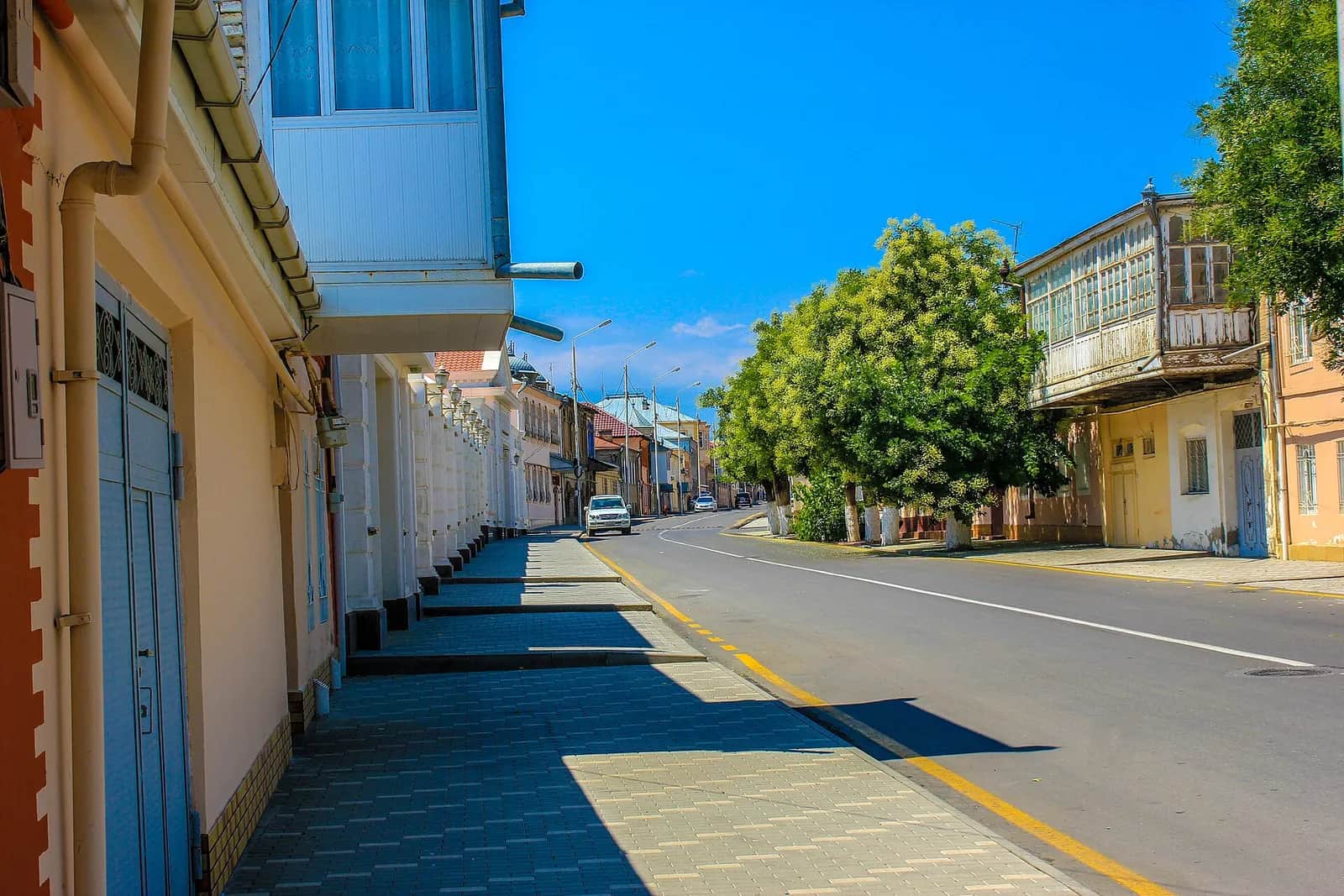

Most visitors to Krasnaya Sloboda arrive knowing one sentence: that this is a Jewish town in a Muslim-majority country and it has been there a long time. That sentence is true and it explains nothing.
This is the background, with the contested parts marked as contested.
The name, and the language
They call themselves Juhuro. "Mountain Jews" is a name that came from outside, and it stuck.
The language is Juhuri, also called Judeo-Tat. It sits in the southwestern Iranian branch of the Indo-European family, which makes it a relative of Persian rather than anything to do with Hebrew grammar, though it carries a large Hebrew vocabulary layered on top.
The alphabet has changed three times in a century, which is its own history in miniature: Hebrew script in the early twentieth century, Latin in the 1920s, then Cyrillic under the Soviets, and Hebrew script again in recent decades.
UNESCO's 2010 Atlas of the World's Languages in Danger classifies Juhuri as definitely endangered.
The number worth sitting with
Roughly 101,000 speakers, distributed like this:
| Where | Speakers | As of |
|---|---|---|
| Israel | ~70,000 | 1998 |
| Azerbaijan | ~24,000 | 1989 |
| United States | ~5,000 | — |
| Canada | ~2,500 | — |
| Russia | ~2,000 | 2010 |
Read the first two rows together. The language's centre of gravity moved to Israel decades ago. An Israeli travelling to Krasnaya Sloboda is not visiting a foreign community; they are going from the place where most Juhuri speakers now live to the place the language came from.
That reversal is the thing that makes this trip land differently for an Israeli family than for a group from New York, and it is worth saying out loud on the coach rather than leaving in a guidebook.
Where they came from, and what we do not know
Community tradition traces the presence back to the Persian Empire, and in some tellings to the destruction of the First Temple. The migration north through the Iranian world, including Gilan, is what gives the Gileki quarter in Krasnaya Sloboda its name.
The honest position is that the timing and the route are not settled. The sources that are careful say so, and we are not going to be more confident than they are.
What is documented is a long continuous presence in the eastern Caucasus, and a semi-independent Mountain Jewish polity in the seventeenth and eighteenth centuries with its capital at Aba-Sava, south of Derbent.
Krasnaya Sloboda itself is later and it is specific: in the eighteenth century the Khan of Quba chartered the land across the river as a refuge. That charter is why the settlement is concentrated and Jewish rather than scattered, and it is why the community talks about Quba the way it does.
The Soviet century, and the passport line
Soviet nationality policy recorded Mountain Jews as Tat rather than Yevrei. On paper, the Jewish part of the identity was gone. Synagogues closed; communities reopened them; rabbis trained in Chabad yeshivas including underground ones.
Then July 1942. German forces reached the northern Caucasus. At Nalchik, a town with thousands of Jews, the community presented itself as Tat rather than Jewish, using the exact designation the Soviet state had imposed to erase it. Torah scrolls were buried, disguised as typhus victims.
German forces withdrew on 4 January 1943, days before a planned massacre.
An identity erasure imposed as suppression became, for one town in one winter, the thing that worked. That is not a moral about Soviet policy. It is what happened, and it is the kind of detail that a museum label cannot carry and a person standing in the room can.
The community today, and where it is
The Mountain Jewish world is not only Azerbaijani. It runs through Krasnaya Sloboda in the Quba district and, across the border in the Russian republic of Dagestan, through Derbent, Makhachkala, Nalchik and Pyatigorsk. Over the past three decades a diaspora has formed in Israel, Brooklyn, Toronto, Moscow and Vienna.
The Dagestani side of that world has had a hard recent decade. In 2013 Rabbi Ovadiah Isakov was shot and badly wounded in Derbent. In the summer of 2024 the Kele-Numaz synagogue in Derbent was attacked and burned. Those events are in Russia, not Azerbaijan, and we are not going to draw a comparison from them; they belong here because a community's history does not stop at a border and a reader deserves the whole map.
What it means for a visit
Three practical consequences, and they are why this page exists rather than a paragraph on the destination page.
The customs are genuinely distinct. Liturgy, melody, food, the texture of the calendar. Not decorative variation. Anyone planning a ceremony should check their assumptions with the community rather than carrying an Ashkenazi or Sephardi template north. Ask the community and each provider to confirm the lead time for your dates. That is the practical half of the bar and bat mitzvah guide.
The language is worth hearing rather than reading about. If your group would like to hear Juhuri, include this in the visit brief and ask the museum or guide whether an appropriate speaker and session can be arranged for your dates.
The community is small enough that visiting is a relationship, not a transaction. Roughly 500 people through the winter in Krasnaya Sloboda, over 3,000 in summer. Plan visits respectfully with the community; private family visits and access to religious spaces require specific consent.
The Museum of the History of Mountain Jews, opened February 2020 in the restored Karchog synagogue, is the only institution anywhere devoted to this. It covers the language, the migration, the dress, the Soviet decades and the present. Go with the curator.
- Who are the Mountain Jews?
- A Jewish community of the eastern Caucasus, in what is now Azerbaijan and the Russian republic of Dagestan, descended from Persian-speaking Jews who moved north. They speak Juhuri, an Iranian language with heavy Hebrew influence, and keep a liturgical and culinary tradition distinct from both Ashkenazi and Sephardi practice. The name is exonymic; in their own language they are Juhuro.
- What language do the Mountain Jews speak?
- Juhuri, also called Judeo-Tat. It belongs to the southwestern Iranian branch of the Indo-European family, which makes it a cousin of Persian rather than a dialect of Hebrew, though it carries a large Hebrew vocabulary. UNESCO's 2010 Atlas classifies it as definitely endangered.
- How many Juhuri speakers are there?
- About 101,000 across all countries, and the distribution is the surprising part: roughly 70,000 in Israel as of 1998, 24,000 in Azerbaijan as of 1989, 5,000 in the United States, 2,500 in Canada and 2,000 in Russia as of 2010. The language's centre of gravity moved to Israel decades ago. Someone travelling from Tel Aviv to Krasnaya Sloboda is going from where most speakers live to where the language comes from.
- When did the Mountain Jews arrive in the Caucasus?
- Nobody knows precisely, and the honest sources say so. Community tradition traces the presence back to the Persian Empire and, in some tellings, to the destruction of the First Temple. What is documented is a long continuous presence in the eastern Caucasus and a semi-independent polity in the 17th and 18th centuries with its capital at Aba-Sava, south of Derbent.
- Why were Mountain Jews registered as 'Tat' in the Soviet Union?
- Because Soviet nationality policy recorded them as Tat rather than Yevrei, which erased the Jewish part of the identity on paper. It was an act of suppression. In July 1942, when German forces reached Nalchik, the community used that same paper identity to present itself as Tat rather than Jewish, and the massacre planned for the town did not happen before the withdrawal on 4 January 1943.
- Are Mountain Jewish customs different from Ashkenazi or Sephardi ones?
- Yes, in liturgy, melody, food and the calendar's texture, and the differences are real rather than decorative. This matters practically for anyone planning a ceremony there: assumptions carried from an Ashkenazi or Sephardi home community should be checked with the local community rather than assumed, and checked early.