Best time to visit Azerbaijan: month-by-month weather, routes and busy dates
how-to · 14 min read
When to visit Azerbaijan for Baku, Sheki, Gabala, Shahdag and the Caspian: month-by-month weather, the best route by season, summer heat, winter mountain access and dates that squeeze hotel availability.
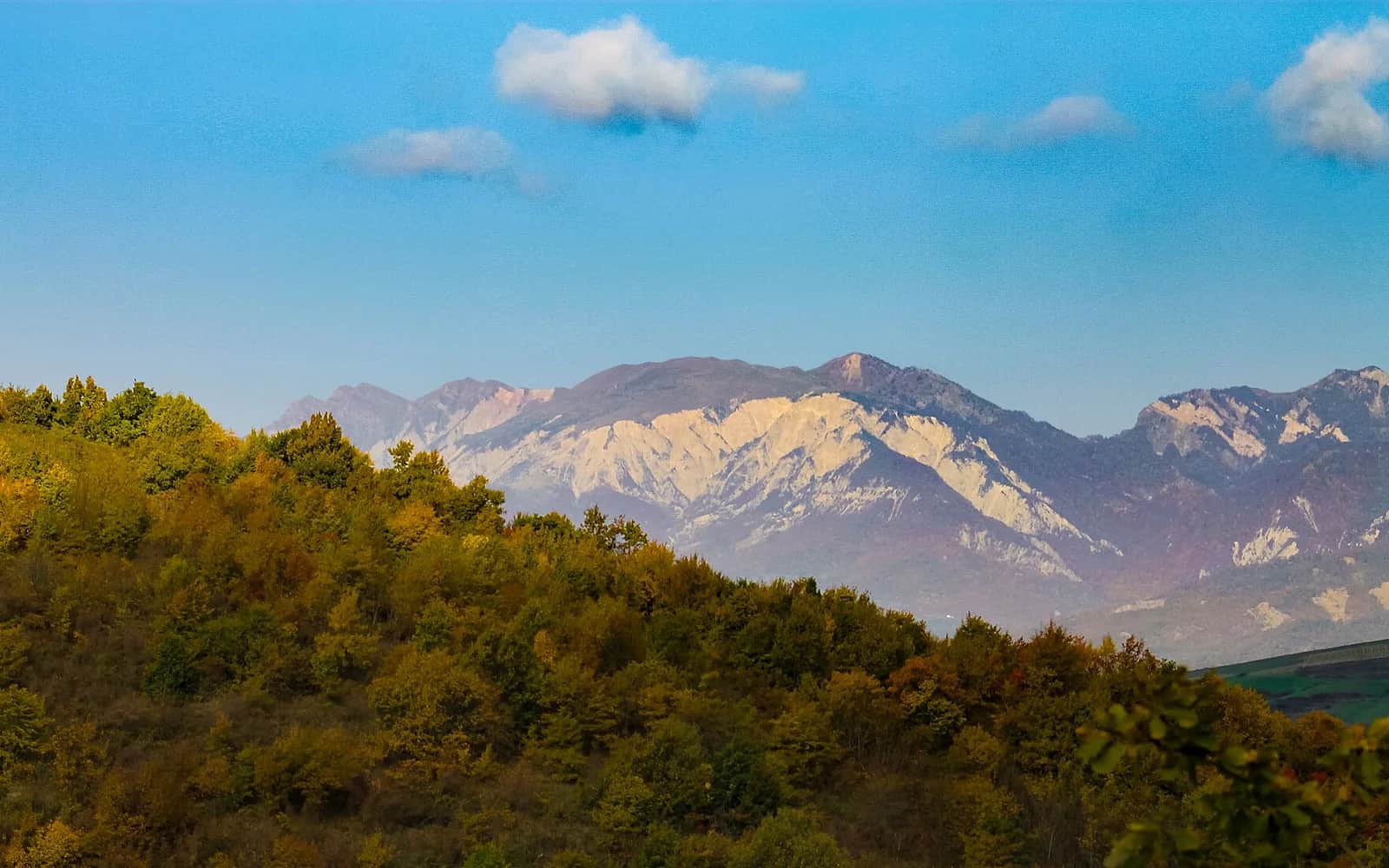

Birtour is a Baku-based local operator. For a first trip that combines Baku with Sheki, Gabala or another region, the easiest months are May, early June, September outside major event dates, and October. July and August work for travellers who accept hot city afternoons and use the Caspian or cooler mountain stops. December to March fits a Baku-and-Shahdag snow trip, with colder and windier city days.
The right month depends on the route rather than on one countrywide temperature. This guide combines the weather curve with mountain access, wind and the few event weeks that tighten hotel availability.
Why the Azerbaijan calendar is an access question, not a weather question
The temperature curve here is the least interesting constraint. What actually decides whether a date works is whether the mountain road is open, whether the wind lets your marquee stand, whether a permit runway fits before the deposit, and whether a citywide event has already taken the rooms. Baku can suit several seasons, while an event week may tighten the particular hotels and venues your programme needs.
That is the shape of this page. The month-by-month numbers come first because everyone asks for them, but the sections that will change your dates are the wind, the mountain access windows, the permit runways, and the event weeks.
What is the Baku climate, month by month?
Baku sits in a cold semi-arid zone on the Caspian: dry, windy, hot summers and cool short winters. The normals below are the 1991 to 2020 official averages, with the near-shore Caspian sea temperature alongside, because a lot of group programs use the water.
| Month | Avg high °C | Avg low °C | Rain mm | Sea °C | Planner read |
|---|---|---|---|---|---|
| Jan | 7 | 3 | 32 | 8 | Cold, windy; indoor only |
| Feb | 8 | 3 | 30 | 7 | As January; GCC Ramadan window in 2027 |
| Mar | 11 | 5 | 18 | 8 | Warming; Novruz week around the 20th |
| Apr | 17 | 9 | 17 | 12 | Shoulder begins |
| May | 23 | 15 | 15 | 18 | Prime. Mild, dry, green |
| Jun | 28 | 20 | 9 | 23 | Warm; Energy Week early in the month |
| Jul | 31 | 23 | 4 | 26 | Hot, driest month; indoor and evening |
| Aug | 31 | 23 | 8 | 27 | Hottest water; GCC summer peak |
| Sep | 26 | 19 | 29 | 25 | Prime, but check F1 and other event dates |
| Oct | 20 | 13 | 33 | 20 | Prime. The other standout month |
| Nov | 13 | 8 | 44 | 15 | Wettest, windy; shoulder closing |
| Dec | 9 | 5 | 35 | 11 | Cold; ski season opens mid-month |
The pattern is clear enough to plan against: a dry, hot core from June to August, two mild green shoulders in spring and autumn, and a cold windy winter. Rain is never heavy by European standards; the annual total is about 274 mm, less than a third of what the north-western regions get.
For a family holiday or a trip with friends, compare private tours for your travel month. Include your dates and preferred mountain stops in the enquiry so seasonal access can be checked for the route.
Which season fits your Azerbaijan route?
| Travel idea | Strongest planning window | What to check |
|---|---|---|
| Baku, Gobustan, Gabala and Sheki first trip | May, early June, September and October | Major Baku event dates, rain in the north-west and final-night airport timing |
| Baku and the Caspian | Mid-June to early September | Wind and sea conditions; keep an inland alternative |
| Baku and Shahdag snow | Mid-December to March, snow permitting | Official slope opening, road conditions and whether non-ski activities are operating |
| Quba and Khinalig landscapes | Late spring to early autumn | Exact mountain road, weather and any access or permit requirement |
| Baku city break | Year-round | Winter wind, summer midday heat and hotel-squeeze dates |
For most first-time travellers, seven days in May or October gives the cleanest balance: Baku plus a western route to Gabala and Sheki without building the trip around heat or snow. Compare the seven-day route and the 3-, 5-, 7- and 10-day scope guide before choosing hotels.
When is the best time for a corporate or MICE program?
May and October are useful months to compare, with June and September also possible depending on the event format. The weather can suit outdoor programming, but hotel rates and venue availability need quotes for the exact dates. Spring reads greener; autumn may allow a waterfront element if the weather and supplier arrangements cooperate.
The catch on autumn is timing inside the month. The official 2027 Azerbaijan Grand Prix schedule lists 24–26 September. That event may constrain particular hotel and venue options; compare a nearby week using the same room block and production brief rather than assuming a universal price premium.
Are July and August too hot for a Baku program?
For an outdoor-led program, usually. Average highs run 30.5 to 30.6°C and heat waves push to 38 to 40°C, and July is the driest month on the calendar at about 4 mm of rain. The suitability of a hot-weather programme depends on the group, schedule and indoor alternatives; do not infer it from a traveller’s home market.
For any group in July or August, compare indoor meeting time, evening activities and a cooler mountain stop such as Gabala or Shahdag. If the itinerary includes the Caspian, confirm the beach or vessel operation and actual wind conditions. Do not assume every guest wants the same heat or water programme.
For a visiting youth football squad, heat also affects training load. Compare a cooler regional base with Baku for the same dates, and plan breaks, indoor alternatives and medical support around the age group. The summer football camp planning guide sets out the questions to resolve before choosing a training base.
What is the khazri, and why does it matter for events?
The khazri is the cold north wind that comes off the Caspian and funnels across the Absheron Peninsula, and it is the single most underestimated weather factor for outdoor events in Baku. Documented gusts exceed 29 metres per second and Caspian northerlies have been recorded at 35 to 40, strong enough to damage roofs, and moderate to strong winds are most frequent in autumn and winter. Its warm summer counterpart, the gilavar, is the still, humid southerly.
For a planner this means the real outdoor-event risk in Baku is not rain or temperature, it is wind. A seafront gala on a khazri evening loses its marquee, its candles, and its sound balance. For waterfront receptions, ask the proposal to include a covered alternative and a date-specific wind decision point.
The water side has a number attached to it, which is more useful than a forecast. The Ministry of Emergency Situations opens the bathing season on 15 June and closes it in early September, staffs the monitored beaches with rescue posts, sets safe hours at 09:00 to 20:00, and prohibits swimming outright above 10 metres per second of wind. Confirm the current rule and agree the operator's weather decision point and alternative before booking a beach or boat element.
One longer-horizon caution on any water element. The Caspian is falling by roughly 9 to 35 cm a year, about 0.93 m over the last five and the lowest level in around 400 years, and berth access and marina draft on the Absheron coast are directly exposed. Confirm the boarding point and vessel draft with the operator for the actual date.
What about the mountains, in winter and in summer?
Both, and the summer half is the one planners keep missing. Shahdag in Qusar and Tufandag above Gabala are two-season resorts, not ski fields that shut in April. On 10 August 2026 Tufandag was running all four of its lifts at 23°C with none of its ten slopes open, which is exactly what a working summer mountain looks like: rope lines, a mountain coaster, quad tours, rafting and guided trails spread across a 10:00 to 17:50 day depending on the activity. Shahdag published summer hours of 09:00 to 17:00 for lifts, slopes and sport activities on the same date.
A mountain day needs a current operating and cost check for the exact activities. Lift, trail, guide, vehicle and meal charges should be separated in the proposal. Some trails were closed for repair on our August 2026 check, so confirm the operating list with the resort rather than treating a general summer programme as guaranteed.
Winter is the better-known half. Both resorts run roughly mid-December to late March or early April, snow permitting, with full snow-making; the 2025/26 season opened on 15 December 2025. The 2026/27 opening dates were not announced as of 10 August 2026, so a December 2026 program should be sold on mid-December as an assumption and confirmed once the resorts publish. One contracting note that matters more than it sounds: Shahdag Mountain Resort is a state asset operating under the State Tourism Agency, so its lead times and its paperwork behave like a public body's, not a hotel chain's.
Which mountain roads and permits set your dates?
Two access constraints do more to fix a date than the weather does. The first is the Quba to Khinalig road, which the national roads agency itself describes as suffering frequent long-duration closures from avalanches, landslides and rockfall onto the carriageway; that is the agency's stated reason for commissioning an alternative route in the first place. The Alpan to Susay leg of that alternative was built, but we have found no announcement that the Susay to Khinalig continuation ever opened, so nobody should be selling winter Khinalig on the promise of a second road. June to September is a useful starting window for a group brief; confirm road conditions and a weather alternative for the actual departure rather than assuming a fixed company-wide seasonal ban. The Quba to Khinalig road guide has the detail.
The second is route-specific permission for trekking in restricted or protected areas. A village visit and a trek beyond it are different briefs. Confirm the exact trail, relevant authorities, required documents and lead time before selling the departure; a general 30-day planning allowance is not a universal legal deadline. The border-zone permit guide separates the village excursion from the trek-permission question.
Two lowland roads carry a seasonal failure mode worth naming. The Ismayilli to Lahij road blocks outright after heavy rain, from mudflow and rockfall, and it is cleared reactively rather than pre-emptively; that is a repeat pattern across seasons, not one bad year, and November is the wettest month on the table above. In better news for the northern corridor, 66 km of the M-1 between Baku and Quba was stripped of failed concrete, resurfaced in asphalt and reopened in June 2026, which is the run that feeds every Quba, Khinalig, Shahdag and Laza product.
Which dates squeeze Baku hotel inventory?
These are dates to check early because a citywide event may change the room and venue options available to your party:
- Formula 1, 24–26 September 2027. The official race schedule lists the Grand Prix on Sunday 26 September, with session times still to be confirmed. Check the actual hotel block, venue access and transport plan for those dates; historic Grand Prix price studies cannot substitute for a current quote. The 2027 Baku Formula 1 programme covers event-specific planning.
- Baku Energy Week, early June. The Caspian Oil and Gas week fills the business hotels every year. The 2026 edition has already run.
- A newly announced major summit. A large event may reduce suitable room or venue availability. Check the organiser's dates, then request a dated block before deciding whether to keep or move your programme.
For GCC programs, two more calendar facts shape demand rather than price. Ramadan falls roughly 7 February to early March in 2027, with Eid al-Fitr around 9 to 11 March, so Gulf corporate travel thins through that window and rebounds after. Eid al-Adha lands around 16 to 18 May 2027. Confirm the exact dates against the moon-sighting announcements close to the time.
What days should a program avoid outright?
Two national dates carry weight beyond logistics. Remembrance Day, 27 September, is a day of mourning for the 2020 war: the country observes a minute of silence at noon and it is not a day for entertainment. It carries enough weight that Formula 1 moved the 2026 race off it, onto the Saturday, which means the day after race day is the day of mourning. Any post-race program in 2026 lands on it. Novruz, the spring-equinox new year around 20 to 24 March, is a five-day national holiday when much of the country is with family and many businesses close; it is a fine thing to witness and a hard week to run a working corporate program through. Plan the arc around both rather than into them.
Daylight and closing times do more damage to autumn and winter days than most planners expect, so sequence the Absheron sites accordingly. Gobustan closes at 17:00 while Ateshgah runs to 20:00, and the Yanardag and Ateshgah combo ticket stays valid for 72 hours, so the two fire sites no longer have to share a half-day. Put Gobustan first and let the flame sites take the dusk slot.
What we wouldn't recommend
Use the dates, programme format and access requirements to make these decisions before booking:
- A July or August outdoor-led European incentive. The heat is real and the wind can spoil the one evening you build outdoors. Move it to the shoulder or take it indoors.
- A major-event week without a confirmed room block. Compare availability and the total contracted rate for the exact dates before committing an event in that window.
- A high-mountain village day in winter. Confirm the road and weather close to departure and agree a suitable alternative in the itinerary.
- A trek requiring permission. Confirm the route-specific process and lead time before selling it. An unconfirmed permit should not be presented as secured.
- Planning an overland arrival on the assumption the border reopens. Azerbaijan's quarantine regime has kept the road land borders shut to inbound passengers and currently runs to 2 January 2027, having been rolled forward in roughly three-month steps. Do not treat road entry or exit as automatically available: official road-exit advice has differed. Check each passport, trip purpose, direction, crossing and vehicle with the relevant authorities before a client books around an overland leg. The entry and rail guide records the conditional rail exception and the road-source conflict.
Winter and high summer can both suit a programme when the activities, indoor options and driving days fit the season.
For planners scoping a program against these windows, the Baku MICE destination guide covers the venue and access side, and the 2026 cost benchmarks show how the per-person figure moves with season. Send the dates through the MICE Azerbaijan page and we can assess the route, venues, hotels, transfers, guides and activities against your programme.
- What is the best time of year to visit Baku?
- For a first leisure trip, May, early June, September outside major event dates, and October offer the easiest balance of city weather and regional touring. July and August suit heat-tolerant travellers and mountain or Caspian plans; December to March suits a Baku-and-ski trip but is colder and windier in the city.
- Is Baku too hot in July and August?
- For an outdoor-heavy programme, July and August can be hot: the listed Baku average highs are about 31°C. Plan indoor or evening time and consider a mountain stop if the party prefers cooler weather. Ask travellers about their own heat tolerance rather than assuming it from nationality.
- When should you avoid Baku because of hotel prices?
- The official 2027 Formula 1 schedule lists Baku for 24–26 September. Compare current hotel offers with nearby weeks; major conferences and exhibitions may also affect availability. A historic event-week uplift is not a live rate for your hotel or dates.
- What is the khazri wind in Baku?
- The khazri is the cold north wind that blows off the Caspian across the Absheron Peninsula. Documented gusts exceed 29 metres per second and Caspian northerlies have been recorded at 35 to 40. It is most frequent in autumn and winter. In summer it brings welcome cooling, but for an outdoor evening event on the seafront it is the real weather risk in Baku, more than rain or temperature, and a covered alternative should be costed for a waterfront reception.
- When is the ski season in Azerbaijan?
- The mountain resorts at Shahdag (Qusar) and Tufandag (Gabala) run roughly mid-December to late March or early April, snow permitting; the 2025/26 season opened slopes on 15 December 2025. The 2026/27 opening dates had not been announced as of 10 August 2026, so treat mid-December as the planning assumption rather than a confirmed date. Both resorts have full snow-making.
- Are the Azerbaijani mountain resorts open in summer?
- Yes, and they run a full summer programme rather than a skeleton one. On 10 August 2026 Tufandag above Gabala showed all four lifts operating at 23°C, with rope lines, a mountain coaster, quad tours, rafting and guided trails running between roughly 10:00 and 17:50 depending on the activity. Shahdag published summer hours of 09:00 to 17:00 for lifts, slopes and sport activities on the same date.
- When can a group swim or run a boat element on the Caspian?
- The bathing season declared by the Ministry of Emergency Situations opens on 15 June and runs to early September, with safe hours of 09:00 to 20:00 and rescue posts on the monitored beaches. Swimming is prohibited outright when wind exceeds 10 metres per second, which is the trigger to build into any beach-club or yacht element rather than a temperature. Sea temperature peaks around 27°C in August and stays swimmable into October.
Guide
Baku for corporate events: a 2027 planner’s guide
Guide
Azerbaijan entry rules for GCC groups (2026): the visa-free pilot, the fourth-entry catch, and registration
Guide
Baku MICE costs: how to compare conference and event quotes
Guide
The Quba to Khinalig road: conditions, seasons, and when you need a 4x4
Guide
Do you need a permit for Khinalig? Border-zone rules explained
Blog
Youth football camp in Azerbaijan: a Gabala planning brief